FedEx Delivery1–3 day delivery across the U.S.Free on orders over $200

Sourcing Guide

Epitalon in the US: The Telomerase Claim, Examined

A four-residue peptide carrying one of the strongest claims in the field, and the thinnest independent evidence base to support it

·Compiled by Eppix Labs

Epitalon carries the boldest claim of any compound in the research-peptide catalog: telomerase activation and telomere elongation in human somatic cells. It also has one of the thinnest independently replicated evidence bases. Both of those facts are worth stating in the same sentence, because almost every piece of marketing copy about this compound states the first and omits the second.

In July 2026 epitalon also became one of six peptides an FDA advisory committee voted to recommend for the compounding bulks list, which has raised its commercial profile without adding to its evidence. Epitalon is supplied for laboratory research use only.

Chemical Identity

Name
Epitalon (Ala-Glu-Asp-Gly)
Also known as
Epitalon, Epithalon, AEDG, Epithalamin tetrapeptide
Molecular formula
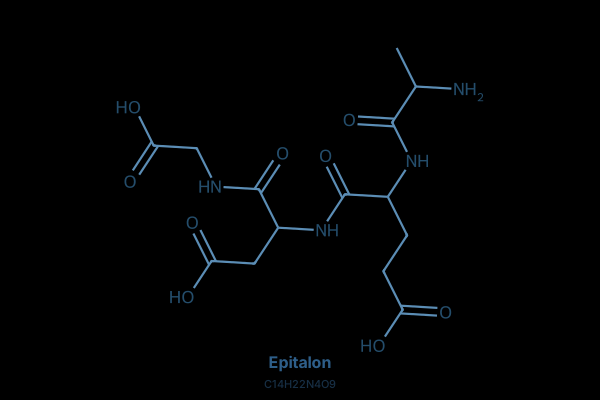
C₁₄H₂₂N₄O₉
Molecular weight
390.35 g/mol
CAS number
307297-39-8
Sequence (1-letter)
AEDG
Sequence (3-letter)
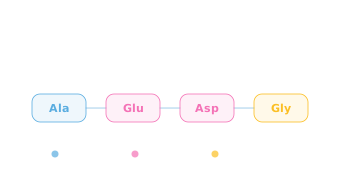
Ala-Glu-Asp-Gly
Salt forms
Free acid · Acetate

What epitalon is

Epitalon is a synthetic tetrapeptide, Ala-Glu-Asp-Gly, developed by Vladimir Khavinson's group at the St Petersburg Institute of Bioregulation and Gerontology. It is the synthetic analog of epithalamin, a peptide preparation extracted from bovine pineal gland, and it belongs to the class the group calls short regulatory peptides.

The proposed mechanism, in that group's framing, is epigenetic: short peptides of this kind are proposed to interact with DNA and chromatin and to influence gene expression, including expression of the telomerase catalytic subunit. That proposal is the subject of the group's publications and is not established outside them.
Research Material
General Image
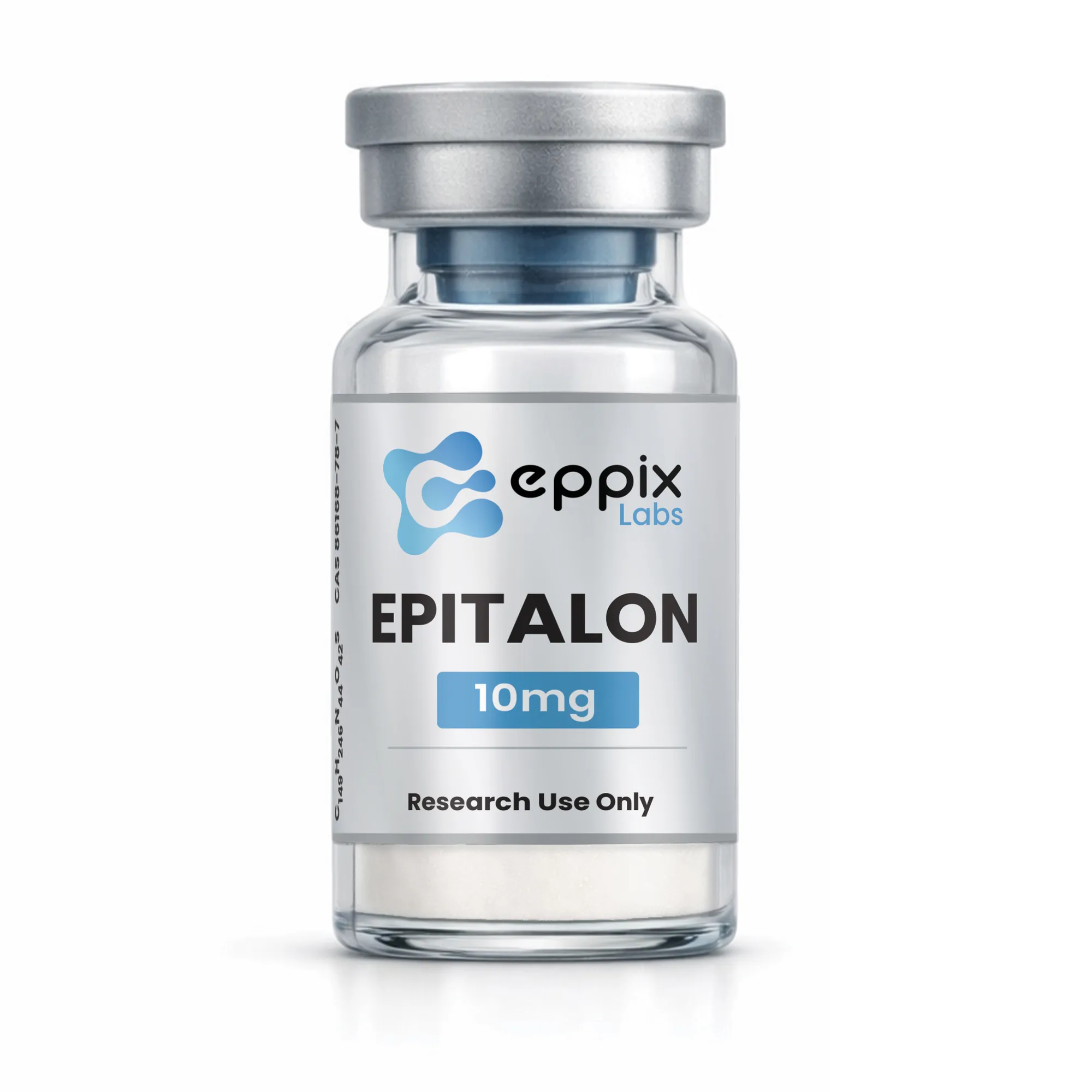
Epitalon lyophilized research material as supplied by Eppix Labs. Labelled and measured content are stated on the certificate below.

Sequence and structure

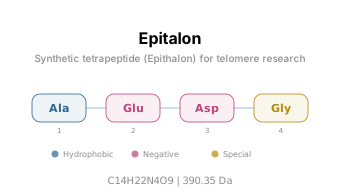
Four residues and around 390 Da, which makes epitalon the smallest peptide in the catalog. Two of its four residues are acidic (Glu, Asp), which matters practically: the free acid form is poorly soluble at low pH and readily soluble at neutral pH, and material that appears not to dissolve is often a pH problem rather than a quality problem.

Amino Acid Sequence
Amino Acid Sequence diagram
Amino-acid sequence of epitalon, AEDG.
Chemical Structure
Chemical Structure diagram
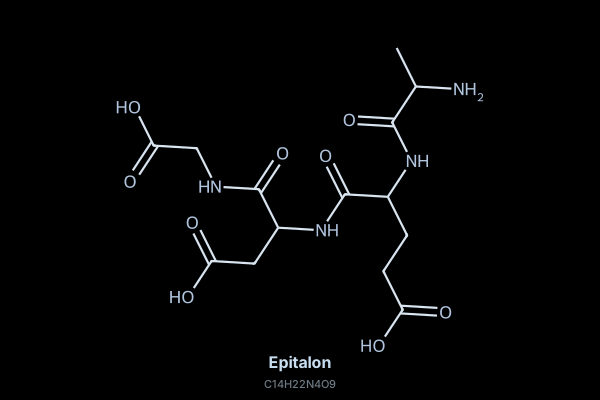
Chemical structure of epitalon, C₁₄H₂₂N₄O₉.

What the published research shows

Almost all of it comes from one research program, which is a fact about the evidence and not a criticism of it:

  • ·Telomerase and telomere length. Khavinson et al. (2003) reported induction of telomerase activity and telomere elongation in cultured human fetal fibroblasts, together with an increase in the number of population doublings.[1]
  • ·Division limit. Khavinson et al. (2004) reported overcoming of the division limit in human somatic cell culture.[4]
  • ·Animal lifespan and tumour incidence. Anisimov et al. (2003) reported effects on ageing biomarkers, lifespan and spontaneous tumour incidence in female SHR mice.[2]
  • ·Human observational work. Khavinson and Morozov (2003) reported long-term follow-up in older adults given pineal and thymic peptide preparations.[3] This is observational work on the extract preparations rather than a controlled trial of the synthetic tetrapeptide.

The limit of the evidence, stated plainly

The central claim, telomerase activation in human cells, rests on a small number of publications from a single group and has not been independently replicated in the mainstream telomere biology literature. Telomerase activation is a heavily studied and heavily scrutinized field, and a robust small-peptide activator would be a significant finding; its absence from that wider literature is information.

There are no randomized controlled trials of synthetic epitalon. The human follow-up work concerns pineal-extract preparations rather than the tetrapeptide. There is no established human dose, no approved indication in any jurisdiction, and the FDA has authorized nothing containing it.

Regulatory status: the July 2026 advisory vote

On 23 and 24 July 2026 the FDA's Pharmacy Compounding Advisory Committee reviewed Epitalon for inclusion on the Section 503A Bulk Drug Substances List, alongside BPC-157, KPV, TB-500, MOTS-c, Epitalon and Semax. FDA staff had recommended against inclusion for every substance under review, citing insufficient characterization, little or no human effectiveness evidence, and inadequate human safety data. The committee voted in favor anyway.

What the vote does not do:

  • ·It is non-binding. The committee advises, it does not decide. No final FDA determination has been issued and none of the six peptides appears in 21 CFR 216.23.
  • ·It requires a further step. Addition to the 503A Bulks List requires formal action by the Secretary of Health and Human Services, which had not occurred as of publication.
  • ·It does not make the compound an FDA-approved drug, and it establishes nothing about efficacy.
  • ·It does not legitimize research-chemical retail. A compounding-list decision concerns licensed pharmacists preparing patient-specific prescriptions under Section 503A, which is a different channel entirely from research material sold in vials.

Verifying an epitalon lot

Identity by mass spectrometry against the expected mass near 390 Da, HPLC purity, and measured content against the labeled amount. For a tetrapeptide this cheap to synthesize, measured content is the figure that matters most commercially: the raw-material cost is low enough that underfilling is the main way a supplier extracts margin, and it is invisible without a content assay.

Every Eppix epitalon lot is tested by Janoshik Analytical, published before sale and verifiable on the laboratory's own database.

Published Certificate
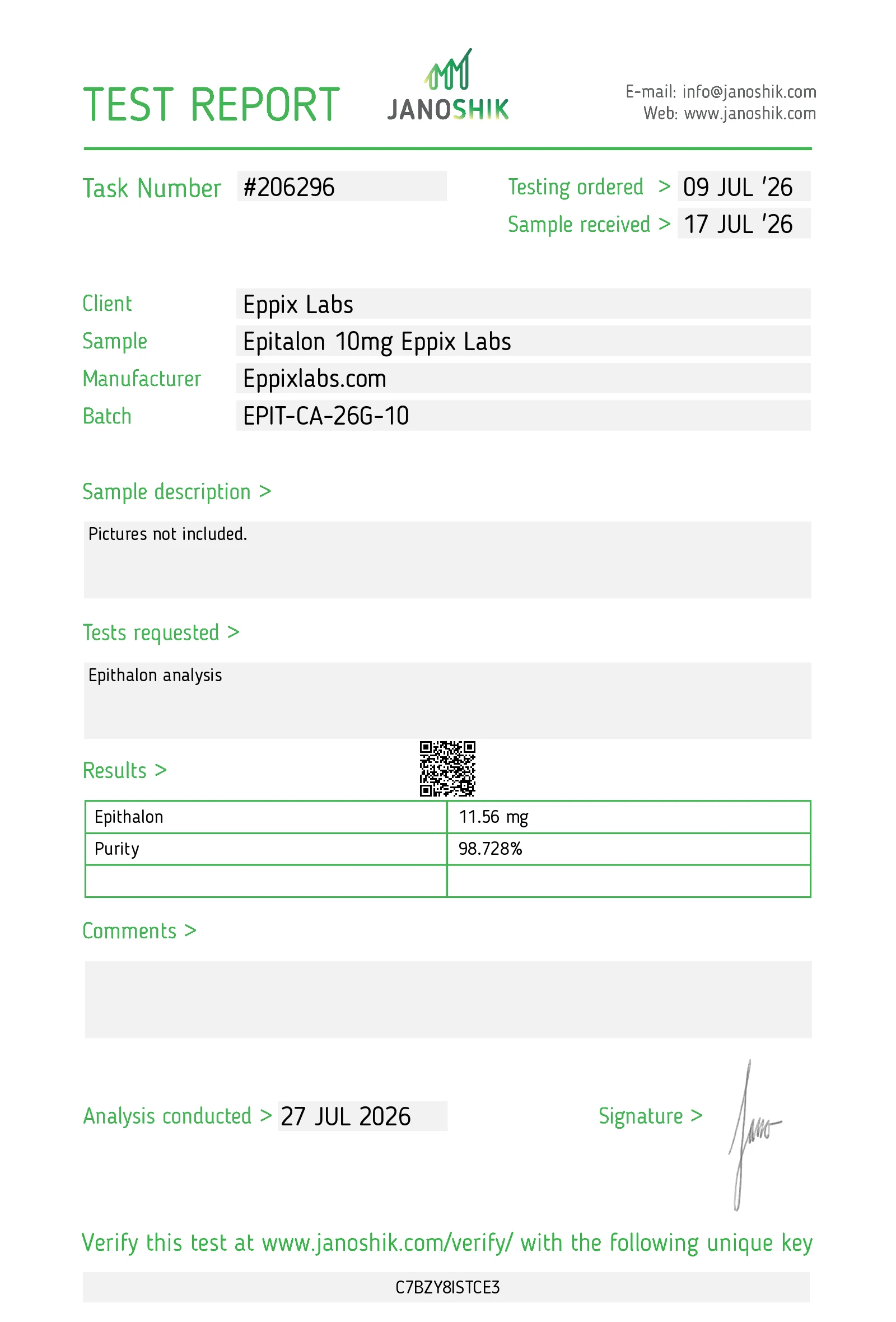
Certificate of analysis for Epitalon 10mg, batch EPI-CA-26A-01, 98.728% purity, 11.56 mg measured content
Batch
EPI-CA-26A-01
Purity (HPLC)
98.728%
Measured content
11.56 mglabeled 10 mg
Laboratory
Janoshik
Published certificate for the current epitalon lot, read live from the batch record.

Sourcing in the United States

Domestic fulfillment is by FedEx, typically one to three business days across the United States, free over $200 USD, with card and PayPal checkout and mix-and-match pricing at 5 and 10 vials.

The other peptides in the July 2026 advisory vote are covered at buy BPC-157 in the US, buy TB-500 in the US, buy KPV in the US and buy MOTS-c in the US.

Frequently Asked

Does epitalon activate telomerase?

Telomerase induction and telomere elongation in cultured human fibroblasts were reported by Khavinson and colleagues in 2003. That finding has not been independently replicated in the wider telomere biology literature, which is a significant caveat given how heavily studied that field is.

What is the difference between epitalon and epithalamin?

Epithalamin is a peptide preparation extracted from bovine pineal gland. Epitalon is the synthetic tetrapeptide Ala-Glu-Asp-Gly derived from that work. Much of the long-term human follow-up literature concerns the extract, not the synthetic peptide.

Is epitalon legal in the US?

It may be sold and held as a laboratory research material. It is not approved by the FDA for human or veterinary use. This is not legal advice.

Did the FDA approve epitalon in 2026?

No. An FDA advisory committee voted in July 2026 to recommend it for the Section 503A compounding bulks list, against FDA staff's recommendation. The vote is non-binding, addition to the list still requires action by the Secretary of Health and Human Services, and no final determination has been issued.

Are there randomized trials of epitalon?

No randomized controlled trials of the synthetic tetrapeptide. The human literature is observational and largely concerns pineal-extract preparations.

Why does my epitalon not dissolve?

Two of its four residues are acidic, so the free acid form is poorly soluble at low pH and dissolves readily at neutral pH. Apparent insolubility is more often a buffer choice than a quality problem. See the reconstitution guide.

References

  1. Khavinson, V.Kh. et al. (2003). Epithalon peptide induces telomerase activity and telomere elongation in human somatic cells. Bull Exp Biol Med 135(6):590-592. PMID 12937682
  2. Anisimov, V.N. et al. (2003). Effect of Epitalon on biomarkers of aging, life span and spontaneous tumor incidence in female Swiss-derived SHR mice. Biogerontology 4(4):193-202. PMID 14501183
  3. Khavinson, V.Kh., Morozov, V.G. (2003). Peptides of pineal gland and thymus prolong human life. Neuro Endocrinol Lett 24(3-4):233-240. PMID 14523363
  4. Khavinson, V.Kh. et al. (2004). Peptide promotes overcoming of the division limit in human somatic cell. Bull Exp Biol Med 137(5):503-506. PMID 15455129
  5. US Food and Drug Administration (2026). Pharmacy Compounding Advisory Committee meeting, 23-24 July 2026: bulk drug substances nominated for inclusion on the Section 503A Bulks List. FDA Advisory Committee Calendar. Source
  6. US Food and Drug Administration (2026). FDA briefing document, Pharmacy Compounding Advisory Committee: BPC-157, KPV, TB-500, MOTS-c, Emideltide, Semax and Epitalon. Agency review recommended against inclusion for each substance. FDA. Source
  7. Office of the Federal Register (2026). 21 CFR 216.23: bulk drug substances that can be used to compound drug products under section 503A. None of the six peptides appear on the list as of publication. eCFR. Source

Research Use Only

This article summarizes published preclinical research literature. Compounds referenced are supplied by Eppix Labs strictly as research materials for laboratory investigation within the United States. They are not approved by the FDA for human or veterinary use, and nothing on this page should be interpreted as medical advice or guidance on human or animal administration.