FedEx Delivery1–3 day delivery across the U.S.Free on orders over $200

Sourcing Guide

MOTS-c in the US: The Mitochondrial-Derived Peptide

A 16-residue peptide encoded in mitochondrial DNA, a decade of metabolic literature, and a July 2026 regulatory vote

·Compiled by Eppix Labs

MOTS-c is unusual among research peptides in that it is not a fragment of something else or a synthetic analog of a hormone. It is encoded in the mitochondrial genome, in a short open reading frame within the 12S rRNA gene, and it was identified in 2015 as part of the emerging class of mitochondrial-derived peptides.[1]

It also became, in July 2026, one of six peptides an FDA advisory committee voted to recommend for the compounding bulks list, which has changed the commercial conversation without changing the evidence. Here is what the literature actually says, and what to check before ordering. MOTS-c is supplied for laboratory research use only.

Chemical Identity

Name
MOTS-c (mitochondrial ORF of the 12S rRNA type-c)
Also known as
MOTS-c, Mitochondrial-derived peptide
Molecular formula
C₁₀₁H₁₇₂N₃₀O₂₂S₂
Molecular weight
2174.6 g/mol
CAS number
1627580-64-6
Sequence (1-letter)
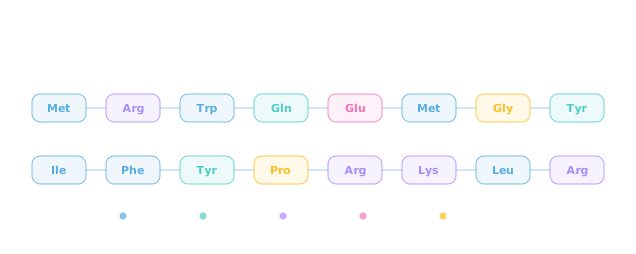
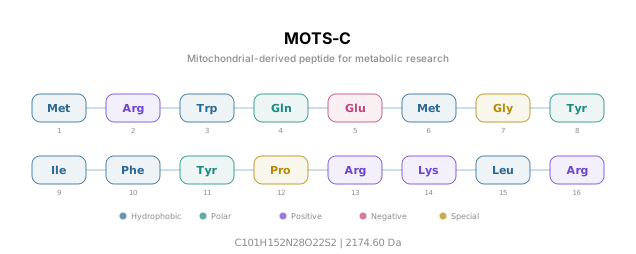
MRWQEMGYIFYPRKLR
Sequence (3-letter)
Met-Arg-Trp-Gln-Glu-Met-Gly-Tyr-Ile-Phe-Tyr-Pro-Arg-Lys-Leu-Arg
Salt forms
Acetate

What MOTS-c is

MOTS-c is a 16-residue peptide, sequence MRWQEMGYIFYPRKLR, translated from a short open reading frame within the mitochondrial 12S rRNA gene. Lee et al. (2015) identified it and reported that it regulates the folate-methionine cycle and de-novo purine biosynthesis, with downstream AMPK activation.[1]

The mechanistic claim is that it acts as a mitochondrial-to-nuclear signaling molecule, translocating to the nucleus under metabolic stress and influencing nuclear gene expression. That framing, mitochondria signaling to the nucleus rather than only the reverse, is what made the compound scientifically interesting.
Research Material
General Image
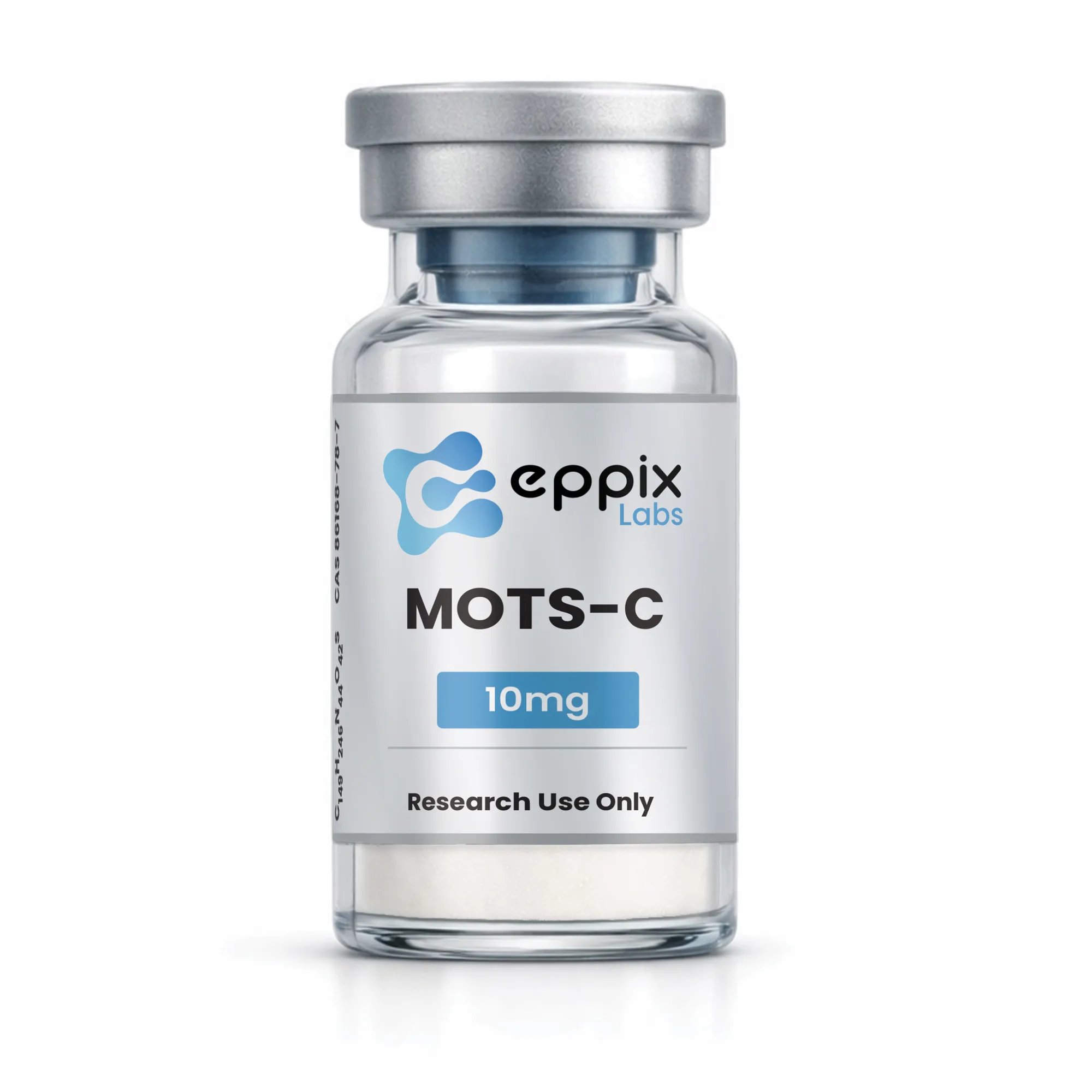
MOTS-c lyophilized research material as supplied by Eppix Labs. Labelled and measured content are stated on the certificate below.

Sequence and structure

Sixteen residues near 2175 Da, including two methionines and a tryptophan. The methionine content is worth noting for handling: methionine oxidizes, and oxidized MOTS-c is a distinct species with a mass 16 Da higher per oxidized residue. That is visible on a mass-spectrometry report and invisible on a casual reading of a purity percentage, which is one more reason identity confirmation belongs on the certificate.

Amino Acid Sequence
Amino Acid Sequence diagram
Amino-acid sequence of MOTS-c, MRWQEMGYIFYPRKLR.
Chemical Structure
Chemical Structure diagram
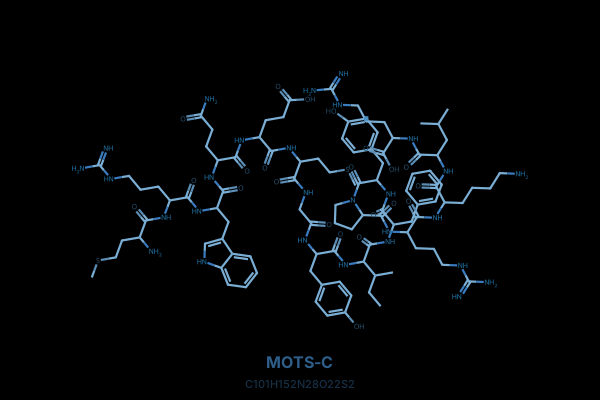
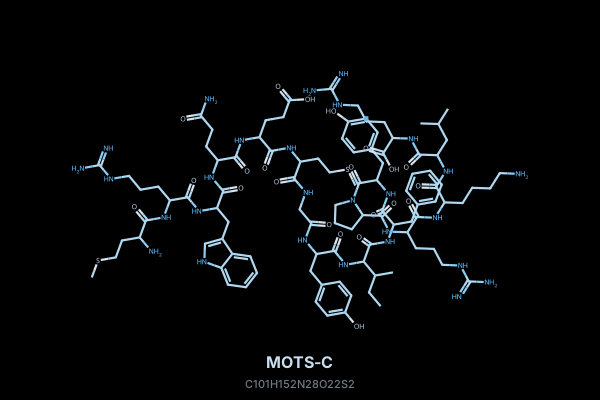
Chemical structure of MOTS-c.

What the published research shows

A decade of work, concentrated in metabolic and exercise physiology:

  • ·Discovery and metabolic phenotype. Lee et al., Cell Metabolism 2015: MOTS-c regulates the folate-methionine cycle and purine biosynthesis, activates AMPK, and in mouse models reduced diet-induced obesity and insulin resistance.[1]
  • ·Exercise induction. Reynolds et al., Nature Communications 2021: MOTS-c is exercise-induced in skeletal muscle and plasma, and in aged mice influenced physical capacity and muscle homeostasis.[2]
  • ·Class context. Merry et al. (2020) review mitochondrial-derived peptides in energy metabolism, placing MOTS-c alongside humanin and the SHLPs.[3] Woodhead et al. (2021) review the exercise literature specifically.[4]

The limit of the evidence

There are no completed randomized human efficacy trials of MOTS-c. The literature is cell culture, animal models, and human observational work on endogenous circulating levels, which is a different thing from administering the peptide. There is no established human dose, no human safety record, and no approved indication anywhere.

Observational associations between endogenous MOTS-c levels and metabolic or fitness measures are frequently presented as if they were administration results. They are not, and the distinction matters more here than for most compounds, because the endogenous-level literature is the larger of the two.

Regulatory status: the July 2026 advisory vote

On 23 and 24 July 2026 the FDA's Pharmacy Compounding Advisory Committee reviewed MOTS-c for inclusion on the Section 503A Bulk Drug Substances List, alongside BPC-157, KPV, TB-500, MOTS-c, Epitalon and Semax. FDA staff had recommended against inclusion for every substance under review, citing insufficient characterization, little or no human effectiveness evidence, and inadequate human safety data. The committee voted in favor anyway. The vote was 7 in favor, 5 against, 2 abstentions.

What the vote does not do:

  • ·It is non-binding. The committee advises, it does not decide. No final FDA determination has been issued and none of the six peptides appears in 21 CFR 216.23.
  • ·It requires a further step. Addition to the 503A Bulks List requires formal action by the Secretary of Health and Human Services, which had not occurred as of publication.
  • ·It does not make the compound an FDA-approved drug, and it establishes nothing about efficacy.
  • ·It does not legitimize research-chemical retail. A compounding-list decision concerns licensed pharmacists preparing patient-specific prescriptions under Section 503A, which is a different channel entirely from research material sold in vials.

Verifying a MOTS-c lot

Identity by mass spectrometry against the expected mass near 2175 Da, HPLC purity, and measured content against the labeled amount. For this sequence, pay attention to whether the identity report shows a clean single species: oxidized methionine variants appear as satellite masses, and a report that shows them at high abundance is telling you about the material's handling history.

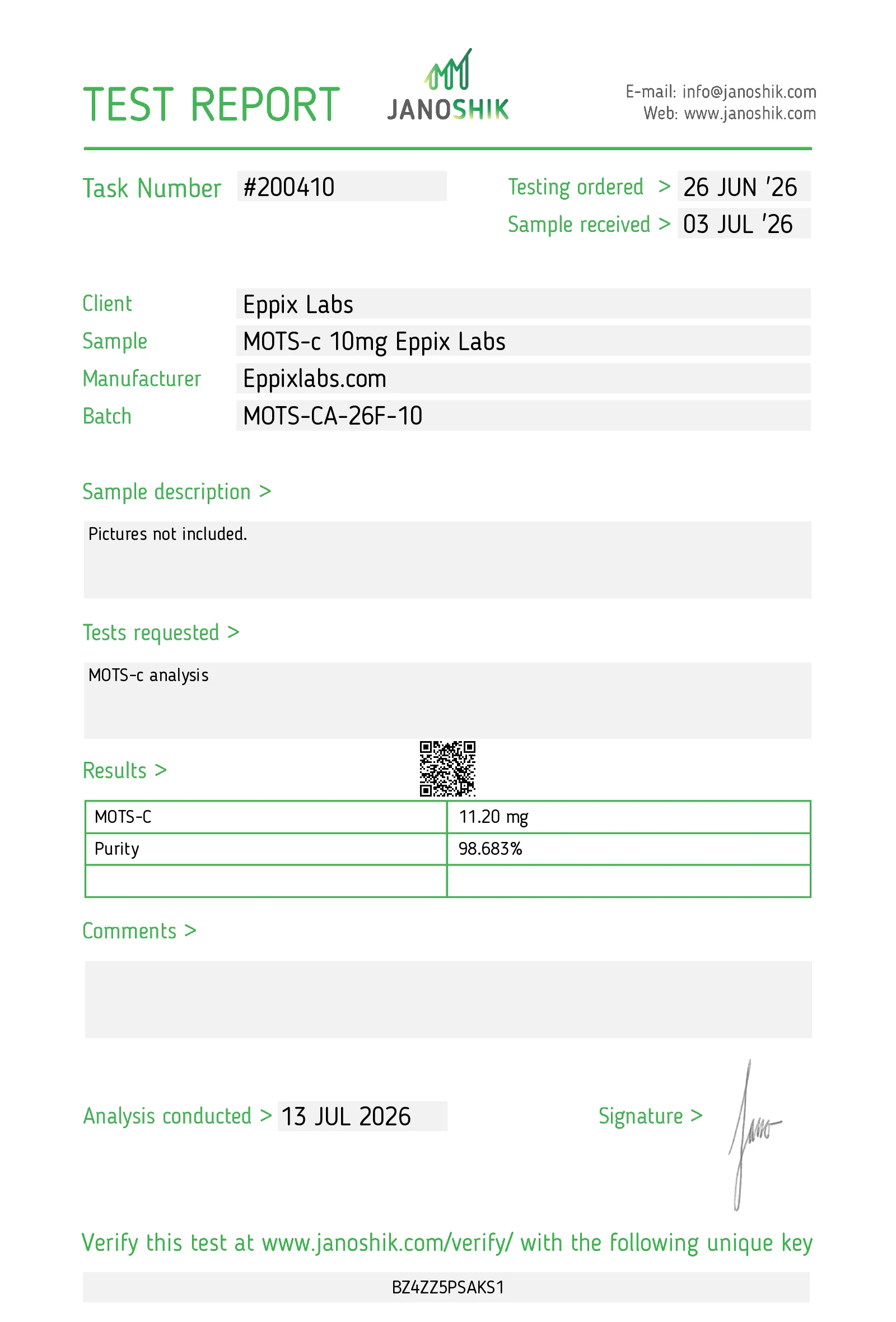
Every Eppix MOTS-c lot is tested by Janoshik Analytical, published before sale and verifiable on the laboratory's own database. Multiple strengths are stocked; the buttons under the certificate switch between them.

Published Certificate
Certificate of analysis for MOTS-c 10mg, batch MOTS-CA-26A-02, 98.683% purity, 11.20 mg measured content

Select strength

Batch
MOTS-CA-26A-02
Purity (HPLC)
98.683%
Measured content
11.20 mglabeled 10 mg
Laboratory
Janoshik
Published certificates for the current MOTS-c lots, by strength, read live from the batch record.

Sourcing in the United States

Domestic fulfillment is by FedEx, typically one to three business days across the United States, free over $200 USD, with card and PayPal checkout and mix-and-match pricing at 5 and 10 vials.

The other peptides in the July 2026 advisory vote are covered at buy BPC-157 in the US, buy TB-500 in the US and buy KPV in the US.

Frequently Asked

What does MOTS-c stand for?

Mitochondrial ORF of the 12S rRNA type-c. It is translated from a short open reading frame inside the mitochondrial 12S ribosomal RNA gene, which is why it is described as mitochondrial-derived rather than nuclear-encoded.

Is MOTS-c legal in the US?

It may be sold and held as a laboratory research material. It is not approved by the FDA for human or veterinary use. This is not legal advice.

Did the FDA approve MOTS-c in 2026?

No. An FDA advisory committee voted 7-5 with 2 abstentions in July 2026 to recommend it for the Section 503A compounding bulks list, against FDA staff's own recommendation. The vote is non-binding, addition to the list still requires action by the Secretary of Health and Human Services, and no final determination has been issued.

Are there human trials of MOTS-c administration?

No completed randomized efficacy trials. Human work to date is observational, on endogenous circulating levels, which is not the same as administering the peptide.

Why does methionine oxidation matter for MOTS-c?

The sequence contains two methionines, and methionine oxidizes on exposure to air and light. Each oxidized residue adds 16 Da, which shows on a mass-spectrometry report as a satellite species. It is a handling and storage signal rather than a synthesis defect.

How is MOTS-c stored?

Lyophilized: cool, dry, dark, at -20 °C for long-term storage, with minimal air exposure given the methionine content. Reconstituted: refrigerated, protected from light, per your protocol.

References

  1. Lee, C. et al. (2015). The mitochondrial-derived peptide MOTS-c promotes metabolic homeostasis and reduces obesity and insulin resistance. Cell Metab 21(3):443-454. PMID 25738459
  2. Reynolds, J.C. et al. (2021). MOTS-c is an exercise-induced mitochondrial-encoded regulator of age-dependent physical decline and muscle homeostasis. Nat Commun 12(1):470. PMID 33473109
  3. Merry, T.L. et al. (2020). Mitochondrial-derived peptides in energy metabolism. Am J Physiol Endocrinol Metab 319(4):E659-E666. PMID 32776825
  4. Woodhead, J.S.T. et al. (2021). Mitochondrial-derived peptides and exercise. Biochim Biophys Acta Gen Subj 1865(12):130011. PMID 34520826
  5. US Food and Drug Administration (2026). Pharmacy Compounding Advisory Committee meeting, 23-24 July 2026: bulk drug substances nominated for inclusion on the Section 503A Bulks List. FDA Advisory Committee Calendar. Source
  6. US Food and Drug Administration (2026). FDA briefing document, Pharmacy Compounding Advisory Committee: BPC-157, KPV, TB-500, MOTS-c, Emideltide, Semax and Epitalon. Agency review recommended against inclusion for each substance. FDA. Source
  7. Office of the Federal Register (2026). 21 CFR 216.23: bulk drug substances that can be used to compound drug products under section 503A. None of the six peptides appear on the list as of publication. eCFR. Source

Research Use Only

This article summarizes published preclinical research literature. Compounds referenced are supplied by Eppix Labs strictly as research materials for laboratory investigation within the United States. They are not approved by the FDA for human or veterinary use, and nothing on this page should be interpreted as medical advice or guidance on human or animal administration.