FedEx Delivery1–3 day delivery across the U.S.Free on orders over $200

Sourcing Guide

BPC-157 in the US: Purity, Batch Certificates and What to Check

The most-searched research peptide in the US, and the four things worth checking before a vial is ordered

·Compiled by Eppix Labs

BPC-157 carries more US search volume than any other research peptide, which means it also carries the most noise. Almost every supplier selling into the United States lists it, the price spread between the cheapest and the most expensive vial runs to several hundred percent, and very few of those listings publish a batch certificate you can check independently. That combination is what this article is about.

What follows is the published evidence, the regulatory position as it actually stands in August 2026, and the specific things on a certificate that separate a verifiable vial from a plausible-looking one. BPC-157 is supplied for in-vitro laboratory research only. Nothing here is dosing, medical or legal guidance.

Chemical Identity

Name
Pentadecapeptide BPC 157
Also known as
BPC-157, Body Protection Compound-157, PL-14736
Molecular formula
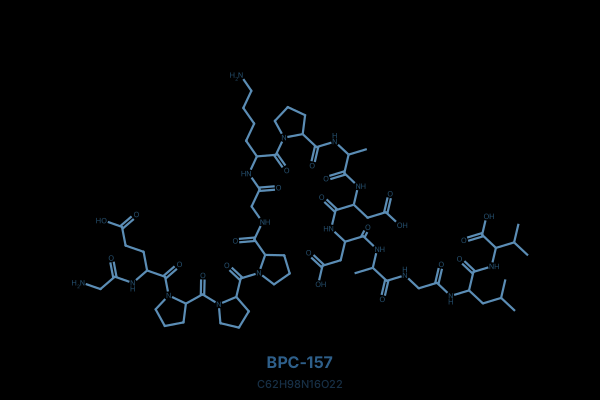
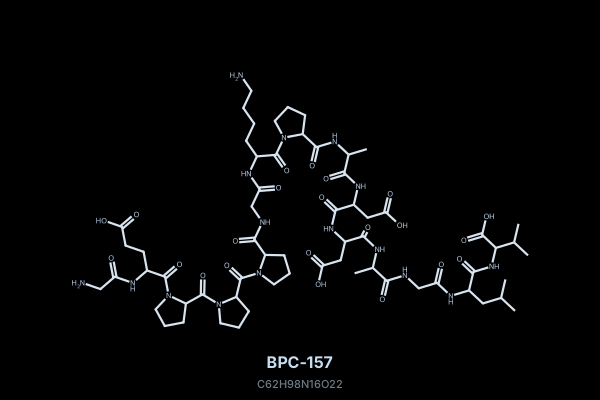
C₆₂H₉₈N₁₆O₂₂
Molecular weight
1419.5 g/mol
CAS number
137525-51-0
PubChem CID
9941957
Sequence (1-letter)
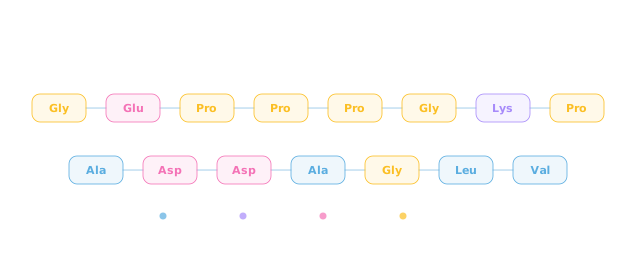
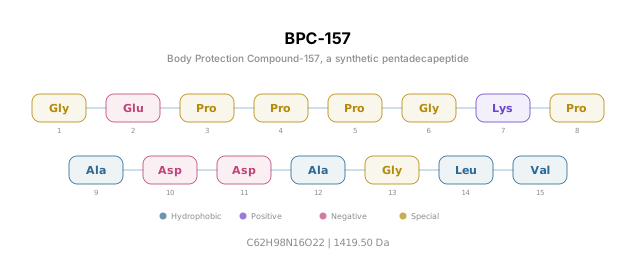
GEPPPGKPADDAGLV
Sequence (3-letter)
Gly-Glu-Pro-Pro-Pro-Gly-Lys-Pro-Ala-Asp-Asp-Ala-Gly-Leu-Val
Salt forms
Acetate (the form usually distributed for research) · Arginate

What BPC-157 is

BPC-157 is a synthetic 15-residue peptide, sequence GEPPPGKPADDAGLV, corresponding to a partial sequence of BPC ("Body Protection Compound"), a roughly 40-residue protein identified in human gastric juice. The fragment was characterized in the early 1990s by the research group of Predrag Sikiric at the University of Zagreb, in the context of what that group called the stomach stress-organoprotection hypothesis.[1]

It is supplied as a lyophilized powder, most commonly as the acetate salt. The arginate salt appears occasionally in research supply. The two differ in handling and solubility, not in the underlying peptide sequence.
Research Material
General Image
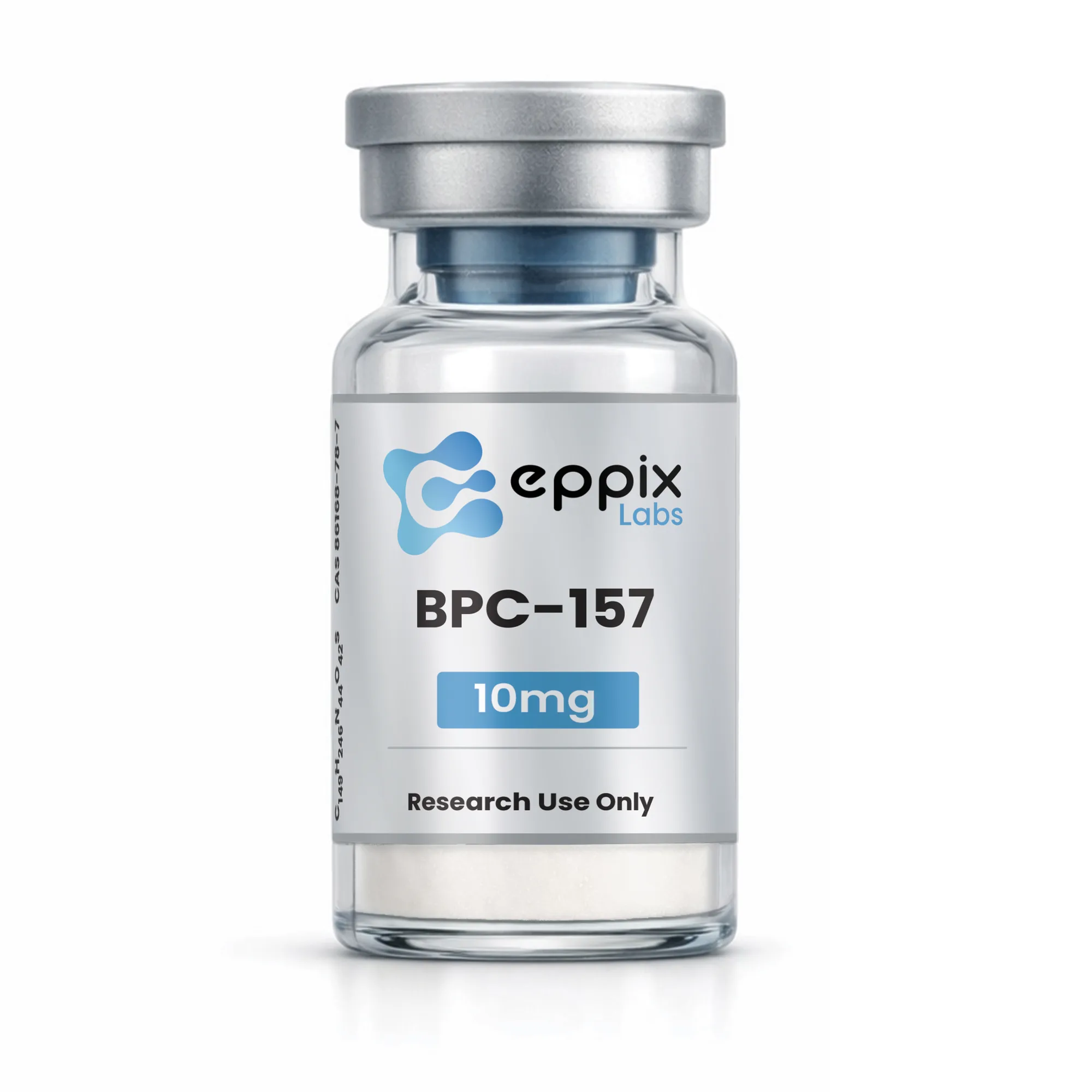
BPC-157 lyophilized research material as supplied by Eppix Labs. Vial contents and labeled strength are stated on the certificate shown further down this page.

Sequence and structure

The sequence is short, unmodified and entirely composed of standard proteinogenic residues, with no cyclization, no lipidation and no non-natural amino acids. That is worth knowing when you evaluate a certificate: BPC-157 is a straightforward synthesis, so a genuinely low purity figure points at a manufacturing or storage problem rather than an inherently difficult target.

Amino Acid Sequence
Amino Acid Sequence diagram
Amino-acid sequence of BPC-157, read N-terminus to C-terminus.
Chemical Structure
Chemical Structure diagram
Chemical structure of the BPC-157 pentadecapeptide, C₆₂H₉₈N₁₆O₂₂.

What the published research shows

The literature is large by research-peptide standards and concentrated in a small number of groups. These are the directions that have actually been published, stated as what was observed in which model:

  • ·Tendon models. Staresinic et al. (2003) reported accelerated healing of transected rat Achilles tendon and stimulation of tendocyte growth in vitro.[2] Chang et al. (2011) reported effects on tendon outgrowth, cell survival and cell migration in tendon fibroblast assays.[3]
  • ·Wound and angiogenesis models. Huang et al. (2015) examined alkali-burn wound healing in vivo, with in-vitro evidence of proliferation, migration and angiogenesis.[4]
  • ·Vascular signaling. Hsieh et al. (2020) characterized modulation of vasomotor tone via the Src, Caveolin-1 and eNOS pathway in experimental vascular preparations.[5]
  • ·Gastrointestinal cytoprotection. The original 1993 framing of the BPC family concerned gastric mucosal protection, and remains the oldest continuous thread in the literature.[1]

The limit of the evidence, stated plainly

There are no completed, published, randomized human efficacy trials of BPC-157. Every finding above comes from cell culture or animal models. A small oral formulation (PL-14736) entered early clinical work for inflammatory bowel disease and did not produce a published pivotal dataset. There is no established human dose, no human safety record of any size, and no approved indication in any jurisdiction.

A large preclinical literature concentrated in one research group is a reason to take a compound seriously as a research subject. It is not a substitute for human data, and any supplier presenting it as one is misrepresenting what has been published.

Regulatory status: the July 2026 vote, and what it changed

On 23 and 24 July 2026 the FDA's Pharmacy Compounding Advisory Committee reviewed BPC-157 for inclusion on the Section 503A Bulk Drug Substances List, alongside BPC-157, KPV, TB-500, MOTS-c, Epitalon and Semax. FDA staff had recommended against inclusion for every substance under review, citing insufficient characterization, little or no human effectiveness evidence, and inadequate human safety data. The committee voted in favor anyway. The vote was 8 in favor, 6 against, 1 abstention.

That result was widely reported as a regulatory shift. It is worth being precise about what it does:

  • ·It is non-binding. The committee advises, it does not decide. No final FDA determination has been issued and none of the six peptides appears in 21 CFR 216.23.
  • ·It requires a further step. Addition to the 503A Bulks List requires formal action by the Secretary of Health and Human Services, which had not occurred as of publication.
  • ·It does not make the compound an FDA-approved drug, and it establishes nothing about efficacy.
  • ·It does not legitimize research-chemical retail. A compounding-list decision concerns licensed pharmacists preparing patient-specific prescriptions under Section 503A, which is a different channel entirely from research material sold in vials.

Buying BPC-157 in the US: what actually matters

Purity and content answer two different questions, and a listing that reports only the first has told you half the story. Purity is the fraction of what is in the vial that is the stated compound. Measured content is how much of it is there against the labeled amount. A vial can be 99.5% pure and hold 6 mg where the label says 10 mg, and a purity figure alone will never reveal that.

Mass-spectrometry identity confirmation closes the third gap: it establishes that the pure material is the right molecule. For a 15-residue peptide with a distinctive mass near 1419.5 Da, that is a cheap check for a laboratory to run and an expensive one to fake.

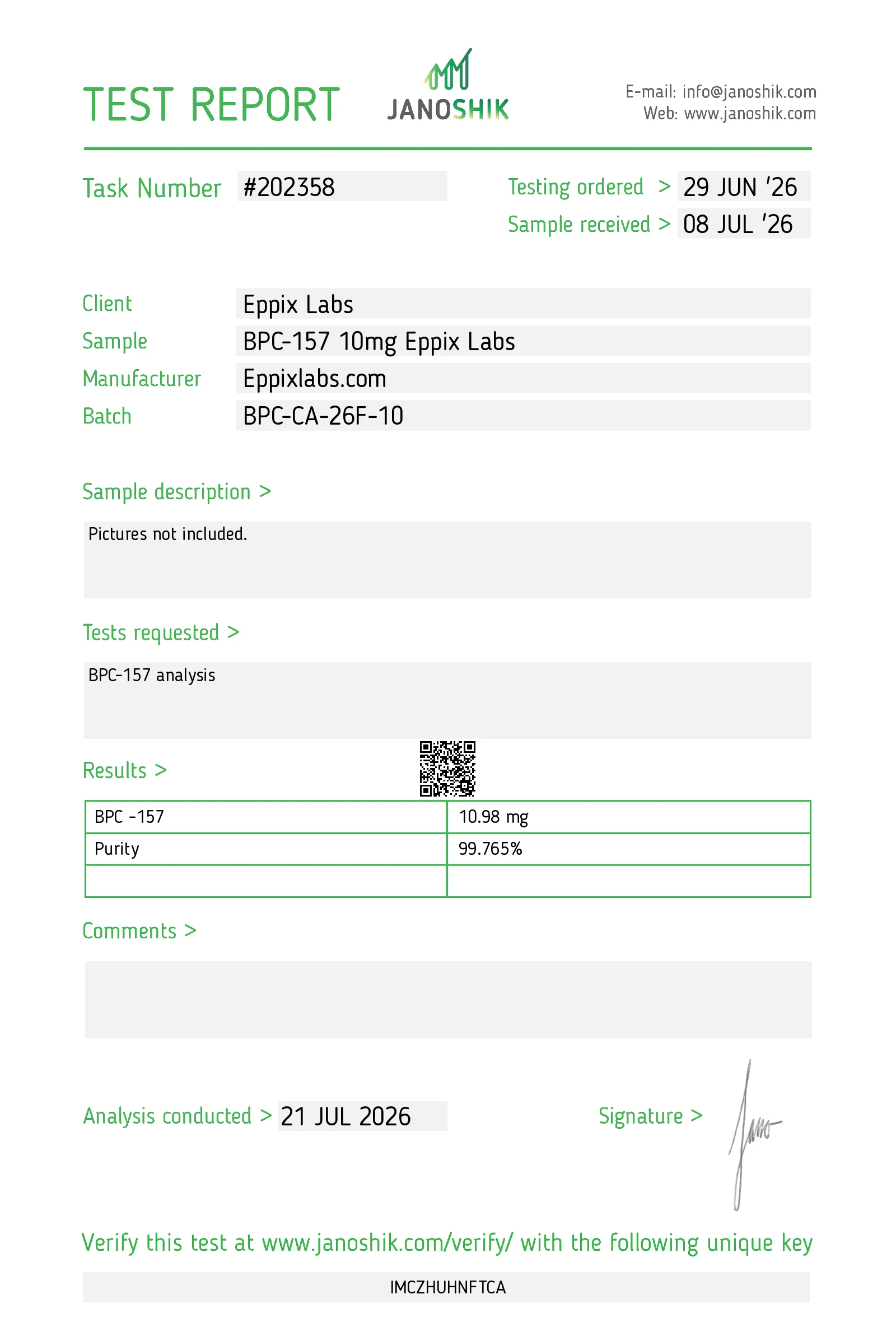
Every Eppix BPC-157 lot is tested by Janoshik Analytical and the certificate is published before the lot goes on sale, verifiable on the laboratory's own database rather than as a PDF hosted by the seller. The certificate below is the current published lot. Use the strength buttons to move between strengths.

Published Certificate
Certificate of analysis for BPC-157 10mg, batch BPC-CA-25L-01, 99.765% purity, 10.98 mg measured content

Select strength

Batch
BPC-CA-25L-01
Purity (HPLC)
99.765%
Measured content
10.98 mglabeled 10 mg
Laboratory
Janoshik
Published certificate of analysis for the current BPC-157 lots. Batch, HPLC purity and measured content are read live from the batch record.

The four-line certificate check

If you read nothing else on a certificate, read these four lines. Our longer walkthrough is in how to verify a peptide COA, and the failure modes are catalogued in how to spot a fake COA.

  • ·Batch number, and it matches the number on the vial you are being sold, not a different lot from six months ago.
  • ·Named testing laboratory, with a verification path on that laboratory's own site.
  • ·Identity by MS, not purity alone.
  • ·Measured content against labeled content, reported as a number rather than described as "verified".

Sourcing in the United States

Eppix ships domestically within the United States by FedEx, typically one to three business days across the country, with free shipping over $200 USD. Card and PayPal checkout are both available, and mix-and-match pricing applies at 5 and 10 vials across the catalog rather than per product.

Researchers working tissue-repair models frequently pair BPC-157 with TB-500; the two are compared directly in BPC-157 vs TB-500. The full literature overview, separate from this sourcing guide, is at BPC-157: a research literature overview.

Frequently Asked

Is BPC-157 legal in the US?

It may be sold and held as a laboratory research material. It is not approved by the FDA for human or veterinary use, and it is not a scheduled substance. This is not legal advice.

Did the FDA approve BPC-157 in July 2026?

No. An FDA advisory committee voted 8-6 to recommend adding BPC-157 to the Section 503A compounding bulks list, against the recommendation of FDA staff. The vote is non-binding, addition to the list still requires action by the Secretary of Health and Human Services, no final determination has been issued, and BPC-157 does not appear in 21 CFR 216.23.

What purity should a BPC-157 certificate show?

For a peptide this short and this easy to synthesize, HPLC purity at or above 99% is a reasonable expectation from a competent manufacturer. The purity number matters less than whether it comes with an MS identity confirmation and a measured content figure, both tied to the batch you are actually buying.

What is the difference between BPC-157 acetate and arginate?

They are two salt forms of the same peptide sequence. Salt form affects solubility and physical handling; it does not change the sequence. Acetate is the form usually distributed for research.

Are there human clinical trials of BPC-157?

No published randomized efficacy trials. An oral formulation designated PL-14736 entered early clinical investigation for inflammatory bowel disease without producing a published pivotal dataset. Everything else in the literature is cell culture or animal work.

How is BPC-157 stored?

Lyophilized material is held cool, dry and dark, at -20 °C for long-term storage. Reconstituted material is refrigerated and used within the window your protocol defines. The detail is in our peptide storage guide.

References

  1. Sikirić, P. et al. (1993). A new gastric juice peptide, BPC. An overview of the stomach-stress-organoprotection hypothesis and beneficial effects of BPC. J Physiol Paris 87(5):313-327. PMID 8298609
  2. Staresinic, M. et al. (2003). Gastric pentadecapeptide BPC 157 accelerates healing of transected rat Achilles tendon and in vitro stimulates tendocytes growth. J Orthop Res 21(6):976-983. PMID 14554208
  3. Chang, C.H. et al. (2011). The promoting effect of pentadecapeptide BPC 157 on tendon healing involves tendon outgrowth, cell survival, and cell migration. J Appl Physiol (1985) 110(3):774-780. PMID 21030672
  4. Huang, T. et al. (2015). Body protective compound-157 enhances alkali-burn wound healing in vivo and promotes proliferation, migration, and angiogenesis in vitro. Drug Des Devel Ther 9:2485-2499. PMID 25995620
  5. Hsieh, M.J. et al. (2020). Modulatory effects of BPC 157 on vasomotor tone and the activation of Src-Caveolin-1-endothelial nitric oxide synthase pathway. Sci Rep 10(1):17078. PMID 33051481
  6. US Food and Drug Administration (2026). Pharmacy Compounding Advisory Committee meeting, 23-24 July 2026: bulk drug substances nominated for inclusion on the Section 503A Bulks List. FDA Advisory Committee Calendar. Source
  7. US Food and Drug Administration (2026). FDA briefing document, Pharmacy Compounding Advisory Committee: BPC-157, KPV, TB-500, MOTS-c, Emideltide, Semax and Epitalon. Agency review recommended against inclusion for each substance. FDA. Source
  8. Office of the Federal Register (2026). 21 CFR 216.23: bulk drug substances that can be used to compound drug products under section 503A. None of the six peptides appear on the list as of publication. eCFR. Source

Research Use Only

This article summarizes published preclinical research literature. Compounds referenced are supplied by Eppix Labs strictly as research materials for laboratory investigation within the United States. They are not approved by the FDA for human or veterinary use, and nothing on this page should be interpreted as medical advice or guidance on human or animal administration.