FedEx Delivery1–3 day delivery across the U.S.Free on orders over $200

Verification

How to Verify a Peptide COA in Three Steps

A certificate is only worth what its verification path is worth, and most of the market has no verification path at all

·Compiled by Eppix Labs

A certificate of analysis is a document, and documents can be produced by anyone with a word processor. What makes a certificate worth reading is not the numbers printed on it but whether those numbers can be traced back to a laboratory that will independently confirm them, against the specific vial in front of you.

This is the three-step check, in the order that fails fastest. Everything here applies to any supplier, not only to ours.

Step one: does the batch on the certificate match the vial?

This is the check that eliminates most bad certificates and takes ten seconds. Read the batch or lot number printed on the vial label. Read the batch number on the certificate. They either match or they do not.

The most common failure in the market is not a forged certificate. It is a genuine certificate for a different lot, republished indefinitely because the numbers on it are good. A supplier showing you a certificate from 2024 for a vial filled in 2026 has shown you a real document about material you are not buying.

  • ·If the vial has no batch number at all, stop. Nothing downstream can be verified.
  • ·If the certificate has no batch number, the same applies.
  • ·If they differ, ask why before ordering rather than after.
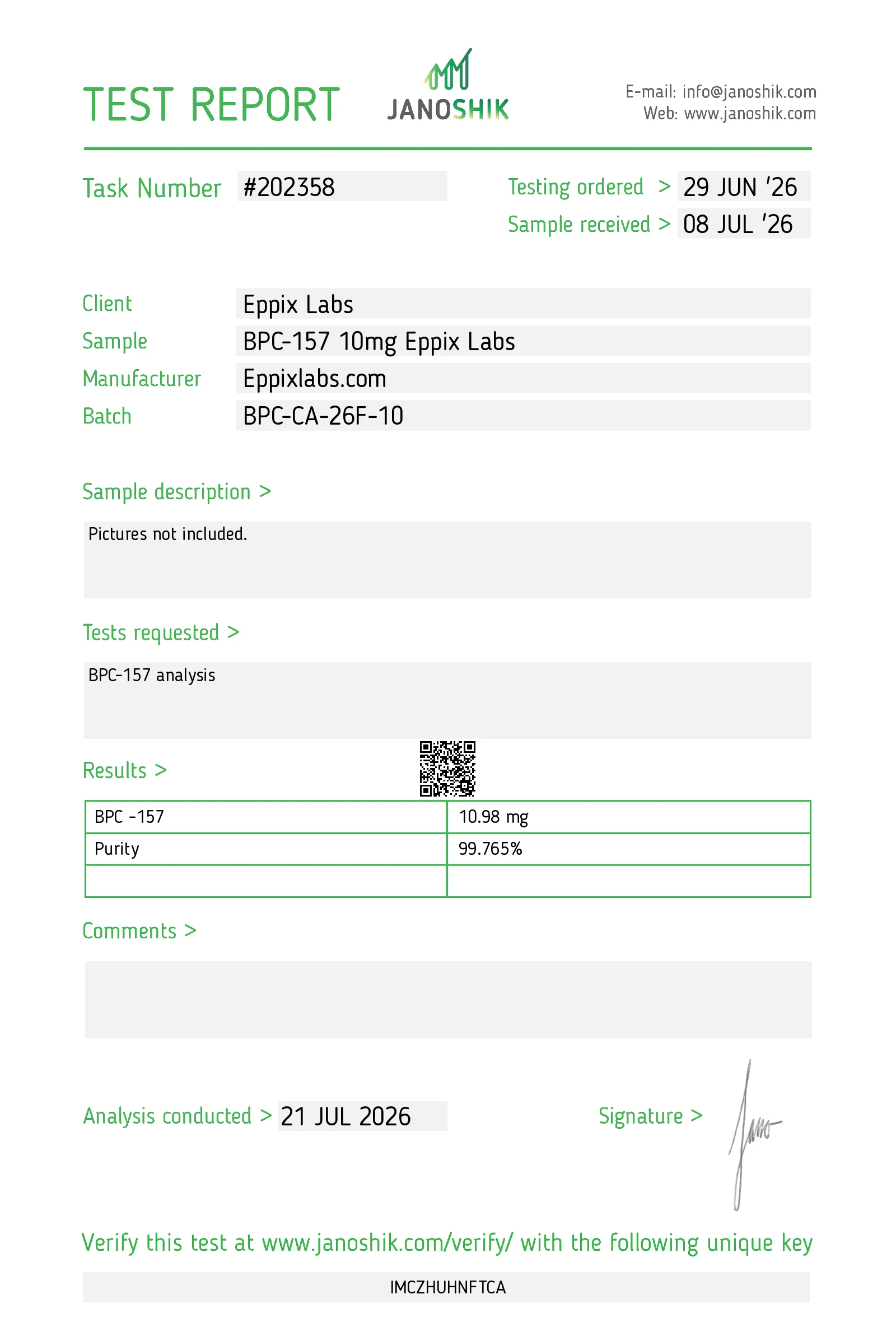
Step two: verify on the laboratory's own database, not the seller's PDF

A PDF hosted by a seller proves that the seller has a PDF. The check that actually matters is whether the issuing laboratory will confirm the same report independently.

Janoshik Analytical, the most widely used independent laboratory in this market, issues every report with a unique key that anyone can look up on the laboratory's own site. That property is what makes its certificates worth something: a supplier can fabricate a document, and cannot fabricate an entry in someone else's database.

What to do: open the certificate, find the report link or key, and check it at the laboratory. The report the laboratory shows you should carry the same client, the same batch, the same date and the same numbers as the copy the seller published. If any of those differ, the seller has edited something.

Published Certificate
Certificate of analysis for BPC-157 10mg, batch BPC-CA-25L-01, 99.765% purity, 10.98 mg measured content

Select strength

Batch
BPC-CA-25L-01
Purity (HPLC)
99.765%
Measured content
10.98 mglabeled 10 mg
Laboratory
Janoshik
A published certificate as it appears on this site: batch, purity, measured content and a direct link to the report on the laboratory's own database.

Step three: read purity and measured content as two separate answers

These are the two numbers that get conflated, and conflating them is how a buyer ends up satisfied with half an answer.

Purity is measured by HPLC and reported as a percentage. It answers: of the peptide material present in this vial, what fraction is the stated compound? It says nothing about how much material is present.

Measured content is a quantitative result, reported in milligrams. It answers: how much of the compound is actually in this vial, against what the label claims? A vial can be 99.6% pure and hold 5 mg where the label says 10 mg. The purity figure will be entirely accurate and you will have lost half of what you paid for.

A certificate reporting only purity has answered one of two questions. The longer treatment is at purity vs fill accuracy.

  • ·Identity (mass spectrometry): is it the right molecule? Catches substitution.
  • ·Purity (HPLC): what fraction of the peptide present is that molecule? Catches poor synthesis.
  • ·Content (quantitative): how much is in the vial against label? Catches underfilling.

What a complete certificate carries

  • ·The client name, which should be the supplier you are buying from and not a different company.
  • ·The sample or product name, matching what you are being sold.
  • ·A batch or lot number, matching the vial.
  • ·The test date, recent enough to concern the current lot.
  • ·Identity confirmation by mass spectrometry.
  • ·HPLC purity as a number, not as a claim.
  • ·Measured content in milligrams against the labeled amount.
  • ·A verification key or link resolving on the laboratory's own site.

Two cases where the rules bend

Blends. HPLC purity is defined against a single analyte, so a two-compound vial cannot carry one meaningful purity percentage. A correct blend certificate reports measured mass per component with identity confirmed for each. A single purity figure on a blend certificate is a signal that something has been simplified that should not have been.

Non-peptides. NAD+ and small molecules such as 5-Amino-1MQ are not made by peptide synthesis and do not have a peptide impurity profile. Their certificates commonly emphasize content and identity over an HPLC area-percent figure, and that is appropriate rather than evasive. Ask what analyte a quoted purity figure was measured against.

How this works here

Every Eppix lot is tested by Janoshik Analytical before it is listed, and the certificate is published before the lot goes on sale rather than supplied on request afterwards. Each certificate carries the batch code printed on the vial label and a link to the report on the laboratory's own database.

The full archive is at certificates of analysis, and the batch lookup is at verify. What the testing laboratory does and does not test is covered in Janoshik testing explained, and the failure modes are catalogued in how to spot a fake COA.

Frequently Asked

What is the single most important check?

That the batch number on the certificate matches the batch number on the vial. A genuine certificate for a different lot is the most common problem in the market, and it takes ten seconds to catch.

Why is a seller-hosted PDF not enough?

Because it only proves the seller has a PDF. A certificate is worth something when the issuing laboratory will independently confirm the same report through its own verification system.

What is the difference between purity and measured content?

Purity is the fraction of the peptide present that is the stated compound. Measured content is how much compound is in the vial against the labeled amount. A vial can be highly pure and badly underfilled, and only the second number reveals it.

Why does a blend certificate have no purity percentage?

HPLC purity is defined against one analyte. With two compounds in a vial there is no single meaningful percentage, so a correct blend certificate reports measured mass per component instead.

How recent should a certificate be?

It should concern the lot you are buying. Age matters less than lot identity: a certificate from last year for the lot in front of you is fine, and a certificate from last month for a different lot is not.

What if a supplier will not provide a certificate before purchase?

That is itself the answer. Publishing results before sale removes a supplier's ability to hide a poor lot, which is precisely why some suppliers do not do it.

Research Use Only

This article summarizes published preclinical research literature. Compounds referenced are supplied by Eppix Labs strictly as research materials for laboratory investigation within the United States. They are not approved by the FDA for human or veterinary use, and nothing on this page should be interpreted as medical advice or guidance on human or animal administration.