FedEx Delivery1–3 day delivery across the U.S.Free on orders over $200

Laboratory Practice

Peptide Storage and Shelf Life: The Laboratory Guide

Four degradation routes, two physical states, and why the dry solid is so much more forgiving than the solution

·Compiled by Eppix Labs

A peptide in a sealed, dry, frozen vial is remarkably stable. The same peptide in aqueous solution at room temperature can lose measurable material in days. The entire practical difference between those two situations is water, and understanding why makes every storage rule follow from one principle rather than being a list to memorize.

This is a laboratory-practice reference. It describes general handling of research materials and contains no dosing, administration or human-use guidance.

Why the dry state is so much better

Peptides degrade by four principal chemical routes, and three of them need water as a reactant or a mobility medium.

  • ·Hydrolysis. Peptide bond cleavage, requiring water. Effectively stopped in a dry solid.
  • ·Deamidation. Conversion of asparagine and glutamine side chains to the corresponding acids, proceeding through a cyclic imide intermediate. Strongly water- and pH-dependent, and among the best-characterized solid-state degradation routes.[2]
  • ·Oxidation. Methionine, cysteine and tryptophan side chains oxidising on exposure to air and light. This is the one route that proceeds meaningfully in the dry state, which is why lyophilized vials are sealed under partial vacuum or inert gas.
  • ·Aggregation. Physical rather than chemical: chains associating into species that will not redissolve. Driven by concentration, agitation and freeze-thaw cycling.
  • ·A fifth route worth naming for lyophilized material specifically: residual moisture in the cake enables amide-linked adduct formation with excipients, which is why moisture control in the dry state matters more than it intuitively should.[1]
Storing lyophilized material

  • ·-20 °C for long-term storage. The standard for research peptides. Colder is not meaningfully better for most sequences and adds handling risk.
  • ·Dark. Tryptophan and tyrosine absorb in the near-UV, and copper complexes such as GHK-Cu are more light-sensitive than plain peptides.
  • ·Dry. Keep the vial sealed. Every opening admits humid air, and the desiccant in a shipping container is not a substitute for an intact seal.
  • ·Room temperature to open. Always let a frozen vial equilibrate before breaking the seal, or condensate goes into the cake.
  • ·In transit. Short ambient shipping is generally tolerated by lyophilized peptides. It is the reason material ships dry rather than in solution.

Storing reconstituted material

Freeze-thaw cycling deserves its own note. Each cycle concentrates solutes at the ice front, drives local pH shifts as buffer components crystallize at different rates, and creates ice-water interfaces at which peptides denature. The loss is cumulative: five cycles is not one cycle five times, it is worse.

  • ·2 to 8 °C, refrigerated. Not frozen unless the protocol specifically calls for it and the solution is aliquoted.
  • ·Protected from light. Amber vials or foil.
  • ·Aliquoted. This is the single most useful habit. Divide into single-use volumes on the day of reconstitution so no aliquot is ever thawed twice.
  • ·Used within the window your protocol defines. Solution stability is sequence-specific and no general number is honest across a whole catalog.

Which sequences are least tolerant

  • ·Methionine-containing peptides. MOTS-c has two methionines. Each oxidized residue adds 16 Da, visible on a mass-spectrometry report as a satellite species. Minimize air exposure.
  • ·Asn and Gln-rich sequences. Most exposed to deamidation, and the effect is pH-sensitive in solution.
  • ·Aggregation-prone classes. Amylin analogs descend from a hormone whose native form aggregates into amyloid fibrils. Handle gently, avoid agitation, avoid repeated freezing.
  • ·Copper complexes. GHK-Cu is more light-sensitive than a plain peptide, and the metal center adds a route that a peptide-only stability discussion does not cover.
  • ·Small molecules. NAD+ is markedly hygroscopic and less stable in solution than most peptides. 5-Amino-1MQ is a quaternary salt and also hygroscopic, though generally more robust than a peptide once dry.

What shelf life actually means here

A certificate reports what a laboratory measured on a given date. It is not a prediction about the future, and no supplier in this market runs the formal stability program that would be needed to assign a real expiry date.

What a batch record does provide is a starting point: material tested at high purity and correct content on a known date, stored correctly from then on, is in a knowable condition. Material with no certificate and no batch code has no starting point at all, which is why the storage question and the verification question are the same question asked at different times.

Published Certificate
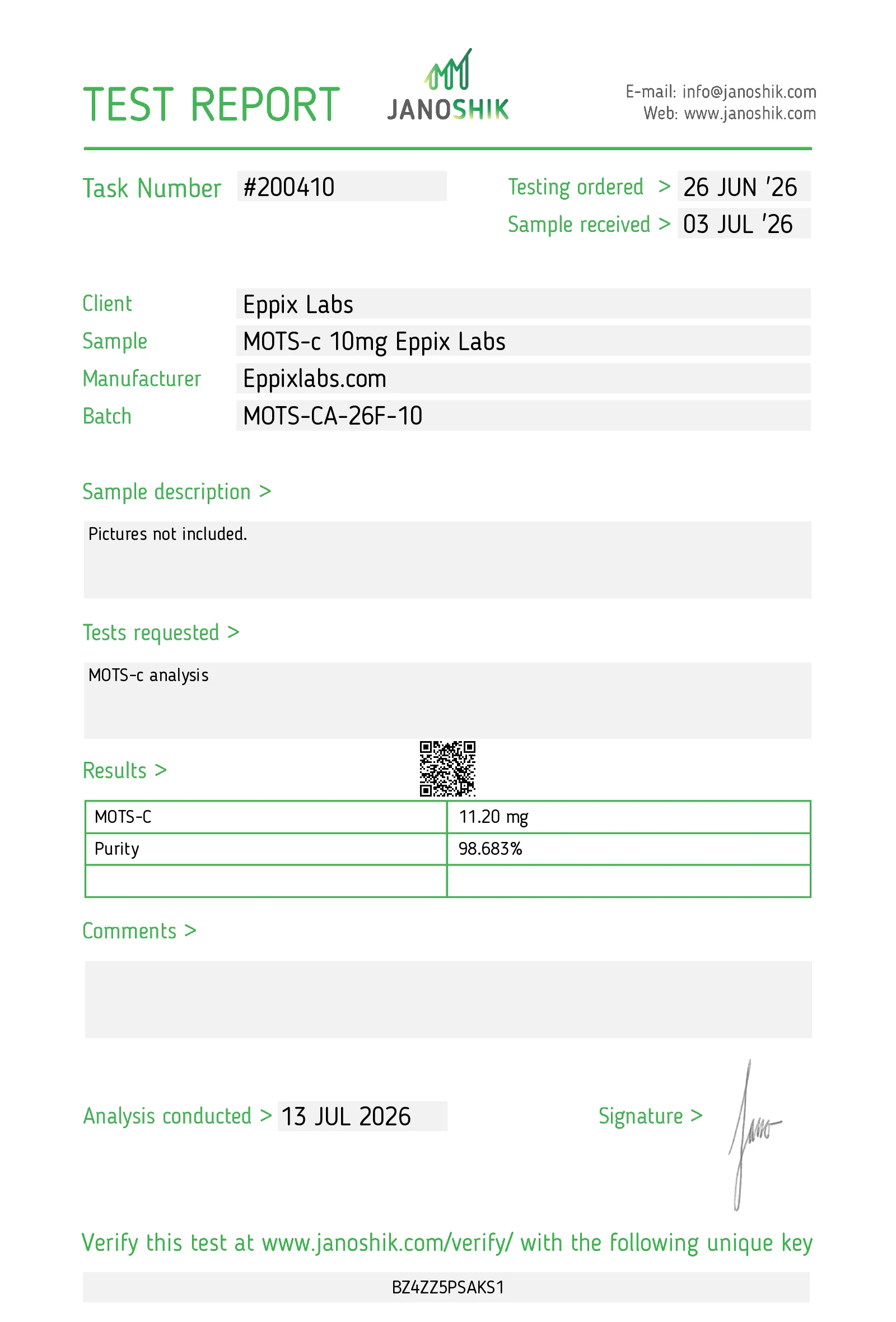
Certificate of analysis for MOTS-c 10mg, batch MOTS-CA-26A-02, 98.683% purity, 11.20 mg measured content

Select strength

Batch
MOTS-CA-26A-02
Purity (HPLC)
98.683%
Measured content
11.20 mglabeled 10 mg
Laboratory
Janoshik
A certificate is a measurement on a date, not an expiry guarantee. Test date and batch are what make later condition assessable.

The short version

  • ·Lyophilized: -20 °C, dark, dry, sealed, equilibrate to room temperature before opening.
  • ·Reconstituted: 2 to 8 °C, dark, aliquoted, used within your protocol's window.
  • ·Never freeze-thaw the same aliquot repeatedly.
  • ·Swirl, never shake. Foam is lost material.
  • ·Methionine-containing and copper-complexed compounds need more care than the rest.

Frequently Asked

Do peptides need to be frozen?

Lyophilized material is generally held at -20 °C for long-term storage. Short periods at ambient temperature, including shipping, are usually tolerated in the dry state, which is why material ships lyophilized rather than in solution.

How long does reconstituted material last?

It is sequence-specific and no single number is honest across a catalog. Refrigerated at 2 to 8 °C, protected from light, aliquoted, and used within the window your protocol defines.

Why is freeze-thaw cycling harmful?

Each cycle concentrates solutes at the ice front, shifts local pH as buffer components crystallize unevenly, and creates ice-water interfaces where peptides denature. The damage accumulates across cycles.

What are the main degradation routes?

Hydrolysis, deamidation of Asn and Gln, oxidation of Met, Cys and Trp, and physical aggregation. Three of the four need water, which is why the dry state is so much more stable.

Which compounds need the most care?

Methionine-containing sequences such as MOTS-c (oxidation), amylin analogs (aggregation), GHK-Cu (light and the metal center), and the non-peptides NAD+ and 5-Amino-1MQ (both hygroscopic).

Does a certificate give an expiry date?

No. It reports what a laboratory measured on a stated date. No supplier in this market runs the formal stability program that would be needed to assign a genuine expiry date.

References

  1. DeHart, M.P., Anderson, B.D. (2012). Effects of water and polymer content on covalent amide-linked adduct formation in peptide-containing amorphous lyophiles. J Pharm Sci 101(9):3096-3109. PMID 22437444
  2. Li, B. et al. (2005). Effects of sucrose and mannitol on asparagine deamidation rates of model peptides in solution and in the solid state. J Pharm Sci 94(8):1723-1735. PMID 15986465

Research Use Only

This article summarizes published preclinical research literature. Compounds referenced are supplied by Eppix Labs strictly as research materials for laboratory investigation within the United States. They are not approved by the FDA for human or veterinary use, and nothing on this page should be interpreted as medical advice or guidance on human or animal administration.