✦FedEx Delivery1–3 day delivery across the U.S.Free on orders over $200

Compound Overview

BPC-157 in the US, 2026: Regulatory Status and What the Preclinical Literature Supports

Two regulatory steps in one year, neither of them an approval, and a preclinical literature that is large, rodent-heavy and concentrated in few hands

·By Adam Reeves · Research Editor, Eppix Labs

BPC-157 had two regulatory moments in 2026: an April removal from the FDA's Category 2 list and a July advisory committee vote in its favor. Both were widely read as a change in what the compound is. Neither was. This piece sets out the US status step by step, then maps the preclinical literature: what it covers, where it is thin, and what a rigorous study design has to account for.

BPC-157 is supplied for laboratory research use only. Nothing below is dosing, medical or legal guidance.

Chemical Identity

Name
Pentadecapeptide BPC 157
Also known as
BPC-157, Body Protection Compound-157, PL-14736
Molecular formula
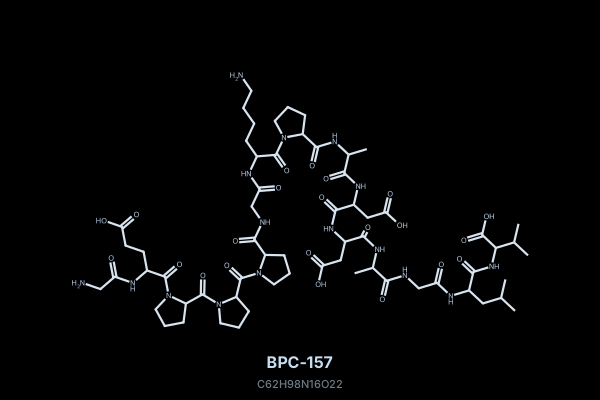
C₆₂H₉₈N₁₆O₂₂
Molecular weight
1419.5 g/mol
CAS number
137525-51-0
PubChem CID
9941957
Sequence (1-letter)
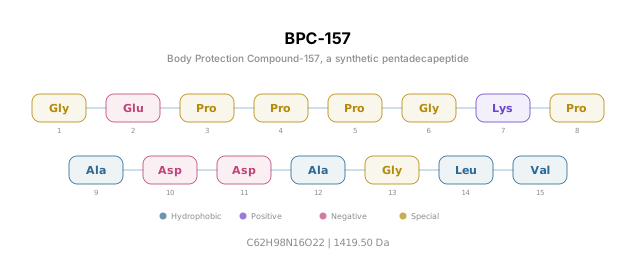
GEPPPGKPADDAGLV
Sequence (3-letter)
Gly-Glu-Pro-Pro-Pro-Gly-Lys-Pro-Ala-Asp-Asp-Ala-Gly-Leu-Val
Salt forms
Acetate (the form usually distributed for research) · Arginate

Key takeaways

  • ·BPC-157 is a synthetic 15-amino-acid peptide (sequence GEPPPGKPADDAGLV) derived from a protein fragment originally described in human gastric juice.
  • ·In 2026 the FDA removed it from Category 2 (April), and its Pharmacy Compounding Advisory Committee (PCAC) voted 8 in favor, 6 against, with 1 abstention, to recommend it for the 503A bulks list (July). Neither step made it an approved drug.[1][2]
  • ·The research base is predominantly preclinical and mostly in rodents, and much of it comes from a single research group; only a handful of groups have studied the peptide in depth.[3]
  • ·Reviews consistently call for controlled human studies and independent replication before conclusions can be drawn.[3][4]

The molecule

Early studies noted BPC-157's apparent stability in human gastric juice, which is part of why researchers have examined it by several routes in animal models. Its identity data:

  • ·Name. BPC-157 (Body Protection Compound 157; also designated PL 14736).
  • ·Sequence. Gly-Glu-Pro-Pro-Pro-Gly-Lys-Pro-Ala-Asp-Asp-Ala-Gly-Leu-Val.
  • ·Length. 15 residues.
  • ·Molecular weight. 1419.5 g/mol for the free peptide, C₆₂H₉₈N₁₆O₂₂.
  • ·Form supplied. Lyophilized powder, typically the acetate salt.
Research Material
General Image
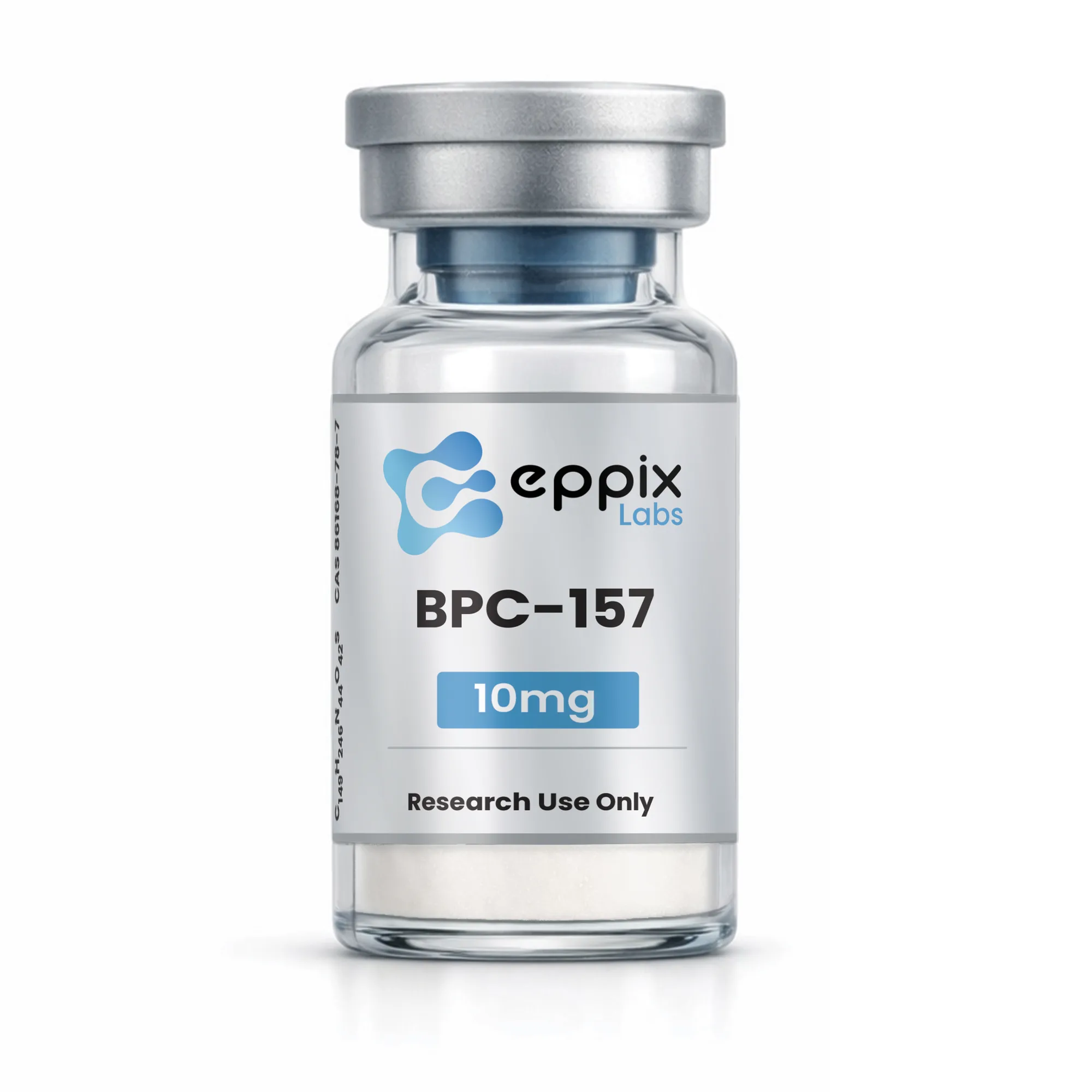
BPC-157 lyophilized research material as supplied by Eppix Labs. Labeled and measured content are stated on the certificate further down this page.
Amino Acid Sequence
Amino Acid Sequence diagram
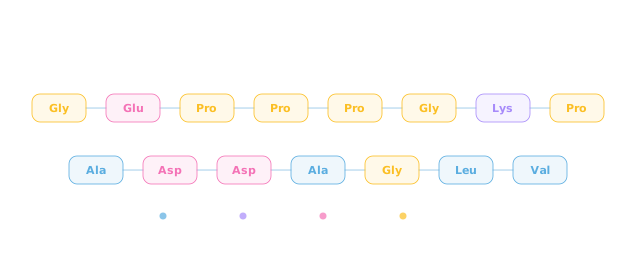
Amino-acid sequence of BPC-157, GEPPPGKPADDAGLV, read N-terminus to C-terminus.
Chemical Structure
Chemical Structure diagram
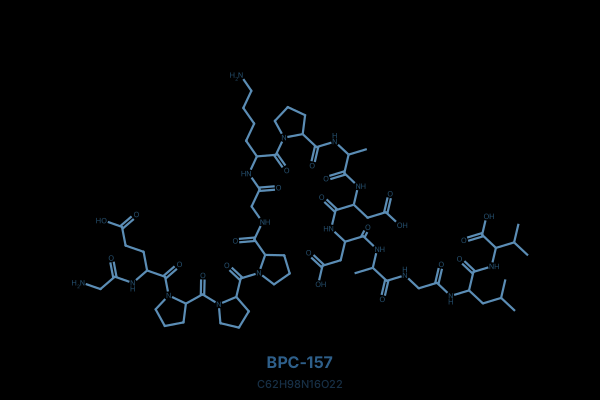
Chemical structure of the BPC-157 pentadecapeptide, C₆₂H₉₈N₁₆O₂₂.

US regulatory status at a glance

The FDA side of the story comes down to four dates. For detail on each step, see our posts on the April 2026 Category 2 removals and the July 2026 PCAC vote.

  • ·2023. Placed in Category 2 of the FDA's interim 503A bulks list, the category for substances that raise significant safety concerns. In practice this barred compounding pharmacies from using it.[1]
  • ·15 April 2026. The FDA announced its removal from Category 2, after the original nomination was withdrawn. Removal does not make it eligible for compounding.[1]
  • ·23 July 2026. The PCAC voted 8 in favor, 6 against, with 1 abstention, to recommend inclusion on the 503A bulks list. The vote is advisory only.[2]
  • ·Pending. FDA notice-and-comment rulemaking, which is required before any change in compounding status.[2]

What the July vote did and did not do

On 23 and 24 July 2026 the FDA's Pharmacy Compounding Advisory Committee reviewed BPC-157 for inclusion on the Section 503A Bulk Drug Substances List, alongside BPC-157, KPV, TB-500, MOTS-c, Epitalon and Semax. FDA staff had recommended against inclusion for every substance under review, citing insufficient characterization, little or no human effectiveness evidence, and inadequate human safety data. The committee voted in favor anyway. The vote was 8 in favor, 6 against, 1 abstention.

Separately from FDA status, BPC-157 appears on the World Anti-Doping Agency Prohibited List, in class S0 (non-approved substances), which is relevant to any research involving athletes.[5]

The FDA's own meeting materials and the current text of the 503A list make the limits of the vote plain:[6][7][8]

  • ·It is non-binding. The committee advises, it does not decide. No final FDA determination has been issued and none of the six peptides appears in 21 CFR 216.23.
  • ·It requires a further step. Addition to the 503A Bulks List requires formal action by the Secretary of Health and Human Services, which had not occurred as of publication.
  • ·It does not make the compound an FDA-approved drug, and it establishes nothing about efficacy.
  • ·It does not legitimize research-chemical retail. A compounding-list decision concerns licensed pharmacists preparing patient-specific prescriptions under Section 503A, which is a different channel entirely from research material sold in vials.

What the preclinical literature covers

Gwyer, Wragg and Wilson's 2019 review in Cell and Tissue Research summarized BPC-157 studies in musculoskeletal soft tissue, focusing on tendon, ligament and skeletal muscle injury models, mostly in small rodents.[3] A 2025 narrative review in Current Reviews in Musculoskeletal Medicine revisited the field with a focus on translation and risk.[4] The primary studies themselves are summarized in our BPC-157 research literature overview.

The main research themes are:

  • ·Tendon and ligament models. Transection and detachment models in rats, with outcomes in histology, biomechanics and functional measures.
  • ·Muscle injury models. Crush and transection injuries.
  • ·Gastrointestinal models. Ulcer, fistula and anastomosis models, reflecting the compound's gastric origin.
  • ·Proposed mechanisms. Interactions with the nitric oxide system, angiogenesis-related signaling (including VEGF pathways), and growth hormone receptor expression in tendon fibroblasts have all been proposed.[3][4]

Limits of the evidence

FDA staff recommended against inclusion, and the committee vote that overrode them was narrow. The concerns raised at the meeting, about human safety data and characterization of the substance, are gaps the literature itself acknowledges.[2] The same reviews are explicit about what is missing:[3][4]

  • ·Human data are very limited. The 2025 review counted three small human pilot studies and no large, controlled clinical trials.[4]
  • ·Concentration of authorship. Much of the literature comes from one group, and only a handful of groups have studied the peptide in depth, which makes independent replication a priority.[3]
  • ·Heterogeneous methods. Routes, models and outcome measures vary, which limits pooling.
  • ·Mechanism is unsettled. Several pathways are proposed; none is established as primary.

Designing a rigorous BPC-157 study

  • ·Characterize your lot. Record HPLC purity, mass-spec identity and measured content from the certificate. Purity and measured content answer different questions; see HPLC purity vs net peptide content.
  • ·Control for endotoxin. Tissue repair and inflammation readouts are sensitive to LPS. Endotoxin screens are run on some lots rather than every lot, so check whether yours carries one before relying on it. See our endotoxin testing guide.
  • ·Blind outcome assessment, and pre-register endpoints where possible.
  • ·Report the salt form and how concentration was calculated. The Peptide Calculator covers stock concentration and mg to mM conversion.

Eppix Labs batch data

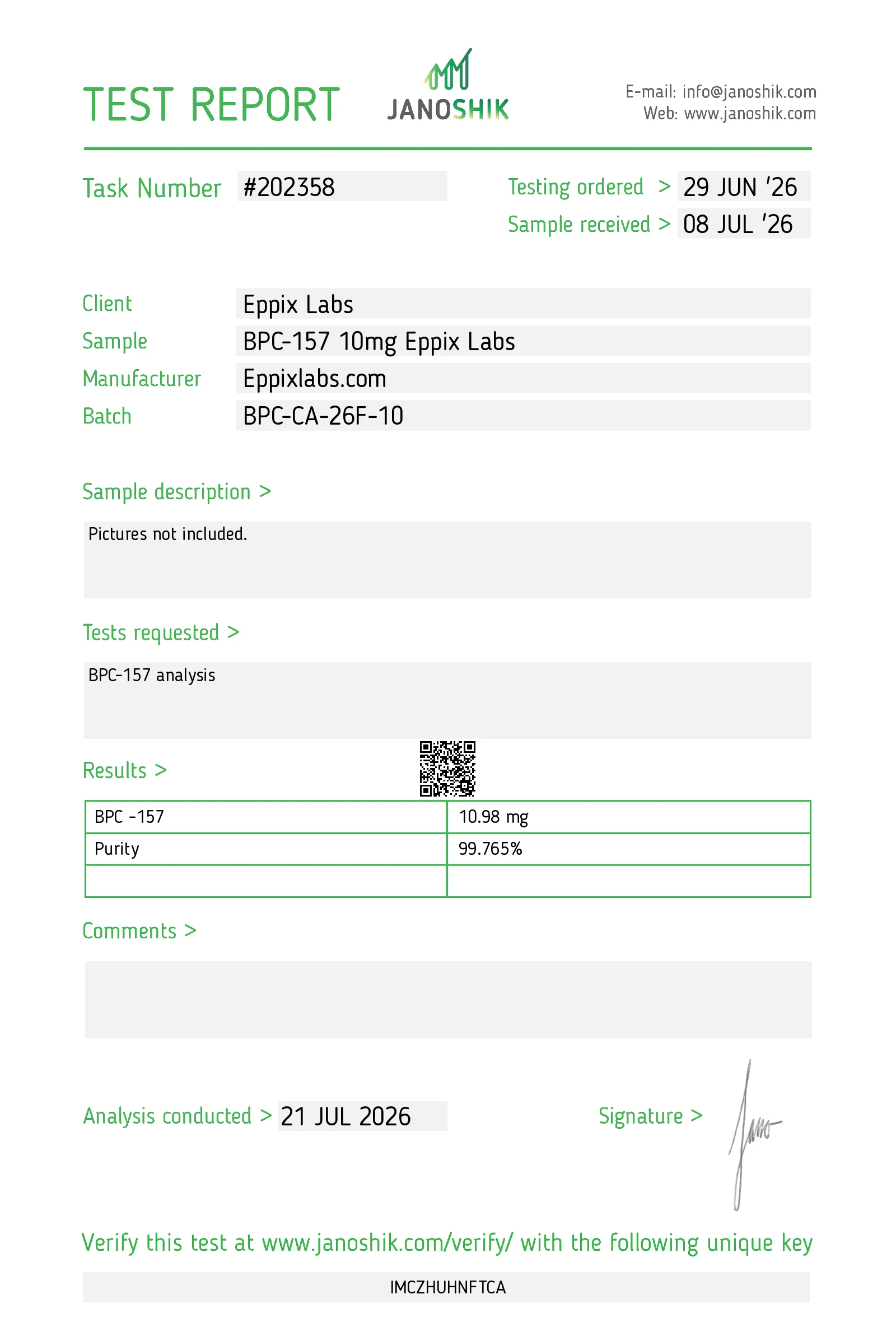
Every BPC-157 lot is tested by Janoshik Analytical before sale, and the certificate is published as the laboratory reported it, verifiable on Janoshik's own site. The current certificate is below, with batch, HPLC purity and measured content read live from the batch record. Every lot is listed on the certificates of analysis page.

Published Certificate
Certificate of analysis for BPC-157 10mg, batch BPC-CA-25L-01, 99.765% purity, 10.98 mg measured content

Select strength

Batch
BPC-CA-25L-01
Purity (HPLC)
99.765%
Measured content
10.98 mglabeled 10 mg
Laboratory
Janoshik
Published certificate of analysis for the current BPC-157 lots. Purity and measured content are reported as separate figures.

Frequently Asked

Is BPC-157 FDA-approved?

No. It is not approved for any use.

Is BPC-157 legal to buy for research in the US?

It can be sold as a research chemical for laboratory use. Marketing it for human use would make it an unapproved drug in the FDA's view. This is not legal advice.

Is there human clinical evidence for BPC-157?

Very little. Reviews describe the evidence base as predominantly preclinical.

References

  1. Frier Levitt (2026). FDA to Remove 12 Popular Peptides from the Category 2 "Do Not Compound" List. Published 16 April 2026. Frier Levitt, Articles. Source
  2. McDermott Will & Schulte (2026). Bulk-list bound? PCAC backs majority of peptides in two-day public meeting. Published 27 July 2026. McDermott Will & Schulte, Insights. Source
  3. Gwyer, D., Wragg, N.M., Wilson, S.L. (2019). Gastric pentadecapeptide body protection compound BPC 157 and its role in accelerating musculoskeletal soft tissue healing. Cell Tissue Res 377(2):153-159. PMID 30915550
  4. McGuire, F.P. et al. (2025). Regeneration or Risk? A Narrative Review of BPC-157 for Musculoskeletal Healing. Curr Rev Musculoskelet Med 18(12):611-619. PMID 40789979
  5. Operation Supplement Safety, US Department of Defense (2025). BPC-157: A Prohibited Peptide and an Unapproved Drug Found in Health and Wellness Products. OPSS. Source
  6. US Food and Drug Administration (2026). Pharmacy Compounding Advisory Committee meeting, 23-24 July 2026: bulk drug substances nominated for inclusion on the Section 503A Bulks List. FDA Advisory Committee Calendar. Source
  7. US Food and Drug Administration (2026). FDA briefing document, Pharmacy Compounding Advisory Committee: BPC-157, KPV, TB-500, MOTS-c, Emideltide, Semax and Epitalon. Agency review recommended against inclusion for each substance. FDA. Source
  8. Office of the Federal Register (2026). 21 CFR 216.23: bulk drug substances that can be used to compound drug products under section 503A. None of the six peptides appear on the list as of publication. eCFR. Source

Research Use Only

This article summarizes published preclinical research literature. Compounds referenced are supplied by Eppix Labs strictly as research materials for laboratory investigation within the United States. They are not approved by the FDA for human or veterinary use, and nothing on this page should be interpreted as medical advice or guidance on human or animal administration.