A certificate reading 99.3% purity invites an easy misreading: that 99.3% of the powder in the vial is peptide. It is not, and the measurement never claimed to be. Purity and peptide content are separate determinations that answer separate questions, and the gap between them carries straight into every concentration a lab works out from the vial.
This piece covers what each number measures, why the second one always sits below 100%, and which one to use at the bench. Every compound mentioned is supplied for laboratory research use only. Nothing below is dosing, medical or legal guidance.
Key takeaways
·HPLC purity answers one question: of the peptide-like material in the vial, how much is the target sequence?
·Net peptide content answers another: of the total powder mass, how much is peptide at all?
·Lyophilized peptides also contain counterions (such as acetate or trifluoroacetate), bound water and residual salts, so net peptide content is always below 100%.[1]
·For accurate concentrations, work from the measured peptide content, not from the label mass multiplied by purity.
What HPLC purity measures
Reversed-phase high-performance liquid chromatography (RP-HPLC) separates the components of a sample by how strongly each one interacts with a hydrophobic column. Peptides are usually detected by UV absorbance at about 210 to 220 nm, the region where the peptide bond absorbs strongly.[2]
The output is a chromatogram: a main peak for the target peptide, and smaller peaks for related impurities such as truncated sequences, deletion sequences, or oxidized and deamidated forms. Purity is reported as main peak area ÷ total peak area × 100, so "99.1% purity" means that 99.1% of the UV-detected, chromatographically separated material is the target peptide.
What HPLC-UV does not see well matters just as much: water, counterions without strong UV absorbance, and inorganic salts. Each of those adds mass to the vial without adding a peak to the chromatogram.
Research Material
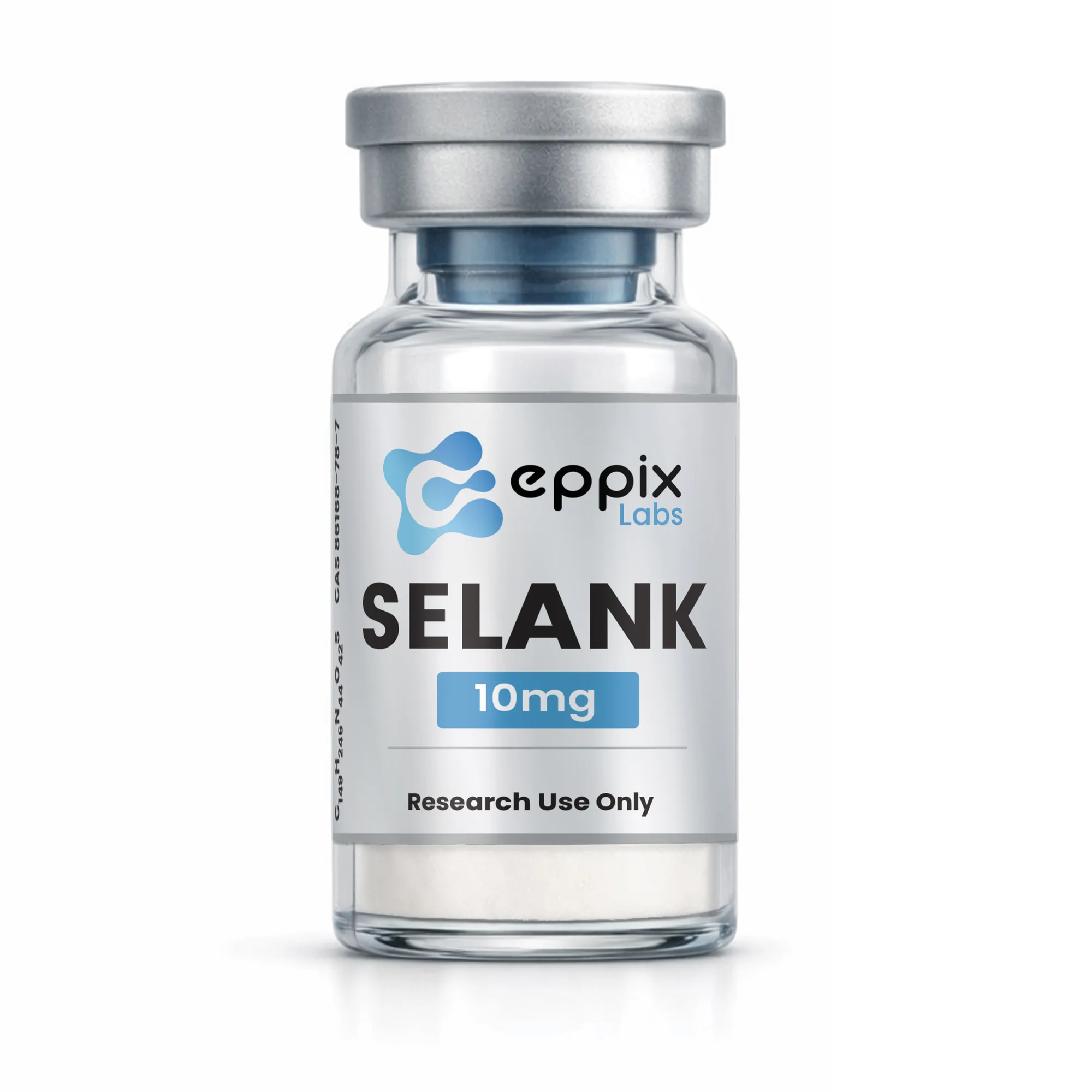
Selank lyophilized research material as supplied by Eppix Labs. Purity and measured content for each lot are reported separately on the certificate further down.
What net peptide content measures
Net peptide content is the fraction of the total powder weight that is peptide. It is measured by amino acid analysis, nitrogen determination or quantitative HPLC against a characterized reference standard. A multi-laboratory USP study compared HPLC assay, amino acid analysis and quantitative NMR for exactly this job; the HPLC assay showed the lowest variability between laboratories.[3]
For synthetic peptides the figure commonly falls well below 100%, and the gap widens for sequences with many basic residues. Three things account for it:
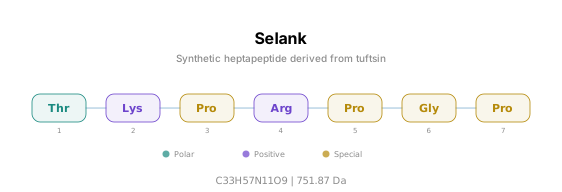
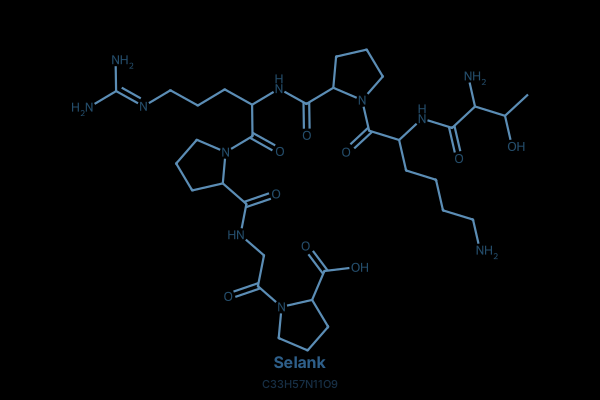
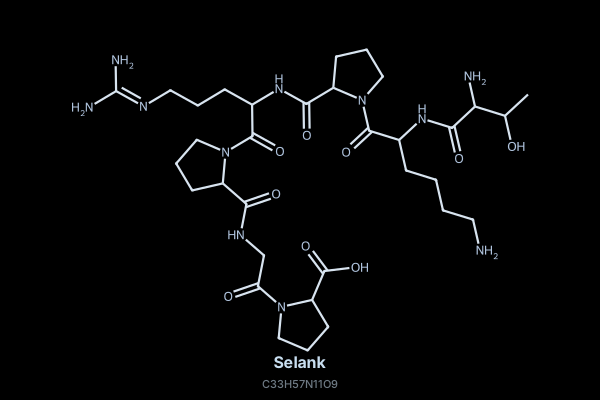
·Counterions. Synthetic peptides are purified and isolated as salts. Basic sites (lysine, arginine and histidine side chains, plus a free N-terminus) pair with an acid such as trifluoroacetate (TFA) or acetate, so a peptide with several basic sites carries several counterion equivalents.[4] Selank, drawn below, has three such sites in seven residues (the N-terminus, a lysine and an arginine) and no acidic residues to offset them. Residual TFA is not always inert in the assay either: in bone-cell cultures, TFA salts of several peptides suppressed proliferation compared with the hydrochloride salts, which is one reason some labs prefer acetate or hydrochloride forms.[5]
·Water. Lyophilized powder is hygroscopic and retains some moisture, which is why reference-standard work measures water content alongside the peptide itself.[1]
·Residual salts and excipients carried over from purification or formulation.[1]
Chemical structure of Selank, C₃₃H₅₇N₁₁O₉, 751.9 g/mol as the free peptide.
A worked example
The figures here are illustrative, not taken from a specific lot. A vial is labeled 10 mg, and its certificate reports an HPLC purity of 99.3% and a measured peptide content of 9.6 mg.
The figure to use for concentration is 9.6 mg. Reconstituted in 2.0 mL: 9.6 mg ÷ 2.0 mL = 4.8 mg/mL.
Had you assumed 10 mg, you would have calculated 5.0 mg/mL and overstated every downstream concentration by about 4%. Multiplying the label by purity does not fix it either: 10 mg × 0.993 = 9.93 mg is a statement about composition, not about how much peptide the vial holds.
The peptide calculator takes the measured figure in place of the label mass, so the concentrations it returns reflect what is actually in the vial. The reconstitution math guide carries the same correction through molarity, dilution and aliquots.
Which number matters more?
Both, for different reasons, and the two failure modes look nothing alike. A high-purity vial that is 20% underfilled gives clean but wrong concentrations. A full vial at 90% purity gives the correct mass but introduces 10% unknown material into the experiment.
Matched to the question being asked:
·Is the material the right molecule, with few impurities? HPLC purity plus mass-spectrometry identity.
·How much peptide am I adding to the assay? Measured content.
·Are two lots comparable? Both, plus the impurity profile.
How Eppix Labs reports it
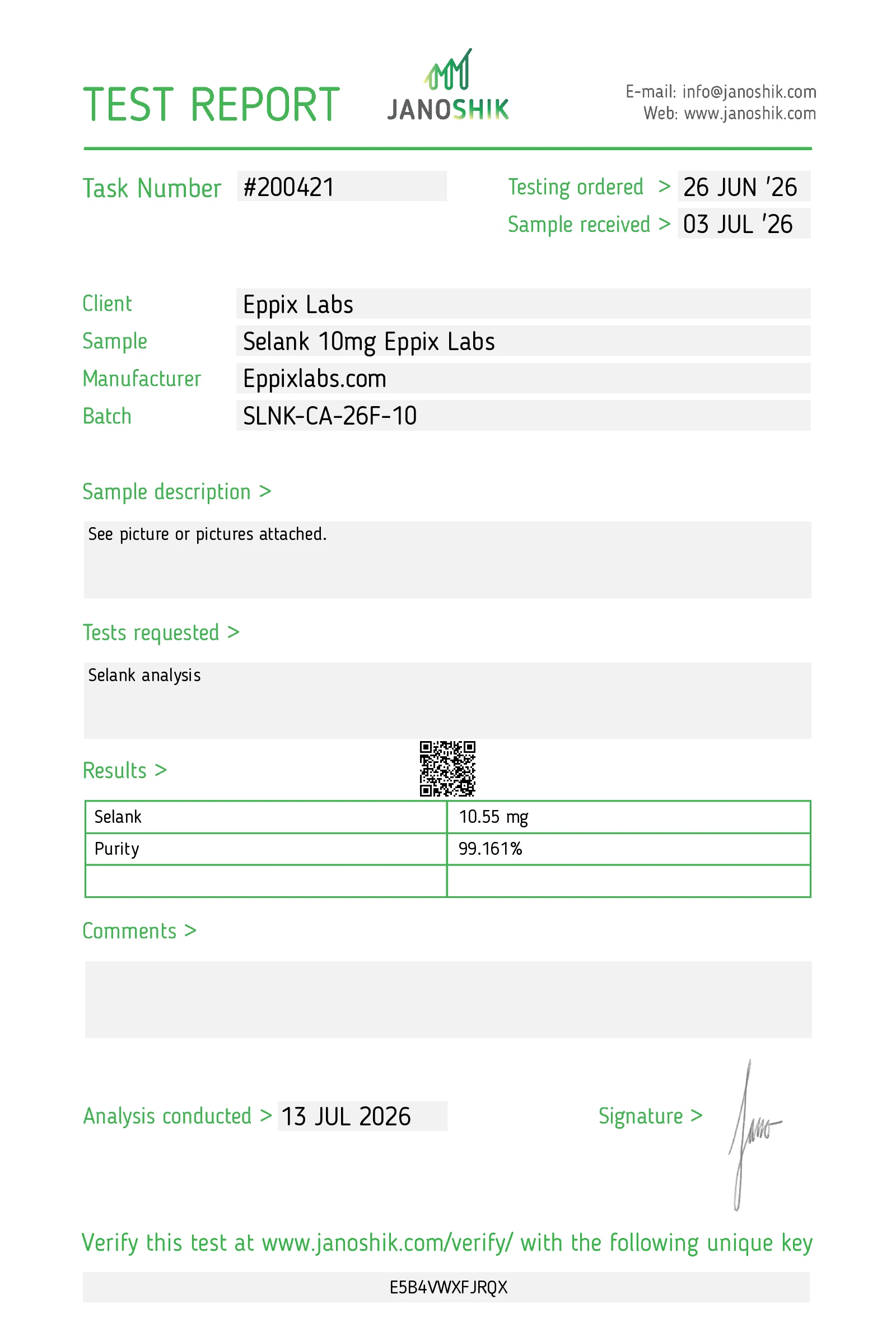
Every Eppix lot is tested by Janoshik Analytical before sale, and its certificate is published. For a single-compound lot the certificate reports HPLC purity and measured content side by side; a blend has no single purity figure, so its certificate reports measured mass for each component instead.
Most lots measure above 99% purity. An occasional lot comes back around 98%, and it is published as the laboratory reported it rather than left out. A lot can read 98% pure and still hold its full labeled amount, which is the whole argument of this article in one line. Every result is on the certificates of analysis page, the guide to reading a Janoshik COA explains each field, and the supplier-side version of this distinction is in purity vs fill accuracy.
Published Janoshik certificate for the current Selank lots. HPLC purity and measured content are reported as separate figures because they answer different questions.
For some cell-based assays residual TFA can affect results, and some labs prefer acetate salts. Check the salt form your protocol calls for.
Why does PubChem list a different molecular weight than my COA?
PubChem typically lists the free peptide. Salt forms add counterion mass, so the molecular weight per salt-form unit is higher.
Can purity be over 100%?
No. Content can exceed the label claim if a vial is overfilled, but purity is a fraction of total peak area and cannot pass 100%.
References
McCarthy, D., Han, Y., Carrick, K. et al. (2023). Reference Standards to Support Quality of Synthetic Peptide Therapeutics. Pharm Res 40(6):1317-1328. PMID 36949371
Mant, C.T., Chen, Y., Yan, Z. et al. (2007). HPLC analysis and purification of peptides. Methods Mol Biol 386:3-55. PMID 18604941
Li, C., Bhavaraju, S., Thibeault, M.P. et al. (2019). Survey of peptide quantification methods and comparison of their reproducibility: A case study using oxytocin. J Pharm Biomed Anal 166:105-112. PMID 30640042
Roux, S., Zékri, E., Rousseau, B. et al. (2008). Elimination and exchange of trifluoroacetate counter-ion from cationic peptides: a critical evaluation of different approaches. J Pept Sci 14(3):354-359. PMID 18035848
Cornish, J., Callon, K.E., Lin, C.Q. et al. (1999). Trifluoroacetate, a contaminant in purified proteins, inhibits proliferation of osteoblasts and chondrocytes. Am J Physiol 277(5):E779-E783. PMID 10567002
This article summarizes published preclinical research literature. Compounds referenced are supplied by Eppix Labs strictly as research materials for laboratory investigation within the United States. They are not approved by the FDA for human or veterinary use, and nothing on this page should be interpreted as medical advice or guidance on human or animal administration.