✦FedEx Delivery1–3 day delivery across the U.S.Free on orders over $200

Laboratory Practice

Peptide Reconstitution Math for the Lab: Concentration, Molarity, Dilution and Aliquots (Worked Examples)

Six steps from a lyophilized vial to labeled aliquots, each with its formula and a worked line you can check

·By Adam Reeves · Research Editor, Eppix Labs

Most mistakes in preparing peptide solutions are not chemistry mistakes. They are arithmetic: a label mass used where the measured one belonged, two peptides compared in mg/mL as if that were molar, a dilution worked the wrong way round. Each step below states its formula and then runs it, and the examples carry through from one step to the next.

The example values are illustrative rather than any specific lot's figures, and they describe preparing laboratory solutions only. Every compound mentioned is supplied for laboratory research use only. Nothing below is dosing, medical or legal guidance.

Key takeaways

  • ·Start from the measured peptide content on the certificate, not the label mass.
  • ·Mass concentration (mg/mL) converts to molar concentration (mM) by dividing by molecular weight.
  • ·Use C1V1 = C2V2 for every working dilution.
  • ·Aliquot the stock on day one to avoid freeze-thaw cycles.
  • ·The free peptide calculator does all of this, including molarity, dilution and aliquot planning.

Step 1: Choose the solvent

The right solvent depends on the peptide's charge and hydrophobicity, and on what your assay tolerates. Test solubility on a small portion first if you are unsure, add solvent gently down the vial wall, and swirl rather than vortex, which can promote aggregation. Technique is covered in more depth in the reconstitution lab guide.

Common first choices, by peptide character:

  • ·Net positive charge (basic): sterile water; dilute acetic acid if needed.
  • ·Net negative charge (acidic): sterile water; dilute ammonium bicarbonate if needed.
  • ·Hydrophobic or neutral: a small volume of DMSO, then dilute into buffer.
Research Material
General Image
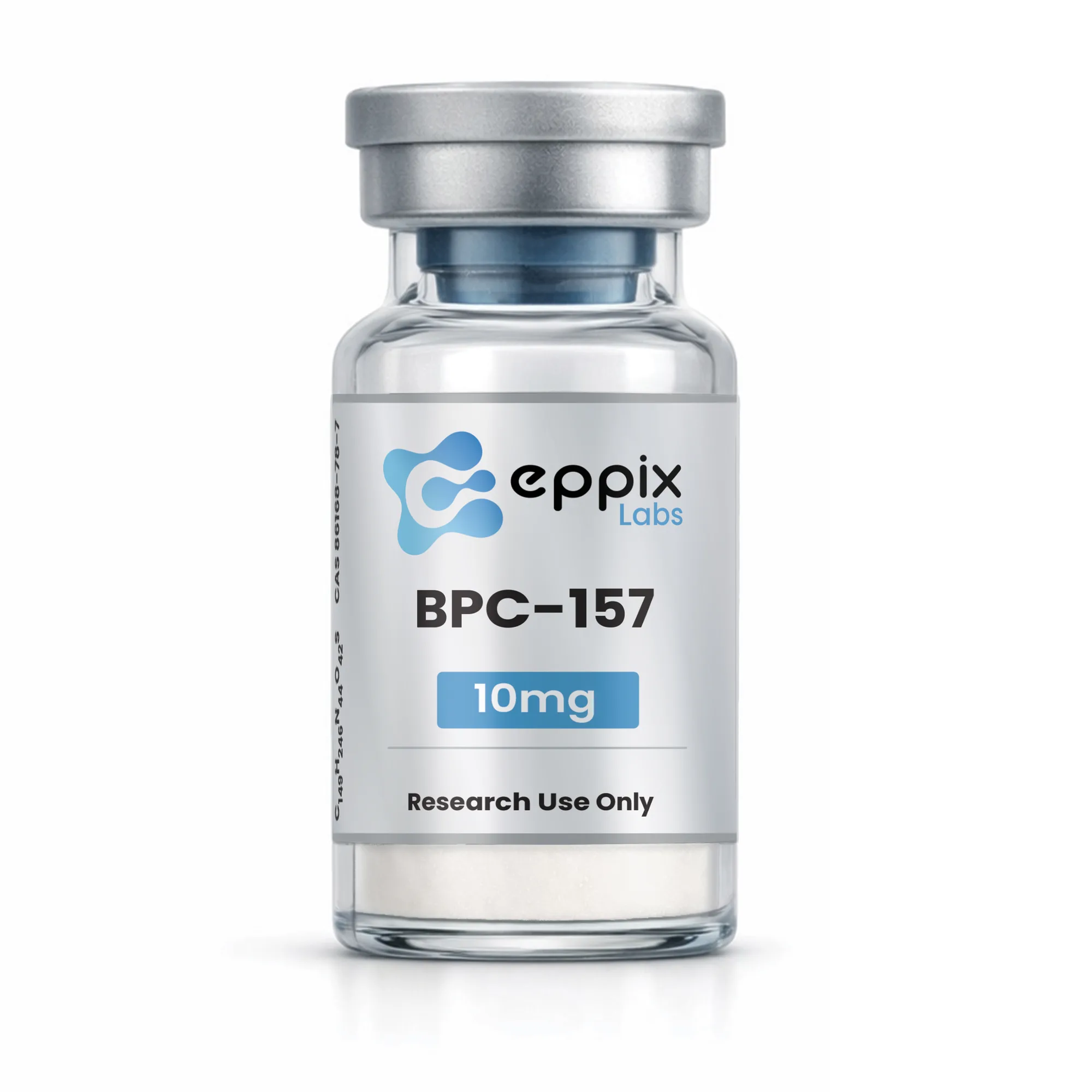
BPC-157 lyophilized research material as supplied by Eppix Labs. Labeled and measured content are stated on the certificate further down.

Step 2: Stock concentration (mg/mL)

Concentration (mg/mL) = peptide mass (mg) ÷ solvent volume (mL)

Example A. A BPC-157 vial's certificate reports a measured content of 5.0 mg, and you add 2.0 mL of solvent: 5.0 mg ÷ 2.0 mL = 2.5 mg/mL. That is the same as 2.5 µg/µL, a convenient form when pipetting.

Amino Acid Sequence
Amino Acid Sequence diagram
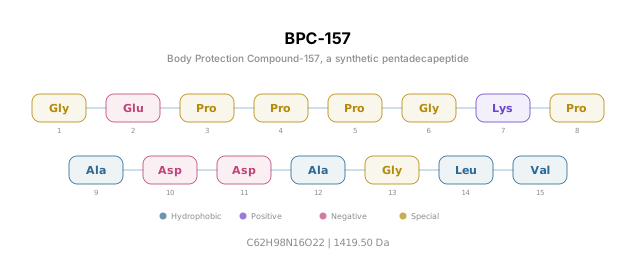
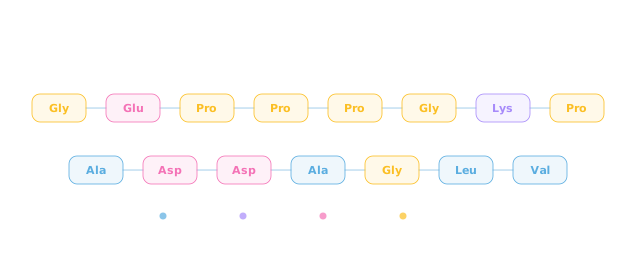
BPC-157: 15 residues, GEPPPGKPADDAGLV.
Chemical Structure
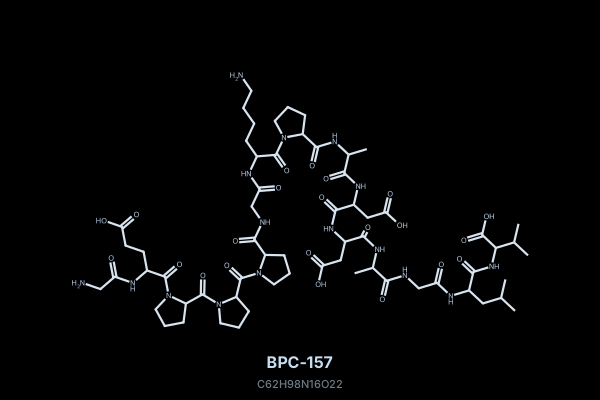
Chemical Structure diagram
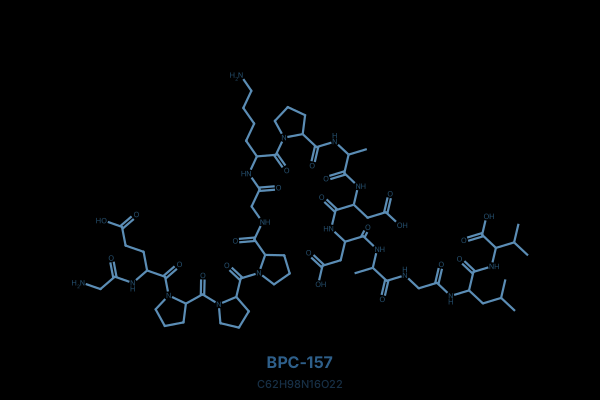
Chemical structure of BPC-157, C₆₂H₉₈N₁₆O₂₂, 1419.5 g/mol.

Step 3: Convert to molarity

Most assays are designed in molar terms. Use the molecular weight (MW) from the certificate or from PubChem,[1][2] and remember that 1 mg/mL = 1 g/L.

Molarity (M) = concentration (g/L) ÷ MW (g/mol)

Example A, continued. BPC-157 has a MW of 1419.5 g/mol.[1] 2.5 g/L ÷ 1419.5 g/mol = 0.001761 M = 1.76 mM.

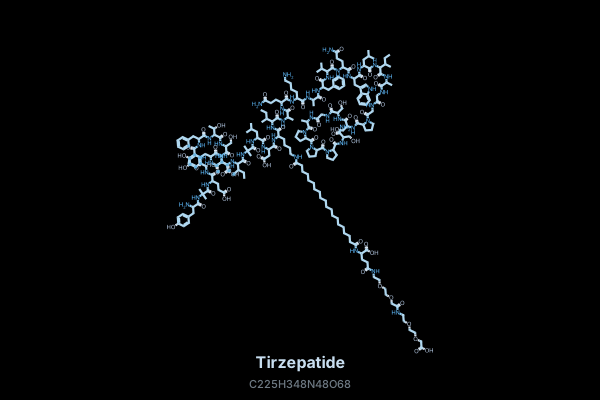
Example B. Tirzepatide has a MW of about 4813.5 g/mol.[2] With a measured content of 10.0 mg in 1.0 mL: 10.0 g/L ÷ 4813.5 g/mol = 0.002077 M = 2.08 mM.

A larger peptide gives a lower molarity at the same mass concentration. At 2.5 mg/mL, tirzepatide would be 2.5 ÷ 4813.5 × 1000 = 0.52 mM, against 1.76 mM for BPC-157. Comparing peptides at equal mg/mL is not comparing them at equal numbers of molecules.

Amino Acid Sequence
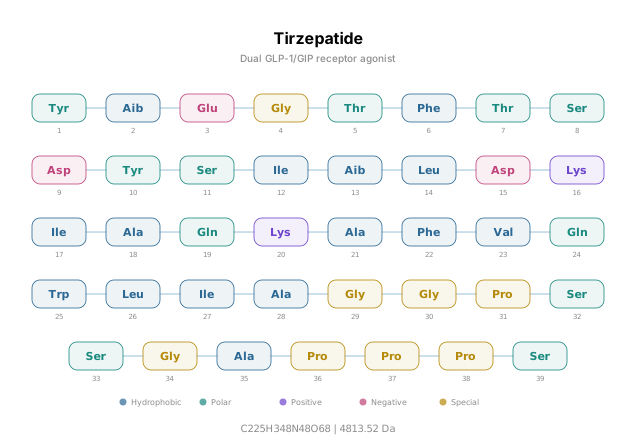
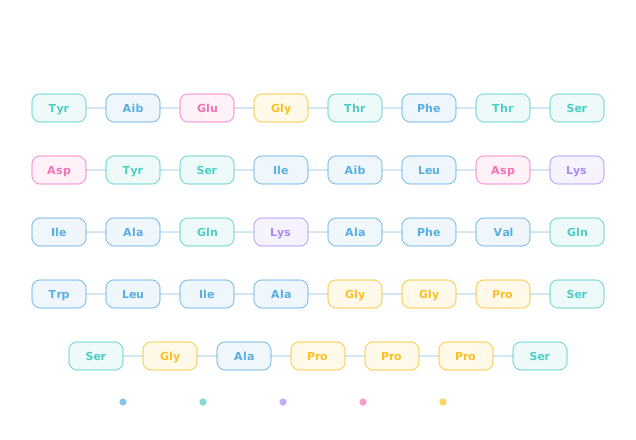
Amino Acid Sequence diagram
Tirzepatide sequence, the larger of the two example peptides.
Chemical Structure
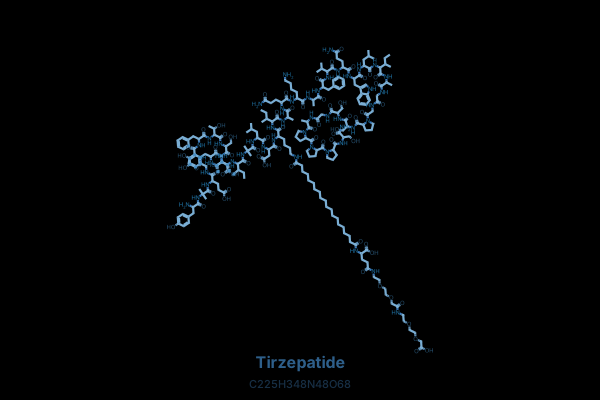
Chemical Structure diagram
Chemical structure of tirzepatide, C₂₂₅H₃₄₈N₄₈O₆₈, about 4813.5 g/mol.

Step 4: Working dilutions with C1V1 = C2V2

C1 × V1 = C2 × V2, where C1 is the stock concentration, V1 the volume of stock needed, C2 the target concentration and V2 the final volume.

Example C. You need 1.0 mL of 10 µM BPC-157 from the 1.76 mM (1,761 µM) stock: V1 = (10 µM × 1.0 mL) ÷ 1,761 µM = 0.00568 mL = 5.68 µL. Pipette 5.68 µL of stock into 994.3 µL of assay buffer.

For very small transfers (under about 2 µL), make an intermediate dilution first, because small-volume pipetting errors otherwise dominate. Applied to Example C, diluting the stock 1:10 (to 176.1 µM) turns the 5.68 µL transfer into 56.8 µL, made up to 1.0 mL with 943.2 µL of buffer.

Step 5: Plan aliquots

Example D. The 2.0 mL BPC-157 stock from Example A will be used across 20 experiments, each needing up to 80 µL of stock.

  • ·Aliquot size: 100 µL, which gives headroom over 80 µL.
  • ·Number: 2.0 mL ÷ 0.1 mL = 20 aliquots.
  • ·Storage: -20 °C or -80 °C. Thaw one per experiment and discard the remainder, since repeated freeze-thaw and time in solution both degrade peptides.[3]
  • ·Labels: peptide, batch ID, concentration (mg/mL and mM), solvent, date and initials on every aliquot.
  • ·Dead volume: in practice a little solution stays behind in the vial and pipette tips, so the twentieth aliquot can come up short. The aliquot planner in the peptide calculator subtracts dead volume per tube.

Step 6: Correct for content if you used the label mass

If you already prepared a stock from the label claim and later find that the measured content differs, correct it:

True concentration = nominal concentration × (measured content ÷ label claim)

A stock made up as "5.0 mg/mL" from a "10 mg" vial (that is, in 2.0 mL) that actually measured 9.6 mg is 5.0 × (9.6 ÷ 10) = 5.0 × 0.96 = 4.8 mg/mL. The post on HPLC purity vs net peptide content explains why the label and the measured content differ.

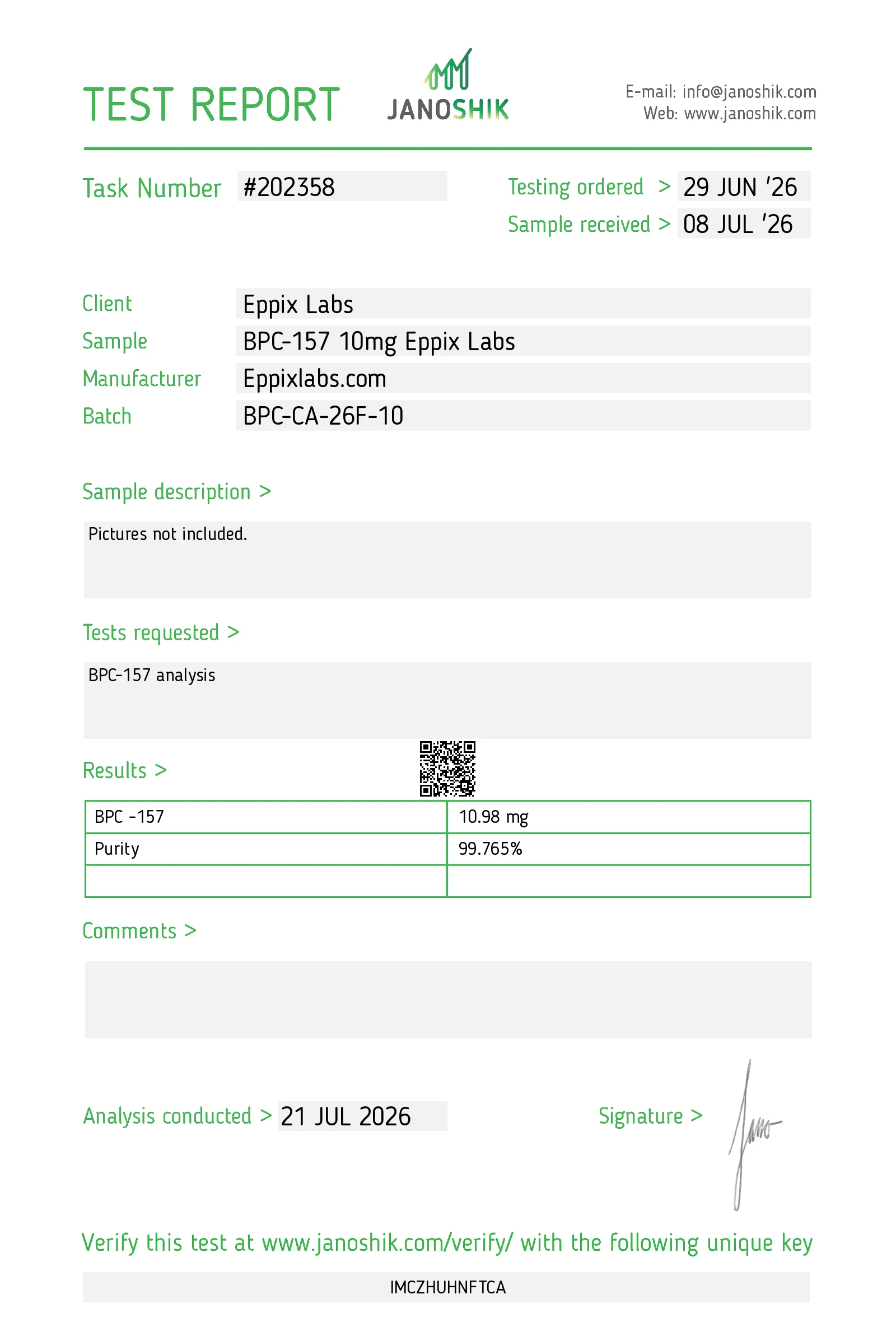
Published Certificate
Certificate of analysis for BPC-157 10mg, batch BPC-CA-25L-01, 99.765% purity, 10.98 mg measured content

Select strength

Batch
BPC-CA-25L-01
Purity (HPLC)
99.765%
Measured content
10.98 mglabeled 10 mg
Laboratory
Janoshik
Published certificate for the current BPC-157 lots. The measured-content line is the figure Step 2 starts from; the examples above use illustrative values, not this lot's.

Frequently Asked

Should I use the free-base or salt MW?

Use the MW that matches how content was measured. Certificates typically report peptide content as free peptide, so use the free-peptide MW for molarity. The peptide calculator uses free-peptide molecular weights for its built-in compounds.

Why do my results drift over weeks?

Repeated freeze-thaw and solution-phase degradation are common causes. Aliquot, and record dates. See shipping and storage.

Does the Peptide Calculator handle molarity?

Yes. It has five connected tools: stock concentration, mg to mM molarity, working dilution and serial series (C1V1 = C2V2), an aliquot split and cold-storage planner, and a sequence tool that estimates molecular weight, pI and hydropathy.

References

  1. National Center for Biotechnology Information (2026). PubChem Compound Summary for CID 9941957, BPC-157 (molecular weight 1419.5 g/mol). PubChem. Source
  2. National Center for Biotechnology Information (2026). PubChem Compound Summary for CID 156588324, Tirzepatide (C₂₂₅H₃₄₈N₄₈O₆₈). PubChem. Source
  3. Manning, M.C., Chou, D.K., Murphy, B.M., Payne, R.W., Katayama, D.S. (2010). Stability of protein pharmaceuticals: an update. Pharm Res 27(4):544-575. PMID 20143256

Research Use Only

This article summarizes published preclinical research literature. Compounds referenced are supplied by Eppix Labs strictly as research materials for laboratory investigation within the United States. They are not approved by the FDA for human or veterinary use, and nothing on this page should be interpreted as medical advice or guidance on human or animal administration.