Lyophilized peptides are shipped dry for a reason: without water, most of the chemistry that degrades them slows to a crawl. That makes a short courier trip at ambient temperature a non-event for most sequences. A long one through a summer sorting hub, or a box left on a porch in July, is a different question.
This guide covers why freeze-dried material travels well, where the US-specific risks sit, and a receiving and storage protocol for the lab. Every compound mentioned is supplied for laboratory research use only. Nothing below is dosing, medical or legal guidance.
Key takeaways
·Lyophilized (freeze-dried) peptides are far more stable than peptides in solution, because most degradation pathways need water.[1]
·Short transit at ambient temperature is generally tolerated by lyophilized material. The bigger risks are prolonged heat, moisture and repeated temperature cycling.
·Shorter transit is the simplest protection. Eppix ships domestic US orders by FedEx, typically arriving in 1 to 3 business days, and orders confirmed before the daily cut-off are dispatched the same business day.
·On arrival, inspect, log, and move vials to the right storage condition the same day.
Why lyophilized peptides travel well
Peptides degrade through a handful of well-characterized chemical routes: hydrolysis of the backbone, deamidation of asparagine and glutamine, oxidation of methionine, cysteine and tryptophan, and aggregation.[1] Most of these reactions are accelerated by water and heat.
Lyophilization removes nearly all water, which slows these reactions considerably. That is why freeze-dried peptides are the standard format for reagent distribution, and why they can usually tolerate the ambient temperatures of a short courier trip.
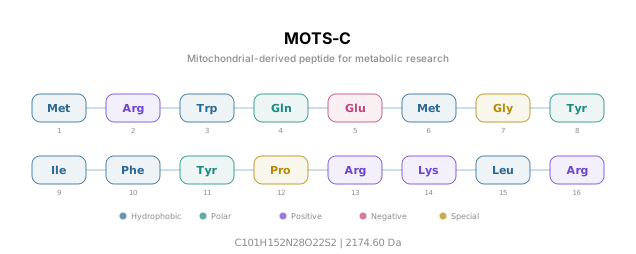
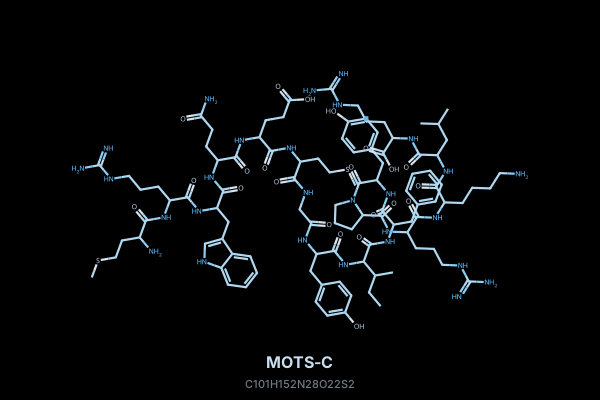
"Usually" is doing work in that sentence. Stability depends on the sequence. Peptides rich in methionine or cysteine are more oxidation-prone, and sequences with Asn-Gly motifs deamidate more readily.[2] MOTS-c, drawn below, carries two methionines and a tryptophan in sixteen residues. When in doubt, treat the material conservatively.
Research Material
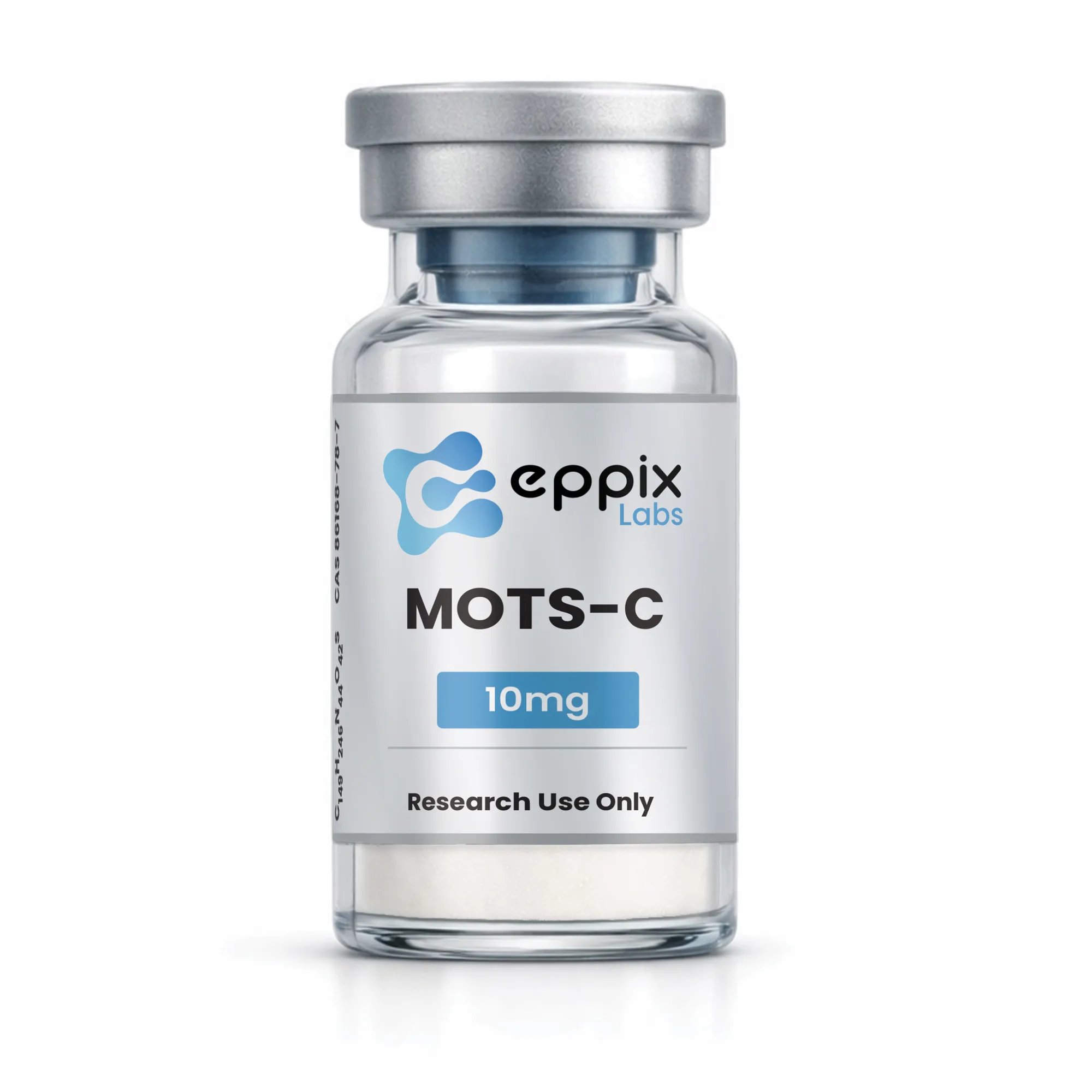
MOTS-c lyophilized research material as supplied by Eppix Labs, sealed and labeled with its lot code.Amino Acid Sequence
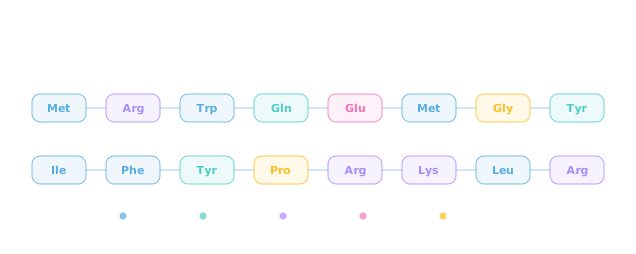
MOTS-c sequence, MRWQEMGYIFYPRKLR: methionine at positions 1 and 6, tryptophan at position 3.Chemical Structure
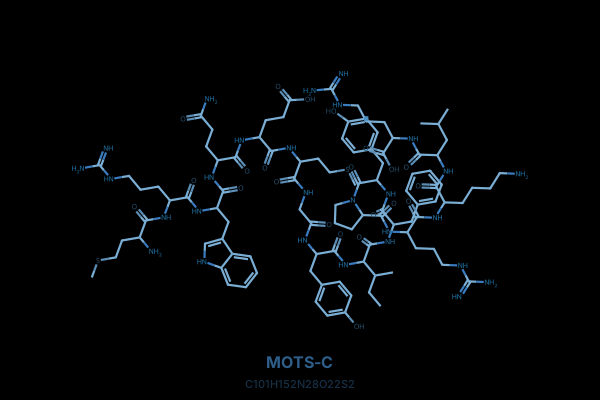
Chemical structure of MOTS-c, C₁₀₁H₁₅₂N₂₈O₂₂S₂.
The US-specific problem: distance and summer heat
The continental US spans several climate zones, and a parcel can pass through a hot sorting hub even when both origin and destination are mild. In summer, the inside of a delivery vehicle or a porch-side mailbox can get far hotter than the air temperature.
Three practical controls reduce that exposure:
·Fewer days in transit. Every extra day is another cycle of daytime heating, and a one-to-three-business-day service keeps that window short.
·Ship early in the week. Orders that would otherwise sit in a depot over a weekend gain avoidable heat days. Eppix processes orders Monday to Friday, excluding US federal holidays.
·Receive promptly. Arrange delivery to a staffed lab or receiving dock rather than an unattended location.
Receiving protocol for research labs
When a shipment arrives:
·Inspect the outer package for damage or moisture.
·Inspect each vial. The lyophilized cake should be intact or a dry powder. A collapsed, glassy or sticky appearance can indicate moisture exposure; note it before use.
·Check the seal and the crimp cap.
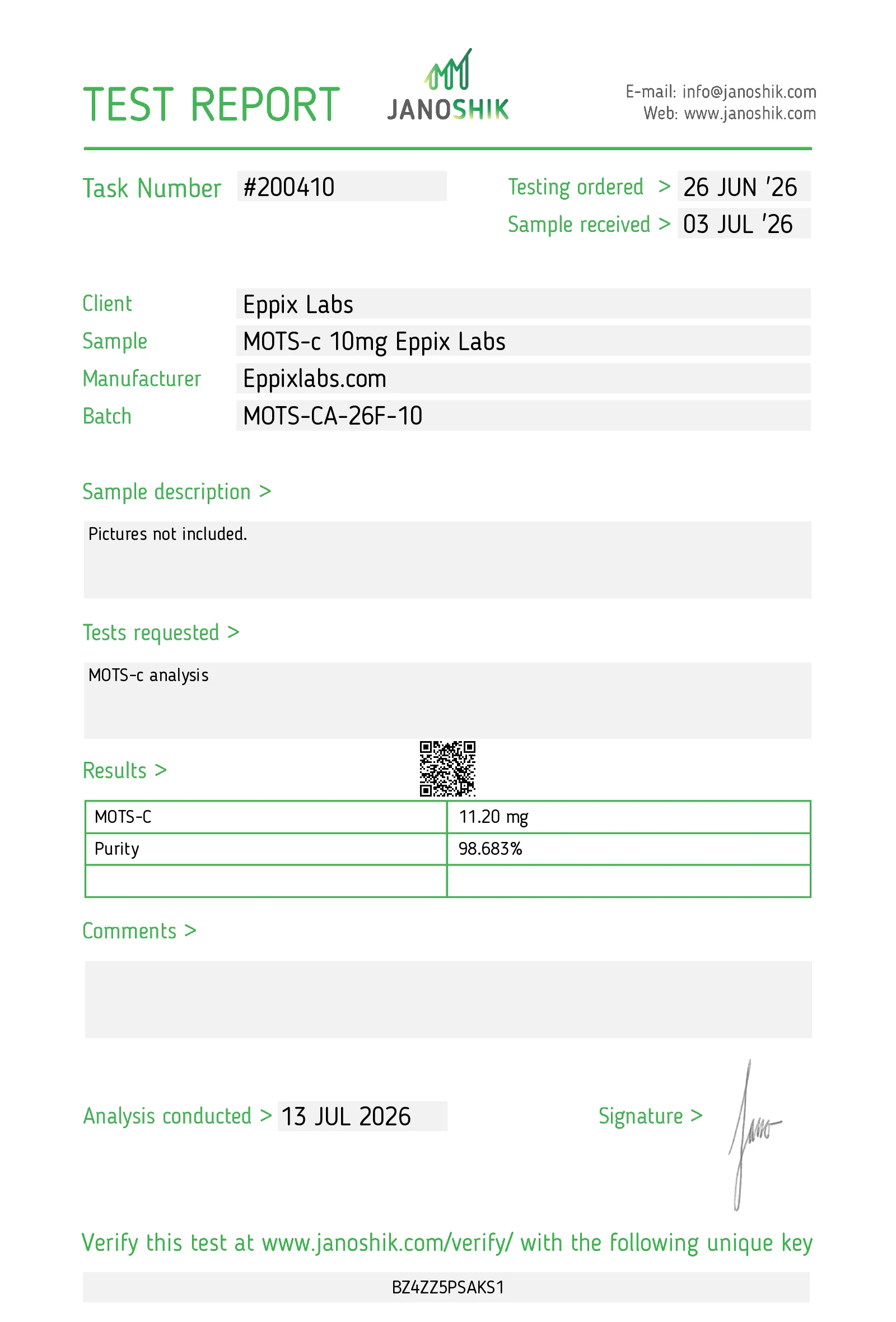
·Record the lot code printed on the vial label and match it to the published certificate on the certificates of analysis page, or enter it in the batch lookup.
·If the vials were refrigerated, let them reach room temperature before opening. Opening a cold vial pulls in humid air, and the moisture condenses on the powder.
·Move the vials to storage the same day.
Storage: lyophilized material
By horizon, the typical conditions are below. The chemistry behind each rule, and which sequences tolerate least, is in the peptide storage guide.
·Days to a few weeks: refrigerated, 2 to 8 °C. Keep sealed and dry.
·Months or longer: frozen, -20 °C or below. Avoid frost-free freezers, which cycle temperature.
·Always: protected from light and humidity. A desiccant in a secondary container helps.
Storage: reconstituted solutions
Once a peptide is dissolved, the stability clock speeds up.[1] The peptide calculator handles stock concentration, dilution and aliquot planning, and the reconstitution math guide works through examples.
General lab practice:
·Use a sterile solvent appropriate to the peptide and the assay.
·Aliquot immediately into single-use volumes, so the stock is not repeatedly warmed and cooled.
·Refrigerate short-term aliquots (2 to 8 °C) and freeze longer-term aliquots (-20 °C or -80 °C).
·Avoid repeated freeze-thaw, which promotes aggregation.[1]
·Label every aliquot with peptide, concentration, solvent, date and batch ID.
What we do on our side
Delivery terms in full are on the shipping page. In short:
·Every lot is tested by Janoshik Analytical before sale, and its certificate is published under the lot code printed on the vial label.
·Vials ship sealed, labeled and dry, in discreet, neutral outer packaging.
·Domestic US orders ship by FedEx, typically arriving in 1 to 3 business days. Orders confirmed before the daily cut-off are dispatched the same business day.
·Free shipping on US orders over $200 USD. Shipping is domestic US only.
·Support is at hello@eppixlabs.com, answered Monday to Friday, 9am to 5pm Mountain Time.
Do lyophilized peptides need ice packs for shipping?
For short transit, lyophilized peptides are generally shipped at ambient temperature. Minimizing transit time matters more than ice packs, which can cause condensation as they thaw.
How long can a reconstituted peptide be kept?
It depends on the sequence, the solvent and the storage temperature. Aliquot and freeze anything beyond short-term use, and avoid repeated freeze-thaw.
My vial arrived warm. Is it usable?
A short warm exposure is usually tolerated by lyophilized material. If the cake looks collapsed or wet, contact hello@eppixlabs.com with your order number and the lot code from the vial label.
References
Manning, M.C., Chou, D.K., Murphy, B.M., Payne, R.W., Katayama, D.S. (2010). Stability of protein pharmaceuticals: an update. Pharm Res 27(4):544-575. PMID 20143256
Geiger, T., Clarke, S. (1987). Deamidation, isomerization, and racemization at asparaginyl and aspartyl residues in peptides. Succinimide-linked reactions that contribute to protein degradation. J Biol Chem 262(2):785-794. PMID 3805008
This article summarizes published preclinical research literature. Compounds referenced are supplied by Eppix Labs strictly as research materials for laboratory investigation within the United States. They are not approved by the FDA for human or veterinary use, and nothing on this page should be interpreted as medical advice or guidance on human or animal administration.