✦FedEx Delivery1–3 day delivery across the U.S.Free on orders over $200

Verification Guide

How to Read a Janoshik Certificate of Analysis: A Line-by-Line Guide for US Labs

Eight fields read top to bottom, and the six red flags that should stop a lab from using a lot

·By Adam Reeves · Research Editor, Eppix Labs

A Janoshik report fits on one page, and most readers look at one number on it. The rest of the page is what decides whether that number describes the material in your vial: the sample line, the batch, the date, the content figure, and the identifiers that let the report be checked at the laboratory rather than taken from the seller.

This guide reads a report field by field, then lists the red flags and the record-keeping habits worth building around it. Every compound mentioned is supplied for laboratory research use only. Nothing below is dosing, medical or legal guidance.

Key takeaways

  • ·A useful COA ties one specific batch to one specific test, and reports identity, purity and quantity.
  • ·Janoshik Analytical is an independent laboratory. Its reports can be checked against the laboratory's own records, so a buyer does not have to rely on the seller's copy.
  • ·The two numbers most buyers look at, purity and content, measure different things. Read both.
  • ·Red flags: no batch ID, a test date older than the lot, a sample name that does not match the product, or a report that cannot be verified.
Why third-party testing matters in the US RUO market

No federal quality standard governs what goes into a research-use-only peptide vial. A supplier's in-house certificate is a claim; an independent laboratory's report is evidence. That distinction is why Eppix Labs sends every lot to an independent laboratory before it is sold (Janoshik Analytical for most lots, and each certificate names the laboratory that issued it), and publishes each report on the certificates of analysis page.

How the laboratory works, and why its reports can be checked at the source, is covered in Janoshik testing explained. This guide is narrower: one report, read from the top.

Research Material
General Image
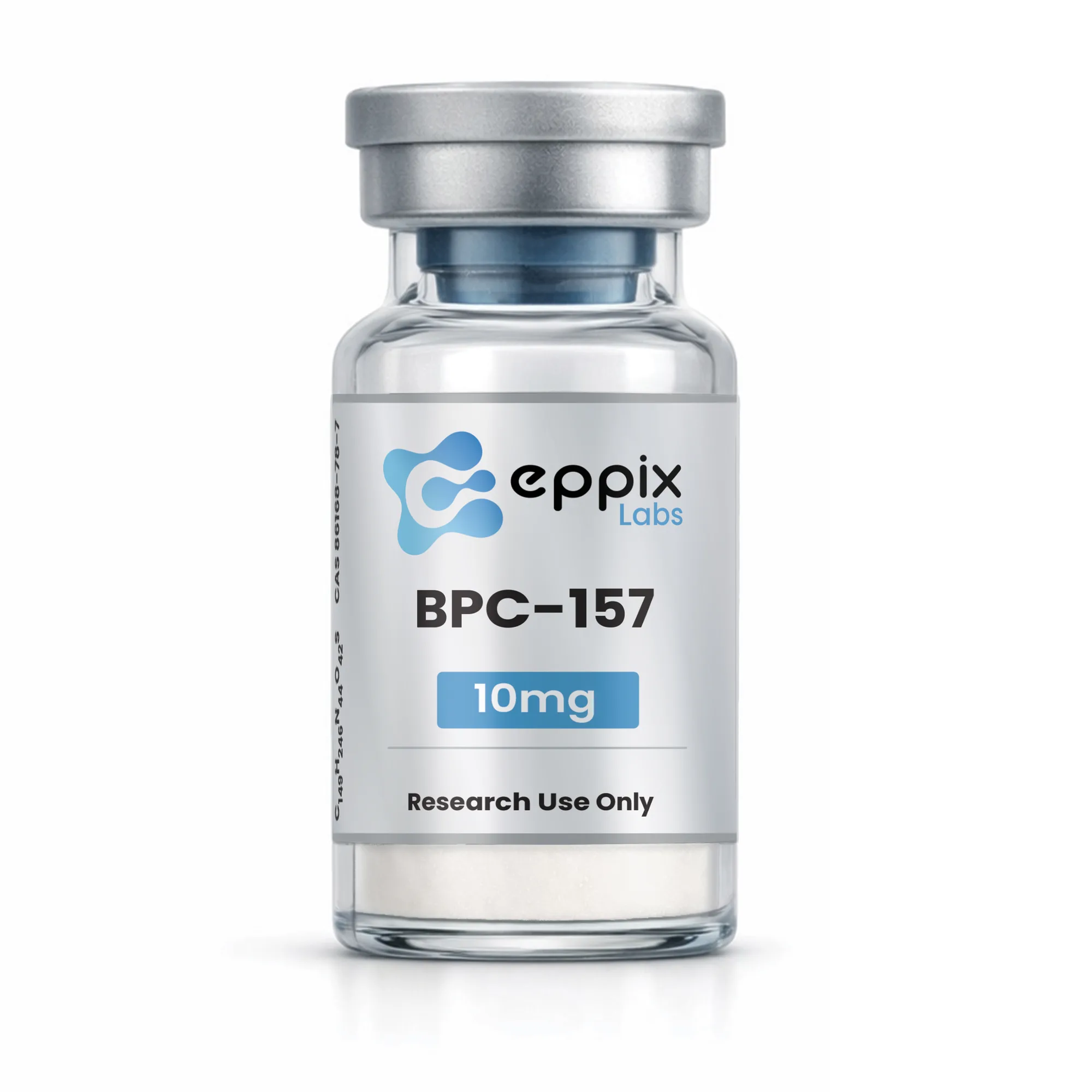
BPC-157 lyophilized research material as supplied by Eppix Labs. The lot code printed on the vial label is where every check below starts.

Anatomy of a Janoshik report

Field names vary slightly between report formats, but a peptide report generally carries the following.

  • ·1. Sample. The product as submitted, including the compound and labeled amount. For Eppix lots it reads as compound, strength and client, for example "BPC-157 10mg Eppix Labs". Check that the compound and amount match the vial in front of you.
  • ·2. Client and manufacturer. Who submitted the sample.
  • ·3. Batch. The lot identifier. It must match the lot code printed on your vial label. A certificate without a batch number cannot be tied to your vial.
  • ·4. Test date and task number. When the analysis ran, and the laboratory's internal job reference. The task number is what makes independent verification possible.
  • ·5. Purity (HPLC). The percentage of the UV-absorbing material that elutes as the main peptide peak. A result of 99.2% means 99.2% of the detected peak area is the target peptide. It does not mean the vial is 99.2% peptide by weight; see HPLC purity vs net peptide content.
  • ·6. Content (quantity). The measured mass of peptide in the vial, reported against the label claim. A 10 mg vial measuring 10.4 mg is slightly overfilled; one measuring 8.1 mg is underfilled by about 19%.
  • ·7. Identity. Confirmation that the main peak is the intended molecule, typically by mass spectrometry matching the expected molecular weight listed in PubChem.[2]
  • ·8. Verification. Janoshik reports carry identifiers that let anyone confirm the report on the laboratory's own website. Use that check rather than trusting a screenshot.[1]

Example: what a clean result looks like

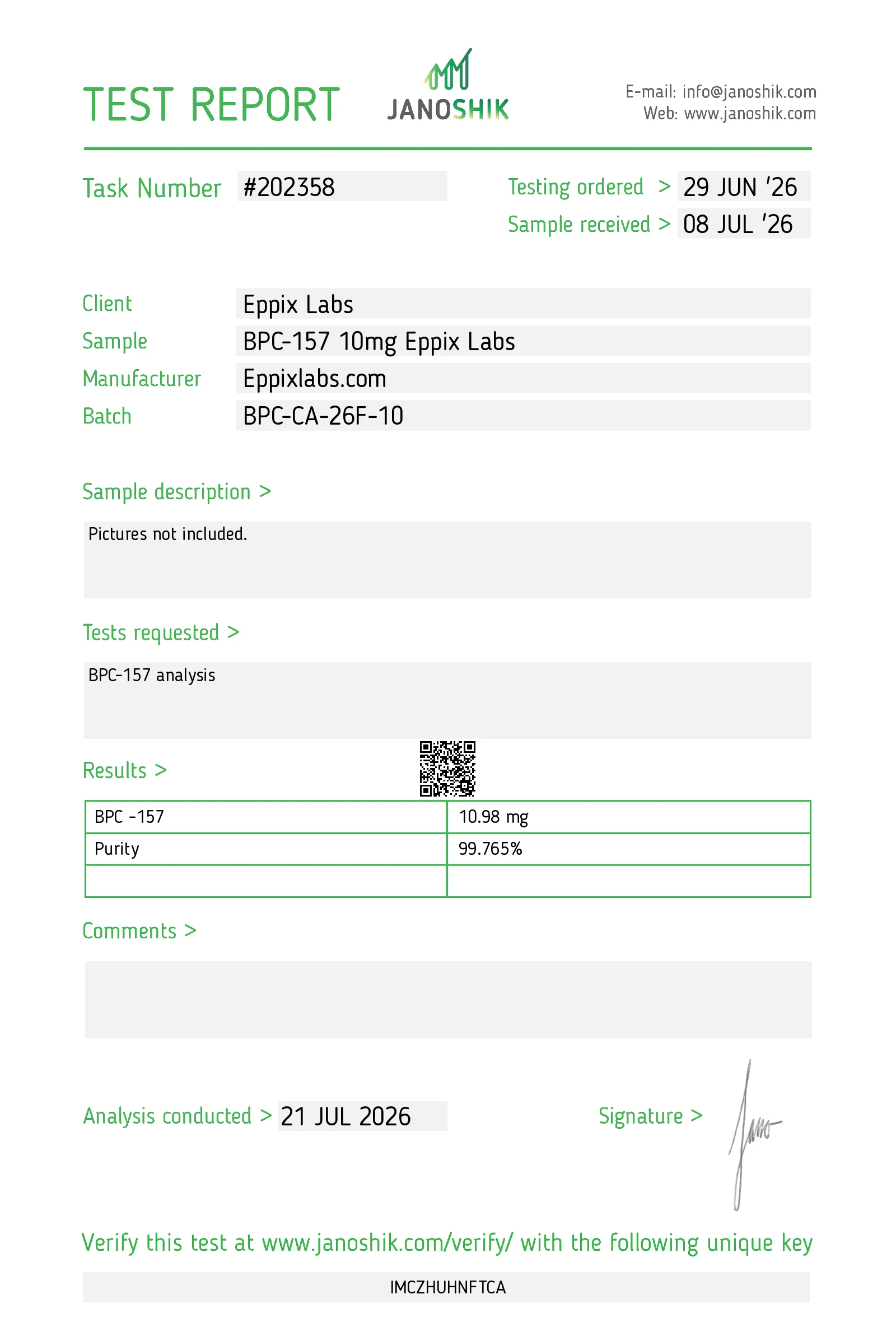
The certificate below is a live one: the current BPC-157 report, exactly as published, with its batch, purity and measured content shown underneath. Read it against this checklist.

  • ·Sample: BPC-157 at the labeled strength, Eppix Labs. Check that it matches your vial.
  • ·Batch: check that it matches the lot code on your vial label.
  • ·Test date: check that it is not older than the lot.
  • ·HPLC purity: read it together with measured content, and judge it against what your protocol specifies.
  • ·Measured content: check that it sits close to the label claim, then use it in your concentration arithmetic.
  • ·Identity (MS): consistent with the expected molecular weight, which for BPC-157 is 1419.5 g/mol in PubChem.[2]
  • ·Verification: check that the report resolves on Janoshik's own site, independently of ours.
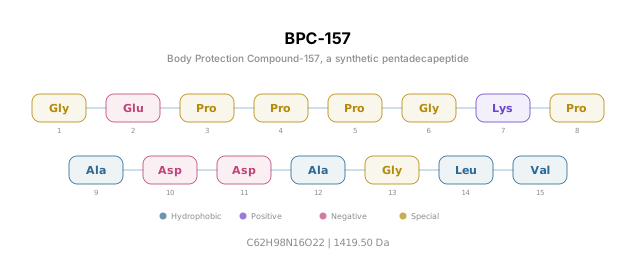
Amino Acid Sequence
Amino Acid Sequence diagram
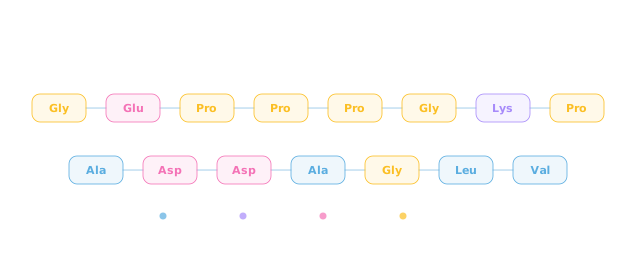
BPC-157: 15 residues, GEPPPGKPADDAGLV.
Chemical Structure
Chemical Structure diagram
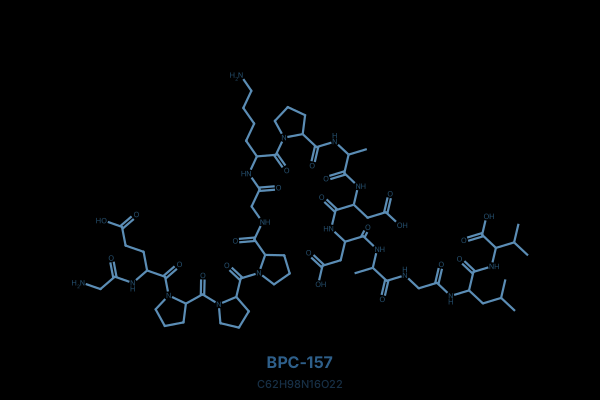
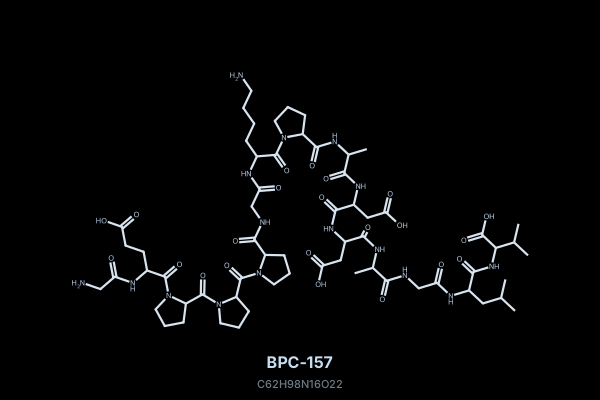
Chemical structure of BPC-157, C₆₂H₉₈N₁₆O₂₂.
Published Certificate
Certificate of analysis for BPC-157 10mg, batch BPC-CA-25L-01, 99.765% purity, 10.98 mg measured content

Select strength

Batch
BPC-CA-25L-01
Purity (HPLC)
99.765%
Measured content
10.98 mglabeled 10 mg
Laboratory
Janoshik
Current published BPC-157 certificate, by strength. Batch, HPLC purity and measured content are read from the report itself.

Red flags

Any one of these is reason to hold a lot back from use until it is resolved. Forgery patterns are covered in more depth in how to spot a fake COA.

  • ·No batch number, or a batch number that does not match the vial label.
  • ·One certificate reused across many lots. Purity and content vary from batch to batch.
  • ·A sample name that does not match: a different compound, amount or supplier name.
  • ·A report that cannot be verified with the issuing laboratory.
  • ·Purity only, with no content. A 99% pure vial can still be badly underfilled.
  • ·A document that looks edited: inconsistent fonts, misaligned fields, or numbers that do not add up.

Frequently Asked

Is a 98% purity result acceptable?

It depends on the research model and what your protocol specifies. Most Eppix lots measure above 99%. When an occasional lot comes back around 98%, it is published as the laboratory reported it rather than left out, so the certificate always shows the real figure to judge.

Why does my vial's measured content differ from the label?

Filling small masses of lyophilized peptide has inherent variability. The measured content tells you the actual amount, and it is the figure to use in concentration calculations.

Does Janoshik test for endotoxin?

Only when that test is commissioned. Endotoxin is a separate assay from purity and identity. Eppix orders endotoxin, heavy-metals and sterility screens on lots picked at random as quality control; where a lot was screened, the result is published with that lot's report, and a lot with no result was not screened. See the endotoxin testing guide.

References

  1. Janoshik Analytical (2026). Public test verification. janoshik.com. Source
  2. National Center for Biotechnology Information (2026). PubChem compound database (reference molecular weights). PubChem. Source

Research Use Only

This article summarizes published preclinical research literature. Compounds referenced are supplied by Eppix Labs strictly as research materials for laboratory investigation within the United States. They are not approved by the FDA for human or veterinary use, and nothing on this page should be interpreted as medical advice or guidance on human or animal administration.