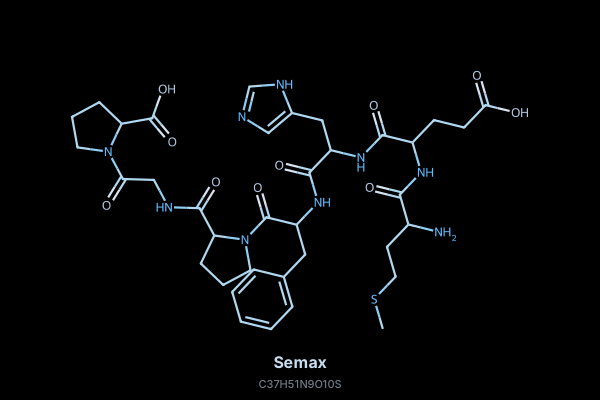
Semax was among the twelve peptides removed from the FDA's Category 2 list in April 2026.[4] Removal from Category 2 did not, by itself, confer any compounding status.[3]
On 23 and 24 July 2026 the FDA's Pharmacy Compounding Advisory Committee reviewed Semax (free base and acetate) for inclusion on the Section 503A Bulk Drug Substances List, alongside BPC-157, KPV, TB-500, MOTS-c, Epitalon and Semax. FDA staff had recommended against inclusion for every substance under review, citing insufficient characterization, little or no human effectiveness evidence, and inadequate human safety data. The committee voted in favor anyway. The vote was 8 in favor, 5 against, 1 abstention.[3][5][6]
Semax was heard on the second day of the meeting, 24 July.[3] It remains unapproved for any use in the US, it does not appear in 21 CFR 216.23,[7] and the FDA would still have to complete rulemaking before anything changed for compounding pharmacies. Our PCAC breakdown covers all seven substances reviewed, and the April 2026 Category 2 removals have their own post. What the vote does not do:
- ·It is non-binding. The committee advises, it does not decide. No final FDA determination has been issued and none of the six peptides appears in 21 CFR 216.23.
- ·It requires a further step. Addition to the 503A Bulks List requires formal action by the Secretary of Health and Human Services, which had not occurred as of publication.
- ·It does not make the compound an FDA-approved drug, and it establishes nothing about efficacy.
- ·It does not legitimize research-chemical retail. A compounding-list decision concerns licensed pharmacists preparing patient-specific prescriptions under Section 503A, which is a different channel entirely from research material sold in vials.