✦FedEx Delivery1–3 day delivery across the U.S.Free on orders over $200

Compound Overview

GHK-Cu Research: Copper Complexation, Gene-Expression Data and the US Route Question

A copper-binding tripeptide with a long skin and wound literature, a large gene-expression dataset, and a US status that depends on the route

·By Adam Reeves · Research Editor, Eppix Labs

GHK-Cu is three amino acids and a copper ion, and it has been studied for roughly fifty years. That history spans plasma biochemistry, wound and skin models, cosmetic chemistry and, more recently, large-scale gene-expression analysis. It also leaves GHK-Cu in an unusual position in the US, where the same molecule is a familiar cosmetic ingredient on one route and an unresolved compounding question on another.

GHK-Cu is supplied for laboratory research use only. Nothing below is dosing, medical or legal guidance.

Chemical Identity

Name
GHK-Cu (glycyl-L-histidyl-L-lysine copper(II))
Also known as
GHK-Cu, Copper peptide, Cu-GHK, Copper tripeptide-1
Molecular formula
C₁₄H₂₃CuN₆O₄
Molecular weight
402.92 g/mol (copper complex); 340.38 g/mol (free GHK peptide)
CAS number
89030-95-5
Sequence (1-letter)
GHK
Sequence (3-letter)
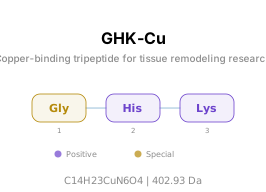
Gly-His-Lys
Salt forms
Copper(II) complex · Acetate (free peptide)

Key takeaways

  • ·GHK is the tripeptide glycyl-L-histidyl-L-lysine. It binds copper(II) with high affinity to form GHK-Cu.[1]
  • ·It was first isolated from human plasma, and much of its research concerns skin, wound and connective-tissue models.[1]
  • ·Gene-expression analyses have reported that GHK influences the expression of a large number of human genes, which has driven interest beyond cosmetics.[1]
  • ·In the US, GHK-Cu's status depends on route. Injectable GHK-Cu was among the twelve peptides removed from FDA Category 2 in April 2026 and is still awaiting PCAC review.[2]
Chemistry

GHK-Cu is blue in solution and as a powder, and the color is a quick visual check: copper-free GHK is white. Color intensity alone, however, does not confirm the copper-to-peptide ratio, which is a quality question worth asking a supplier. Why that ratio matters when comparing vials is covered in GHK-Cu in the US.

The identity data for the peptide and its copper complex:

  • ·Sequence. Gly-His-Lys.
  • ·Length. 3 residues.
  • ·Molecular weight. 340.38 g/mol for free GHK; 402.92 g/mol for the copper complex, C₁₄H₂₃CuN₆O₄.
  • ·Complex. Cu(II) coordinated by the glycine amine, the histidine imidazole and a backbone nitrogen.
  • ·Appearance. Blue for GHK-Cu; white for copper-free GHK.
Research Material
General Image
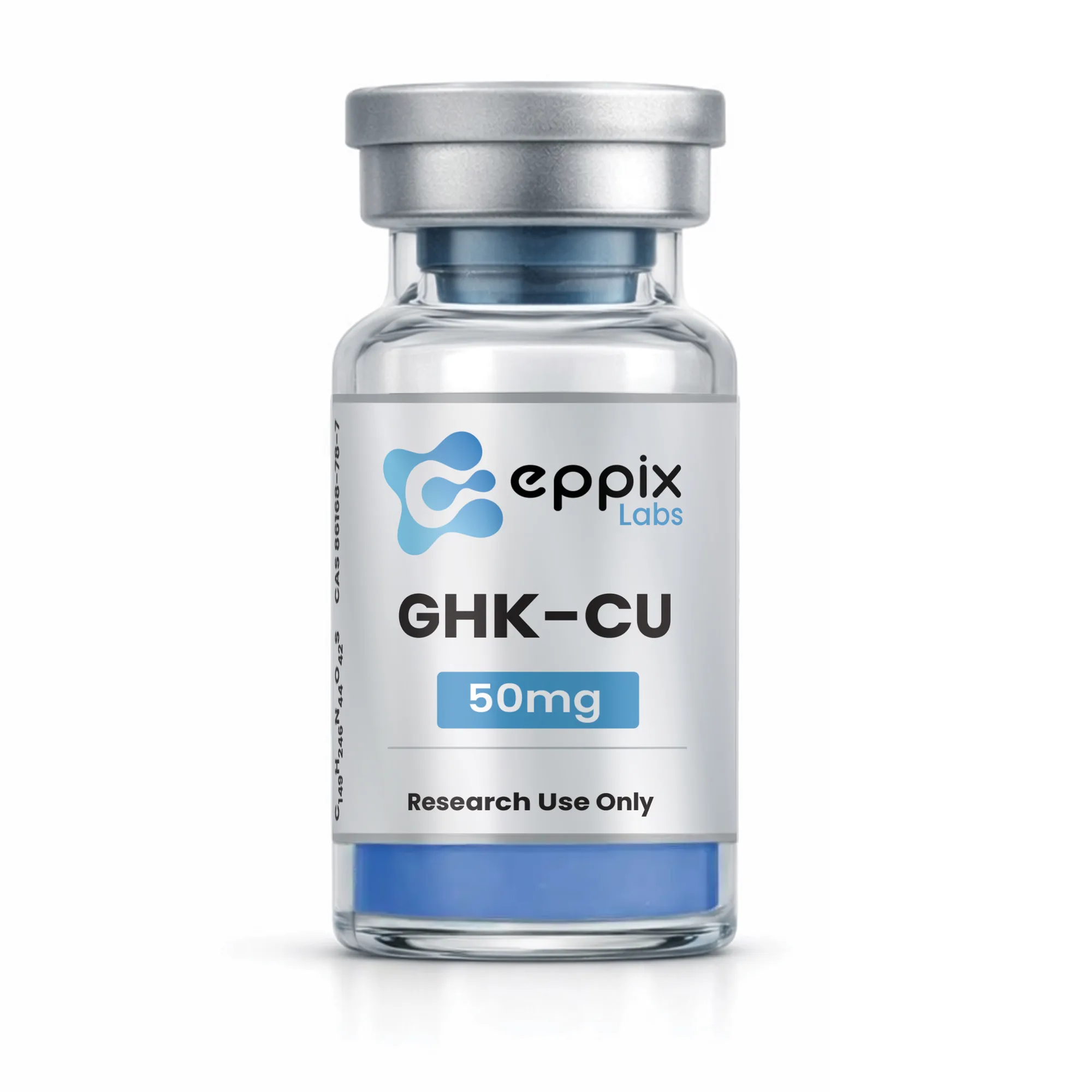
GHK-Cu lyophilized research material as supplied by Eppix Labs. Labeled and measured content are stated on the certificate further down this page.
Amino Acid Sequence
Amino Acid Sequence diagram
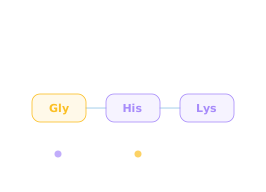
Amino-acid sequence of GHK, Gly-His-Lys.
Chemical Structure
Chemical Structure diagram
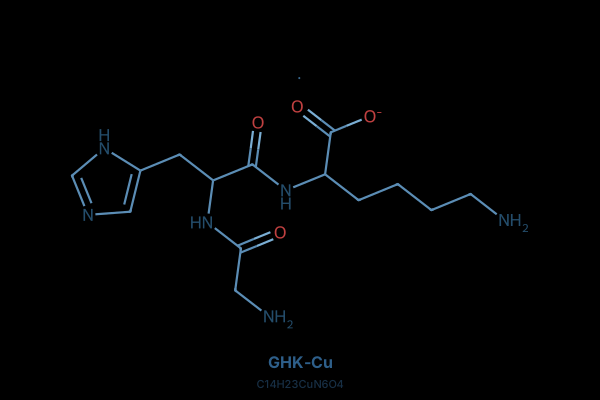
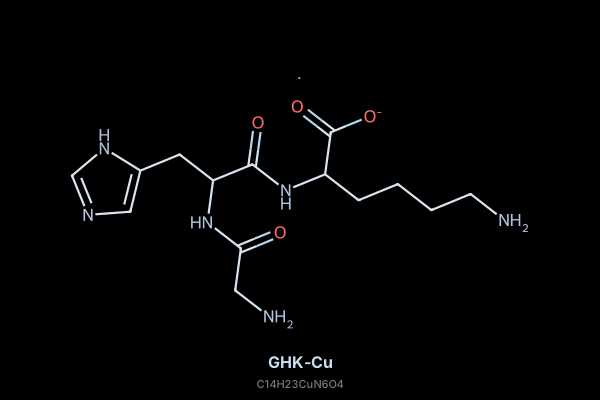
Chemical structure of the GHK-Cu tripeptide-copper(II) complex.

Research history

Pickart first described GHK in the 1970s as a factor in human serum affecting liver cell behavior.[3] Subsequent work focused on copper delivery, tissue remodeling and wound models. The 2018 review by Pickart and Margolina in the International Journal of Molecular Sciences summarizes that history and the newer gene data.[1]

Major research areas:

  • ·Extracellular matrix. Collagen, elastin and glycosaminoglycan synthesis in fibroblast models; regulation of matrix metalloproteinases and their inhibitors.
  • ·Wound models. Animal wound-healing studies.
  • ·Antioxidant and anti-inflammatory signaling. Reported effects on oxidative-stress and inflammatory pathways in cell models.
  • ·Gene expression. Using the Broad Institute's Connectivity Map, researchers reported that GHK shifts the expression of many genes, in directions they interpreted as consistent with tissue repair.[1] These findings are hypothesis-generating: Connectivity Map data come from cultured cell lines at defined concentrations, and do not by themselves show effects in tissue.

Why the route matters in the US

Topical GHK-Cu has been used for years as a cosmetic ingredient. Cosmetics are regulated differently from drugs in the US, and the FDA's Category 2 listing specifically concerned injectable GHK-Cu as a bulk drug substance for compounding; GHK-Cu for non-injectable routes sat in Category 1.[2]

In April 2026 the FDA removed injectable GHK-Cu from Category 2, and non-injectable GHK-Cu from Category 1, after both nominations were withdrawn.[2] Injectable GHK-Cu is one of the five removed peptides not reviewed at the July 2026 PCAC meeting; it was slated for separate review before the end of February 2027.[2][4] Until then, its compounding status is unresolved. For research reagents, none of this changes the intended-use standard covered in our RUO explainer.

Practical notes for in vitro work

  • ·Copper controls matter. Include a copper-salt control at matched copper concentration, and a copper-free GHK control, to separate peptide effects from copper effects.
  • ·Mind the medium. Serum albumin and other copper-binding components in culture medium compete for copper.
  • ·Record the copper ratio if your supplier reports it, alongside purity and content.

Eppix Labs batch data

Each GHK-Cu lot is tested by Janoshik Analytical before sale, and the certificate is published as the laboratory reported it, verifiable on Janoshik's own site. Batch, HPLC purity and measured content are read live from the batch record below. Every lot is listed on the certificates of analysis page.

Published Certificate
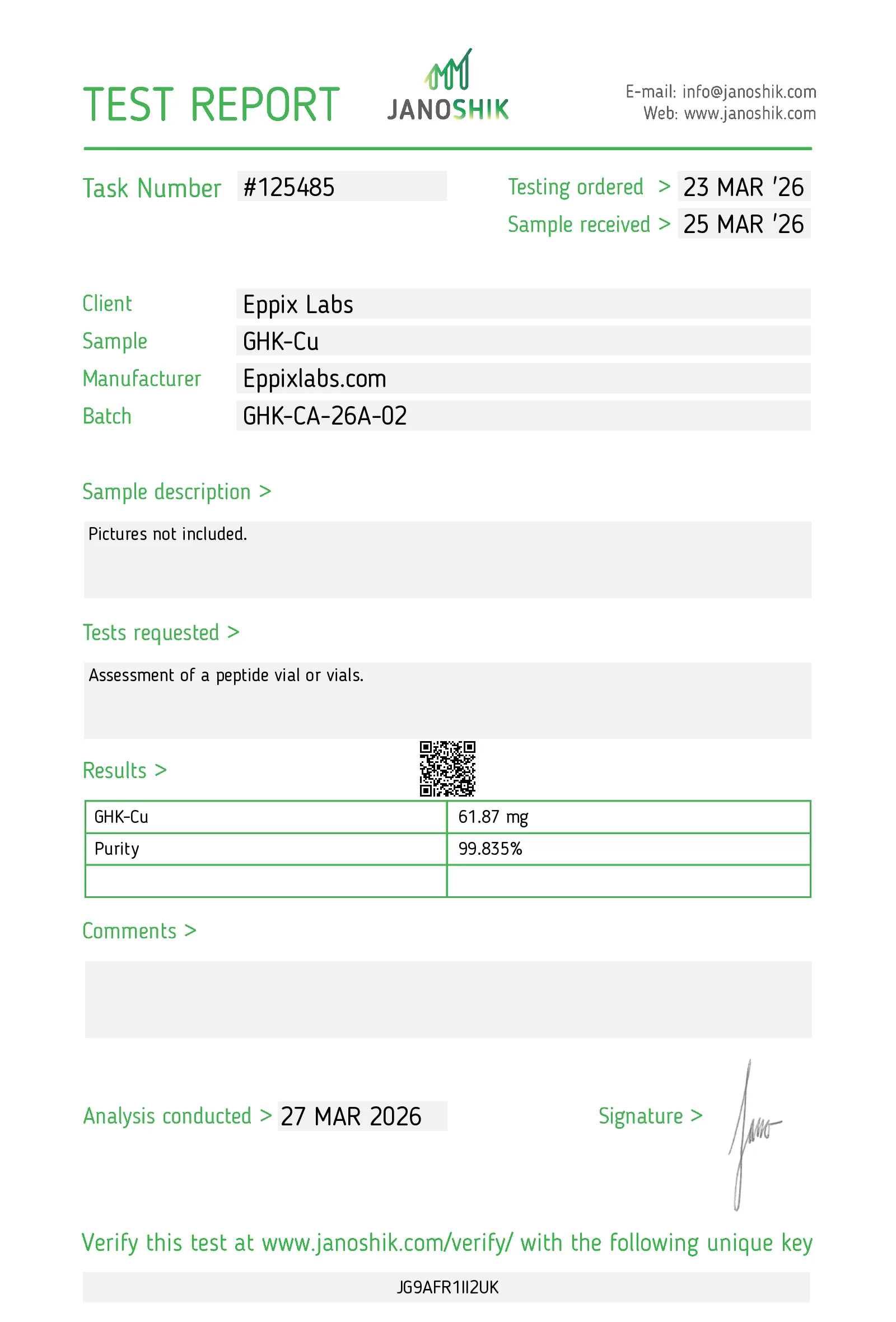
Certificate of analysis for GHK-Cu 50mg, batch GHK-CA-26A-02

Select strength

Batch
GHK-CA-26A-02
Purity (HPLC)
Not reported
Measured content
Not reported
Laboratory
Not reported
Published certificate of analysis for the current GHK-Cu lot.

Frequently Asked

What's the difference between GHK and GHK-Cu?

GHK is the peptide. GHK-Cu is the peptide bound to copper(II).

Why is GHK-Cu blue?

The copper(II) complex absorbs light in the red-orange range, giving a blue color.

Was GHK-Cu voted on at the July 2026 PCAC?

No. It is among five removed peptides scheduled for later review.

References

  1. Pickart, L., Margolina, A. (2018). Regenerative and Protective Actions of the GHK-Cu Peptide in the Light of the New Gene Data. Int J Mol Sci 19(7):1987. PMID 29986520
  2. Frier Levitt (2026). FDA to Remove 12 Popular Peptides from the Category 2 "Do Not Compound" List. Published 16 April 2026. Frier Levitt, Articles. Source
  3. Pickart, L., Thaler, M.M. (1973). Tripeptide in human serum which prolongs survival of normal liver cells and stimulates growth in neoplastic liver. Nat New Biol 243(124):85-87. PMID 4349963
  4. McDermott Will & Schulte (2026). Bulk-list bound? PCAC backs majority of peptides in two-day public meeting. Published 27 July 2026. McDermott Will & Schulte, Insights. Source

Research Use Only

This article summarizes published preclinical research literature. Compounds referenced are supplied by Eppix Labs strictly as research materials for laboratory investigation within the United States. They are not approved by the FDA for human or veterinary use, and nothing on this page should be interpreted as medical advice or guidance on human or animal administration.