✦FedEx Delivery1–3 day delivery across the U.S.Free on orders over $200

Compound Overview

Tesamorelin as a Research Reference: What an FDA-Approved GHRH Analog Tells Us About the Class

The GHRH analog with a current approval behind it, and why that makes it a benchmark for receptor work rather than a shortcut

·By Adam Reeves · Research Editor, Eppix Labs

Few peptides in GH-axis research have a current approval to lean on. Tesamorelin does: it is a GHRH analog with an FDA approval, a published phase 3 record and a well-characterized mechanism, which makes it less interesting as a novelty and more useful as a yardstick. This piece covers its structure, how GHRH signaling works, the clinical record behind the approval, and how a lab can use the molecule as a reference agonist.

Tesamorelin is supplied for laboratory research use only. Nothing below is dosing, medical or legal guidance.

Chemical Identity

Name
Tesamorelin (trans-3-hexenoyl-GHRH(1-44) amide)
Also known as
Tesamorelin, TH9507, Egrifta (approved product)
Molecular formula
C₂₂₁H₃₆₆N₇₂O₆₇S
Molecular weight
5135.9 g/mol
CAS number
218949-48-5
Salt forms
Acetate

Key takeaways

  • ·Tesamorelin is a synthetic analog of growth hormone-releasing hormone (GHRH): the full 44-amino-acid human sequence with a trans-3-hexenoyl group added to the N-terminus.
  • ·The FDA approved it in November 2010 as Egrifta, for reducing excess abdominal fat in HIV-infected patients with lipodystrophy.[1][2]
  • ·The approval was supported by phase 3 work including Falutz et al. in the New England Journal of Medicine (2007).[3]
  • ·Because its pharmacology is well documented, tesamorelin is a useful reference agonist for GHRH receptor research. Research-grade material is not the approved drug product.
Structure

Native GHRH is quickly inactivated in circulation, mainly by dipeptidyl peptidase-4 (DPP-4) cleavage at the N-terminus. Tesamorelin's N-terminal trans-3-hexenoyl modification protects against that cleavage while keeping the full GHRH(1-44) sequence and its receptor activity.

  • ·Parent. Human GHRH(1-44)-NH₂.
  • ·Modification. N-terminal trans-3-hexenoyl group.
  • ·Length. 44 residues.
  • ·Molecular weight. 5135.9 g/mol, C₂₂₁H₃₆₆N₇₂O₆₇S.
  • ·Target. The GHRH receptor, a class B GPCR, on pituitary somatotrophs.
Research Material
General Image
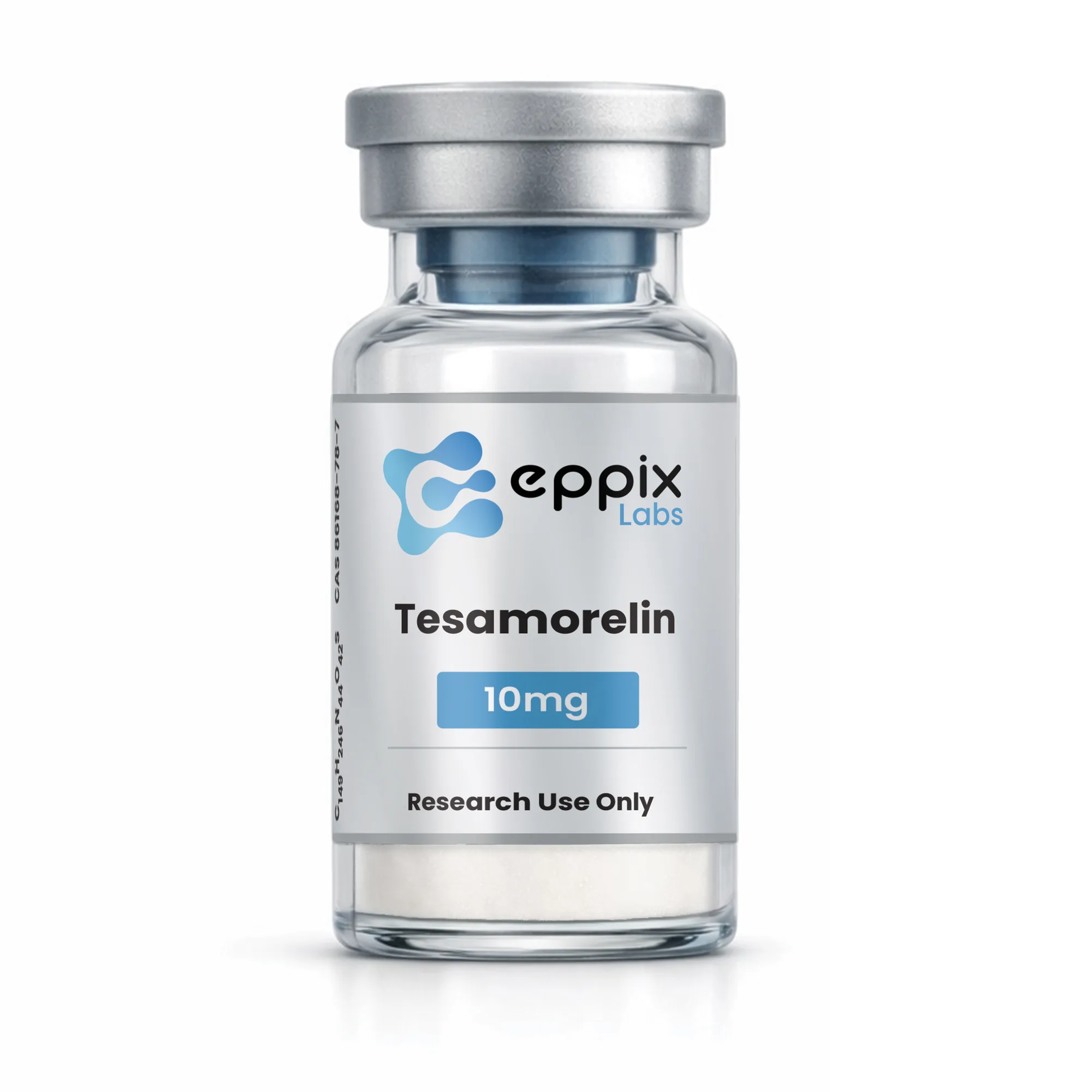
Tesamorelin research vial as supplied by Eppix Labs, lyophilized. The certificate further down states labeled and measured content.
Amino Acid Sequence
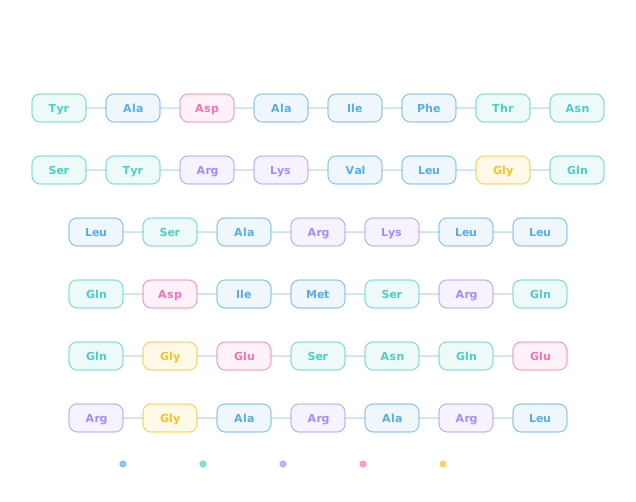
Amino Acid Sequence diagram
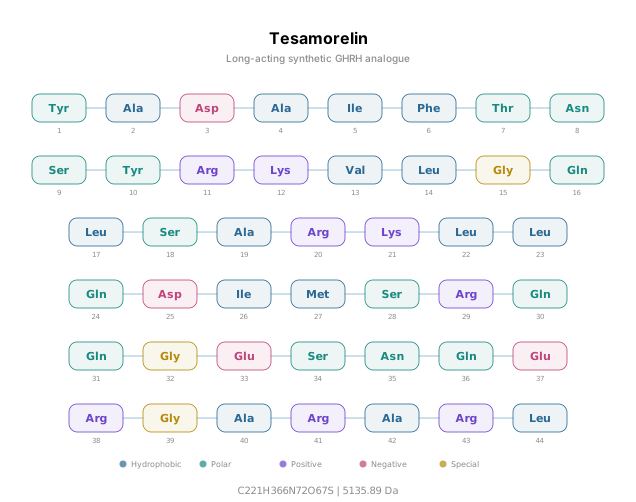
Amino-acid sequence of tesamorelin, the 44 residues of human GHRH with the N-terminal acyl group.
Chemical Structure
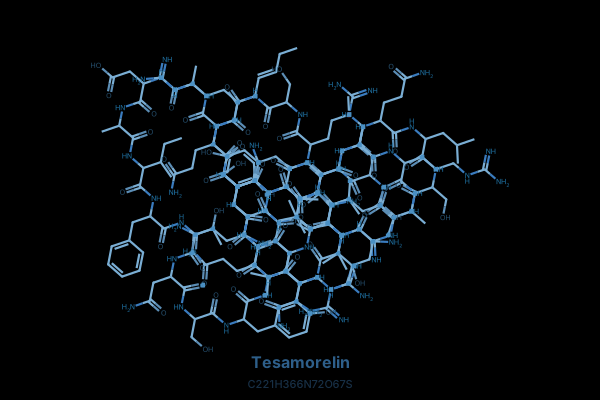
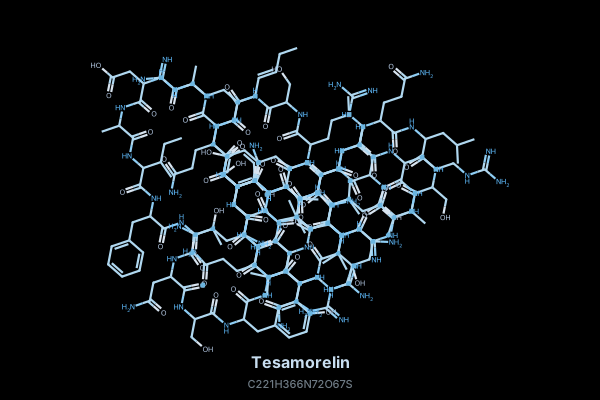
Chemical Structure diagram
Chemical structure of tesamorelin, C₂₂₁H₃₆₆N₇₂O₆₇S.

How GHRH signaling works

GHRH binds its receptor on somatotroph cells of the anterior pituitary, activating Gαs, raising cAMP, and stimulating both growth hormone (GH) synthesis and pulsatile release. GH then drives hepatic production of insulin-like growth factor 1 (IGF-1).

Because tesamorelin acts upstream, GH release stays subject to the normal feedback controls of somatostatin and IGF-1. That distinguishes the GHRH-analog class from direct GH administration in experimental designs.

The clinical record

Falutz and colleagues reported a 26-week, randomized, placebo-controlled trial in 412 HIV-infected patients with abdominal fat accumulation, with visceral adipose tissue measured by computed tomography as the primary endpoint.[3] Visceral fat fell by 15.2% in the tesamorelin group and rose by 5.0% in the placebo group, and IGF-1 rose alongside the visceral-fat reduction.[3] FDA approval followed on 10 November 2010 under NDA 022505.[1][2]

The pooled phase 3 analysis and the later hepatic-fat trial are summarized in tesamorelin in the US.

Using tesamorelin as a reference compound

Approved molecules make good benchmarks because their pharmacology has been examined in depth. In GHRH receptor research, tesamorelin can serve as:

  • ·A positive control in cAMP assays using GHRH receptor-expressing cells.
  • ·A comparator for other GHRH analogs, such as sermorelin (GHRH 1-29) or modified GHRH(1-29) analogs like CJC-1295.
  • ·A stability benchmark for DPP-4 resistance studies, compared against native GHRH.
  • ·A contrast with ghrelin mimetics. Ghrelin-receptor agonists such as ipamorelin act through a different receptor, GHSR-1a. Studies combining both mechanisms should include each agonist alone as a control.

US status

Tesamorelin is an FDA-approved active ingredient in a branded drug product. Research-grade tesamorelin sold as a chemical reagent is not that product, is not manufactured to drug CGMP, and is for laboratory research only.

Eppix Labs batch data

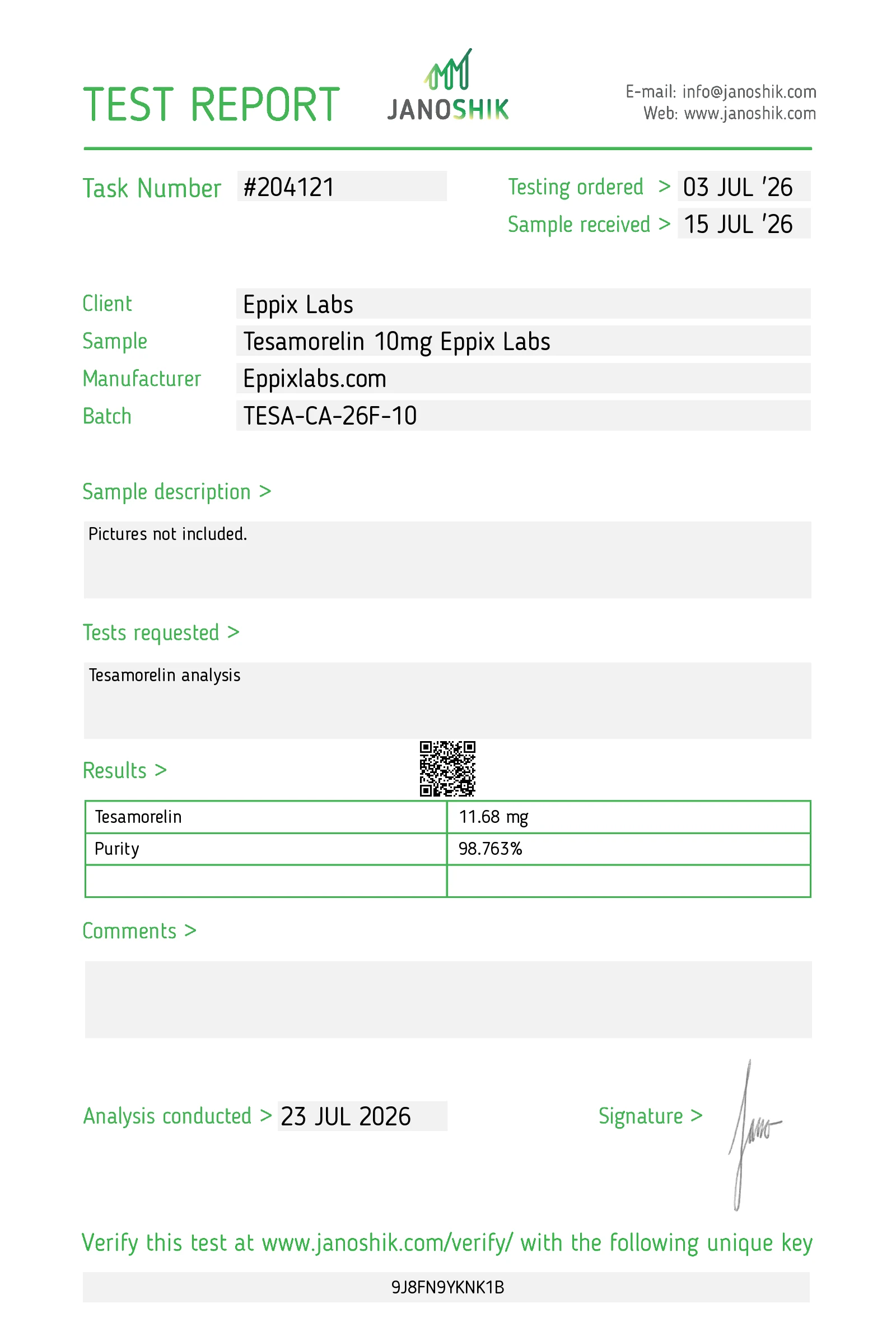
Each tesamorelin lot is tested by Janoshik Analytical before sale, and the certificate is published as the laboratory reported it, verifiable on Janoshik's own site. The current certificates are below, with a switch for each strength stocked. At 44 residues, purity and measured content deserve separate attention: purity speaks to synthesis quality, measured content to what is actually in the vial. Every lot is listed on the certificates of analysis page.

Published Certificate
Certificate of analysis for Tesamorelin 10mg, batch TESA-CA-26A-01, 98.763% purity, 11.68 mg measured content

Select strength

Batch
TESA-CA-26A-01
Purity (HPLC)
98.763%
Measured content
11.68 mglabeled 10 mg
Laboratory
Janoshik
Published certificates of analysis for the current tesamorelin lots, by strength, read live from the batch record.

Frequently Asked

Is tesamorelin FDA-approved?

Yes, as the active ingredient in Egrifta, for a specific indication. Research-grade tesamorelin is a reagent, not the approved product.

How is tesamorelin different from sermorelin?

Sermorelin is GHRH(1-29). Tesamorelin is full-length GHRH(1-44) with an N-terminal modification for stability.

Does tesamorelin act on the ghrelin receptor?

No. It acts on the GHRH receptor.

References

  1. US Food and Drug Administration (2010). Approval package for Egrifta (tesamorelin for injection), application number 22-505. Approval date 10 November 2010; indication: reduction of excess abdominal fat in HIV-infected patients with lipodystrophy. Drugs@FDA. Source
  2. Traynor, K. (2010). FDA approves tesamorelin for HIV-related lipodystrophy. Am J Health Syst Pharm 67(24):2082. PMID 21115997
  3. Falutz, J., Allas, S., Blot, K. et al. (2007). Metabolic effects of a growth hormone-releasing factor in patients with HIV. N Engl J Med 357(23):2359-2370. PMID 18057338

Research Use Only

This article summarizes published preclinical research literature. Compounds referenced are supplied by Eppix Labs strictly as research materials for laboratory investigation within the United States. They are not approved by the FDA for human or veterinary use, and nothing on this page should be interpreted as medical advice or guidance on human or animal administration.