✦FedEx Delivery1–3 day delivery across the U.S.Free on orders over $200

Compound Comparison

TB-500 vs Thymosin Beta-4 vs Ac-SDKP: Three Molecules Sold Under One Name

A 43-residue protein, a seven-residue fragment and a four-residue cleavage product, and the one certificate line that tells them apart

·By Adam Reeves · Research Editor, Eppix Labs

Thymosin beta-4, TB-500 and Ac-SDKP are routinely discussed as if they were one compound. They are three different molecules: a 43-residue protein, a short fragment of it, and a tetrapeptide cleaved from its N-terminus. Their masses differ by thousands of daltons, their literatures differ, and so does their regulatory history.

The Eppix Labs TB-500 is synthetic full-length thymosin beta-4; the seven-residue fragment is listed separately as TB-500 Fragment 17-23. All are supplied for laboratory research use only. Nothing below is dosing, medical or legal guidance.

Key takeaways

  • ·Thymosin beta-4 (Tβ4) is a 43-amino-acid, N-terminally acetylated protein and the main G-actin-sequestering molecule in most cells.[1]
  • ·"TB-500" is a market name, not a defined chemical entity. Depending on the supplier, it can refer to full-length synthetic Tβ4 or to a short fragment built around the actin-binding motif LKKTETQ. The Eppix Labs TB-500 is full-length Tβ4.
  • ·Ac-SDKP (N-acetyl-Ser-Asp-Lys-Pro) is a different molecule again: the N-terminal tetrapeptide of Tβ4, released by enzymatic cleavage and studied in its own right.[2][3]
  • ·Because these differ in mass by thousands of daltons, the mass-spectrometry result on a certificate tells you which one you actually have.

Thymosin beta-4: the parent protein

Tβ4 is a small, highly conserved protein found at high concentration in platelets, white blood cells and many tissues. Its best-understood job is binding monomeric actin (G-actin) and holding it in reserve, which regulates how quickly cells can build actin filaments for movement and shape change.[1]

Research interest extends well beyond actin. Goldstein, Hannappel and Kleinman's 2005 review described Tβ4 as an actin-sequestering protein that "moonlights" in tissue repair, with reported roles in cell migration, angiogenesis and inflammation in wound and cardiac models.[1] Full-length synthetic Tβ4 is the molecule in the Eppix Labs TB-500 vial, so its identity data are the ones to check against:

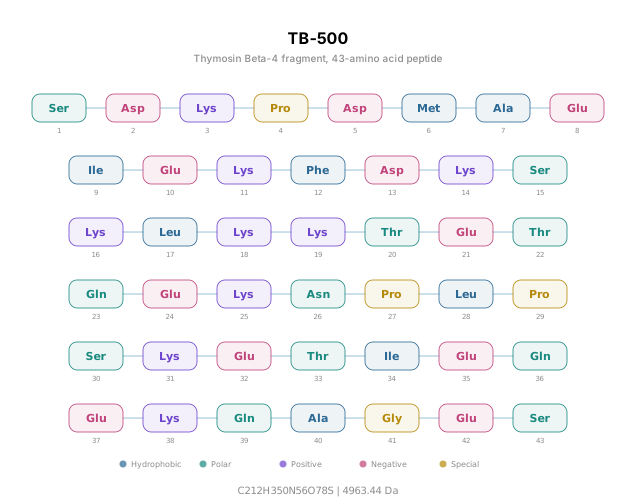
  • ·Length. 43 residues, SDKPDMAEIEKFDKSKLKKTETQEKNPLPSKETIEQEKQAGES.
  • ·N-terminus. Acetylated serine.
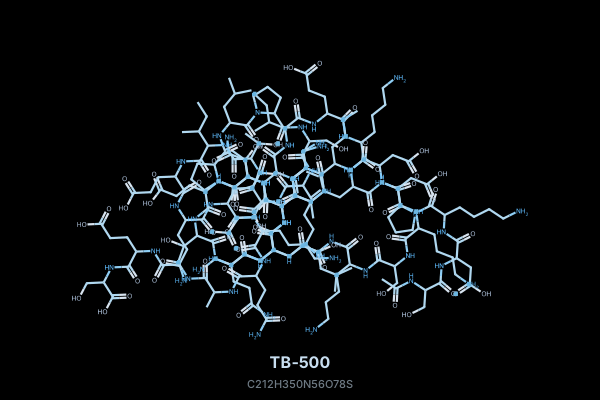
  • ·Molecular weight. 4963 g/mol (C₂₁₂H₃₅₀N₅₆O₇₈S; CAS 77591-33-4).
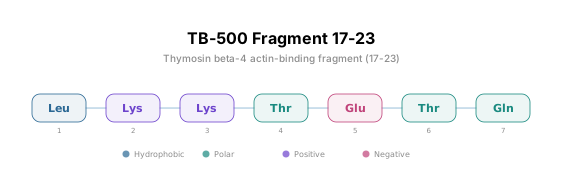
  • ·Key motif. LKKTETQ, residues 17 to 23, the actin-binding region.
  • ·N-terminal tetrapeptide. Ac-SDKP.
Research Material
General Image
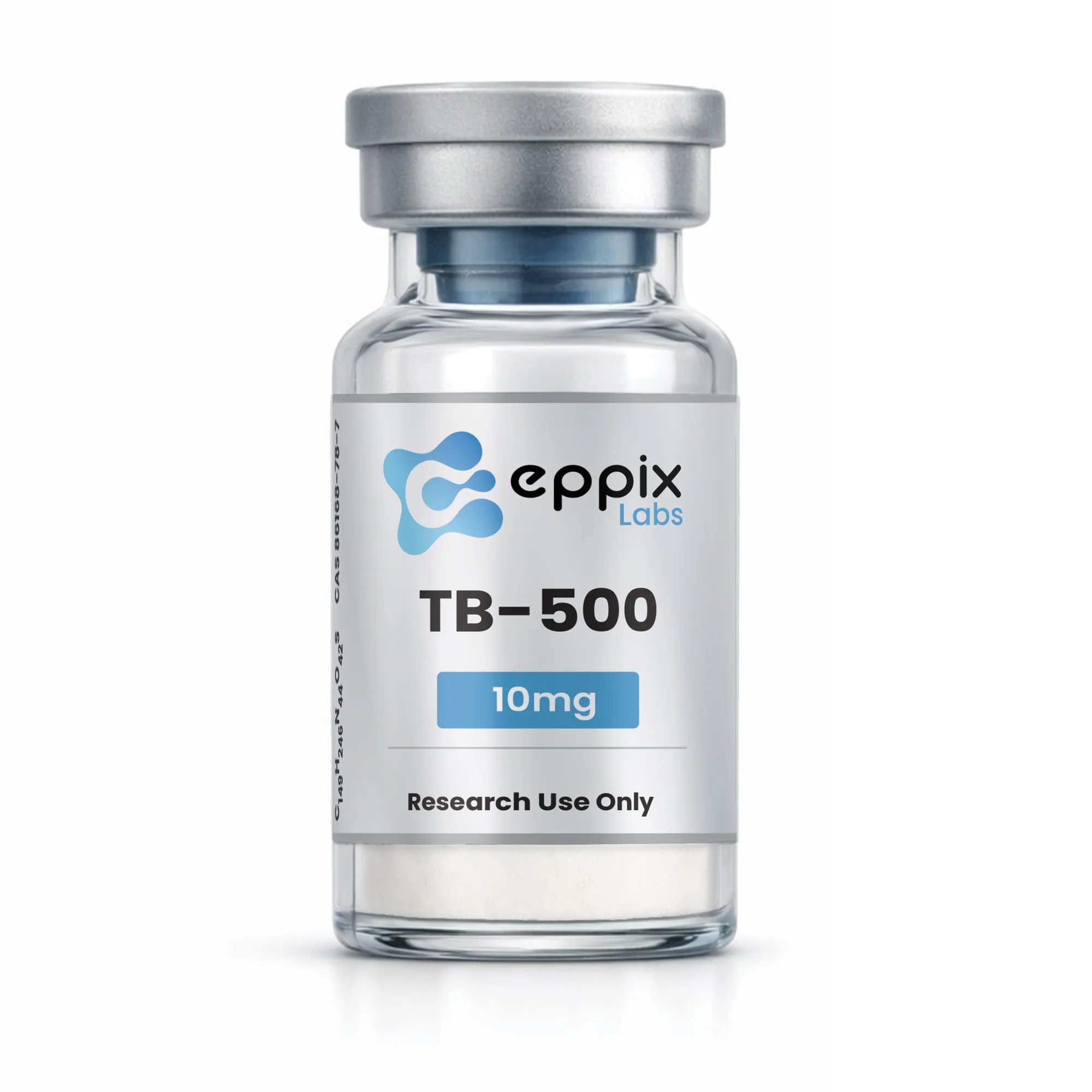
TB-500 (synthetic full-length thymosin β4) lyophilized research material as supplied by Eppix Labs. Labeled and measured content appear on the certificate further down this page.
Amino Acid Sequence
Amino Acid Sequence diagram
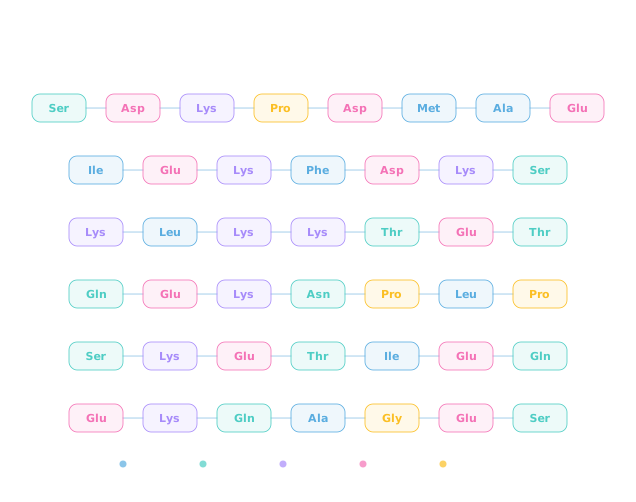
Amino-acid sequence of TB-500 as supplied by Eppix Labs: full-length thymosin β4, 43 residues.
Chemical Structure
Chemical Structure diagram
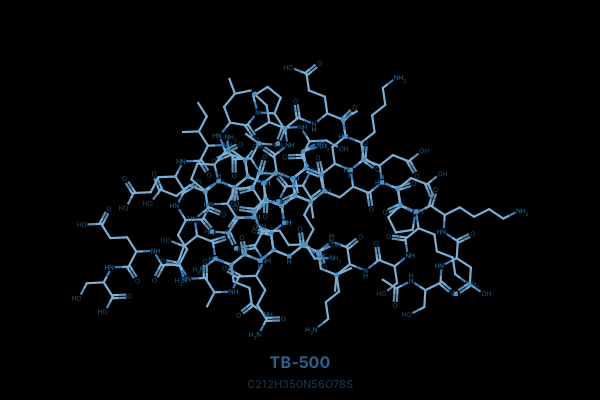
Chemical structure of thymosin β4, C₂₁₂H₃₅₀N₅₆O₇₈S.

Mapping activity to short sequences

A 2010 review in The FASEB Journal mapped which parts of Tβ4 carry which activities.[4] It assigned anti-inflammatory and antifibrotic activity to the N-terminal Ac-SDKP, cell-survival activity to a 15-residue N-terminal site that includes Ac-SDKP, and angiogenesis, wound healing and cell migration to a short sequence built on the central actin-binding domain, LKKTETQ.[4]

That mapping is one reason fragment peptides entered the research market: if a short sequence reproduces part of the activity, it is cheaper and easier to synthesize than the full protein. The LKKTETQ fragment weighs about 847 g/mol as the free heptapeptide, or about 889 g/mol when N-acetylated, so either form sits under 1 kDa. On this store it is listed separately as TB-500 Fragment 17-23.

Amino Acid Sequence
Amino Acid Sequence diagram
Amino-acid sequence of TB-500 Fragment 17-23, Leu-Lys-Lys-Thr-Glu-Thr-Gln.
Chemical Structure
Chemical Structure diagram
Chemical structure of the thymosin β4 17-23 fragment, LKKTETQ.

Ac-SDKP: a separate research compound

Ac-SDKP is released from Tβ4 by the sequential action of meprin-α and prolyl oligopeptidase: neither enzyme releases it alone.[3] It has its own literature, particularly in cardiovascular and renal fibrosis models, and it is a substrate of angiotensin-converting enzyme, whose N-terminal domain degrades it.[2]

Ac-SDKP is a tetrapeptide of about 0.49 kDa (487.5 g/mol, C₂₀H₃₃N₅O₉; also known by the name goralatide). It should never be confused with full-length Tβ4, which is roughly ten times heavier.

Why the naming problem matters

If two labs both report results with "TB-500," they may have used different molecules. That undermines comparison across studies and makes replication difficult. It also matters for regulation: the FDA's lists name the substance "Thymosin Beta-4, Fragment (LKKTETQ) (TB-500)," which is narrower than how the TB-500 name is used commercially.[5]

How to confirm what you have:

  • ·Check the sequence stated by the supplier.
  • ·Check the mass on the certificate. Full-length Tβ4 sits near 4.96 kDa (4963 g/mol); LKKTETQ-based fragments are under 1 kDa; Ac-SDKP is under 0.5 kDa.
  • ·Report the sequence in your methods, not just the name.

Regulatory context in the US

The thymosin beta-4 fragment was among the twelve peptides removed from FDA Category 2 in April 2026, and TB-500 received a PCAC recommendation in July 2026.[5][6] Neither action approved it as a drug. Both concerned the substance listed as the LKKTETQ fragment, in free base and acetate forms, rather than the full-length protein.[5]

On 23 and 24 July 2026 the FDA's Pharmacy Compounding Advisory Committee reviewed TB-500 for inclusion on the Section 503A Bulk Drug Substances List, alongside BPC-157, KPV, TB-500, MOTS-c, Epitalon and Semax. FDA staff had recommended against inclusion for every substance under review, citing insufficient characterization, little or no human effectiveness evidence, and inadequate human safety data. The committee voted in favor anyway. The vote was 8 in favor, 6 against, 1 abstention.

The full breakdown is in our July 2026 PCAC post. What the vote does not do, per the FDA's meeting materials and the current 503A list:[7][8][9]

  • ·It is non-binding. The committee advises, it does not decide. No final FDA determination has been issued and none of the six peptides appears in 21 CFR 216.23.
  • ·It requires a further step. Addition to the 503A Bulks List requires formal action by the Secretary of Health and Human Services, which had not occurred as of publication.
  • ·It does not make the compound an FDA-approved drug, and it establishes nothing about efficacy.
  • ·It does not legitimize research-chemical retail. A compounding-list decision concerns licensed pharmacists preparing patient-specific prescriptions under Section 503A, which is a different channel entirely from research material sold in vials.

Eppix Labs batch data

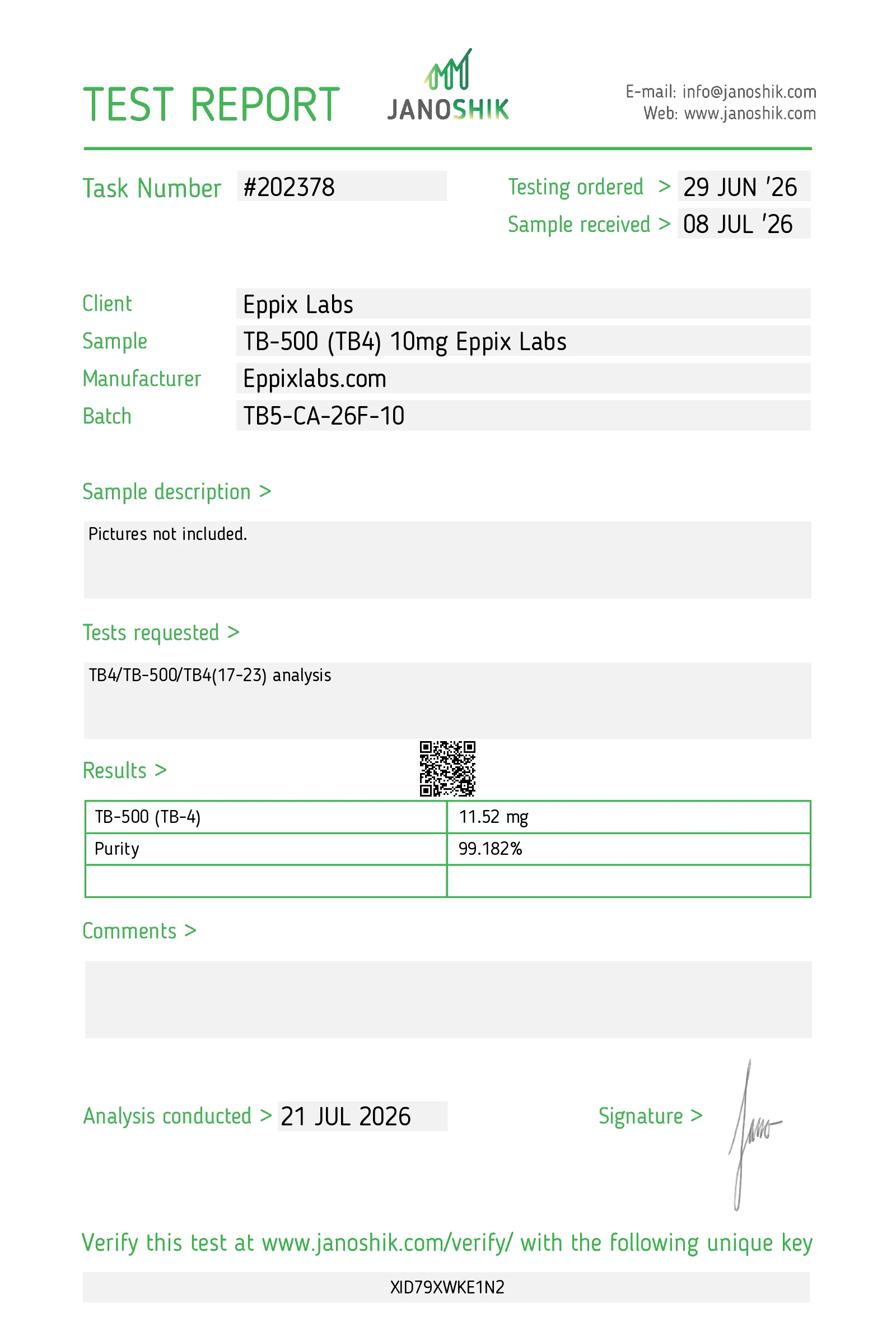
Each TB-500 lot is tested by Janoshik Analytical before sale, and the certificate is published as the laboratory reported it, verifiable on Janoshik's own site. For this product the identity line should match full-length Tβ4, near 4963 Da, rather than a sub-kilodalton fragment. HPLC purity and measured content are reported as separate figures, read live from the batch record. Full reports are on the certificates of analysis page.

Published Certificate
Certificate of analysis for TB-500 10mg, batch TB-CA-26A-01, 99.182% purity, 11.52 mg measured content
Batch
TB-CA-26A-01
Purity (HPLC)
99.182%
Measured content
11.52 mglabeled 10 mg
Laboratory
Janoshik
Published certificate of analysis for the current TB-500 (synthetic thymosin β4) lot.

Frequently Asked

Is TB-500 the same as thymosin beta-4?

Not necessarily. The name is used for both full-length Tβ4 and shorter fragments. Check the sequence and mass. The Eppix Labs TB-500 is synthetic full-length Tβ4; the fragment is listed separately as TB-500 Fragment 17-23.

What is LKKTETQ?

The seven-residue actin-binding motif within Tβ4, residues 17 to 23.

Is Ac-SDKP a form of TB-500?

No. It is the N-terminal tetrapeptide of Tβ4 and a distinct research compound.

References

  1. Goldstein, A.L., Hannappel, E., Kleinman, H.K. (2005). Thymosin beta4: actin-sequestering protein moonlights to repair injured tissues. Trends Mol Med 11(9):421-429. PMID 16099219
  2. Kassem, K.M., Vaid, S., Peng, H., Sarkar, S., Rhaleb, N.E. (2019). Tβ4-Ac-SDKP pathway: Any relevance for the cardiovascular system? Can J Physiol Pharmacol 97(7):589-599. PMID 30854877
  3. Kumar, N. et al. (2016). The anti-inflammatory peptide Ac-SDKP is released from thymosin-β4 by renal meprin-α and prolyl oligopeptidase. Am J Physiol Renal Physiol 310(10):F1026-F1034. PMID 26962108
  4. Sosne, G., Qiu, P., Goldstein, A.L., Wheater, M. (2010). Biological activities of thymosin beta4 defined by active sites in short peptide sequences. FASEB J 24(7):2144-2151. PMID 20179146
  5. Frier Levitt (2026). FDA to Remove 12 Popular Peptides from the Category 2 "Do Not Compound" List. Published 16 April 2026. Frier Levitt, Articles. Source
  6. McDermott Will & Schulte (2026). Bulk-list bound? PCAC backs majority of peptides in two-day public meeting. Published 27 July 2026. McDermott Will & Schulte, Insights. Source
  7. US Food and Drug Administration (2026). Pharmacy Compounding Advisory Committee meeting, 23-24 July 2026: bulk drug substances nominated for inclusion on the Section 503A Bulks List. FDA Advisory Committee Calendar. Source
  8. US Food and Drug Administration (2026). FDA briefing document, Pharmacy Compounding Advisory Committee: BPC-157, KPV, TB-500, MOTS-c, Emideltide, Semax and Epitalon. Agency review recommended against inclusion for each substance. FDA. Source
  9. Office of the Federal Register (2026). 21 CFR 216.23: bulk drug substances that can be used to compound drug products under section 503A. None of the six peptides appear on the list as of publication. eCFR. Source

Research Use Only

This article summarizes published preclinical research literature. Compounds referenced are supplied by Eppix Labs strictly as research materials for laboratory investigation within the United States. They are not approved by the FDA for human or veterinary use, and nothing on this page should be interpreted as medical advice or guidance on human or animal administration.