✦FedEx Delivery1–3 day delivery across the U.S.Free on orders over $200

Compound Overview

Cagrilintide and Amylin Receptor Research: From Phase 2 to REDEFINE 1

How amylin receptors are built, what the long-acting analog was engineered to fix, and what its two key trials reported

·By Adam Reeves · Research Editor, Eppix Labs

Cagrilintide is a long-acting amylin analog whose trial program, alone and co-administered with semaglutide, has made amylin receptor pharmacology a working question for metabolic labs. Modeling it in vitro is less straightforward than modeling an incretin, because the receptor it acts on is not a single protein. This summary covers the hormone, the receptor system, the two trials that define the clinical record, and the handling points that follow from the molecule's design.

Cagrilintide is supplied for laboratory research use only. Nothing below is dosing, medical or legal guidance.

Chemical Identity

Name
Cagrilintide (AM833)
Also known as
Cagrilintide, AM833, NNC0174-0833
Molecular formula
C₁₉₄H₃₁₂N₅₄O₅₉S₂
Molecular weight
4409.0 g/mol
CAS number
1415456-99-3
Salt forms
Acetate (research supply)

Key takeaways

  • ·Cagrilintide is a long-acting, acylated analog of amylin, a peptide hormone co-secreted with insulin from pancreatic β-cells.[1][4]
  • ·It acts at amylin receptors (the calcitonin receptor paired with receptor activity-modifying proteins, RAMPs) and at the calcitonin receptor itself.[5][6]
  • ·A phase 2 dose-finding trial was published in The Lancet in 2021.[1] The phase 3 REDEFINE 1 trial of cagrilintide co-administered with semaglutide was published in the New England Journal of Medicine in 2025.[2]
  • ·Cagrilintide is investigational in the US and not approved for any use. Research material is for laboratory use only.
Amylin biology in brief

Amylin (islet amyloid polypeptide, IAPP) is a 37-amino-acid peptide released with insulin after meals. It acts centrally, notably in the area postrema of the brainstem, to promote satiety, slow gastric emptying, and suppress post-meal glucagon.[5]

Human amylin is hard to work with. It aggregates into amyloid fibrils, which limits its use both as a drug and as a research tool. Pramlintide, an FDA-approved analog for diabetes, solved part of this with proline substitutions but has a short half-life. Cagrilintide was engineered to be both stable against aggregation and long-acting.[4]

Research Material
General Image
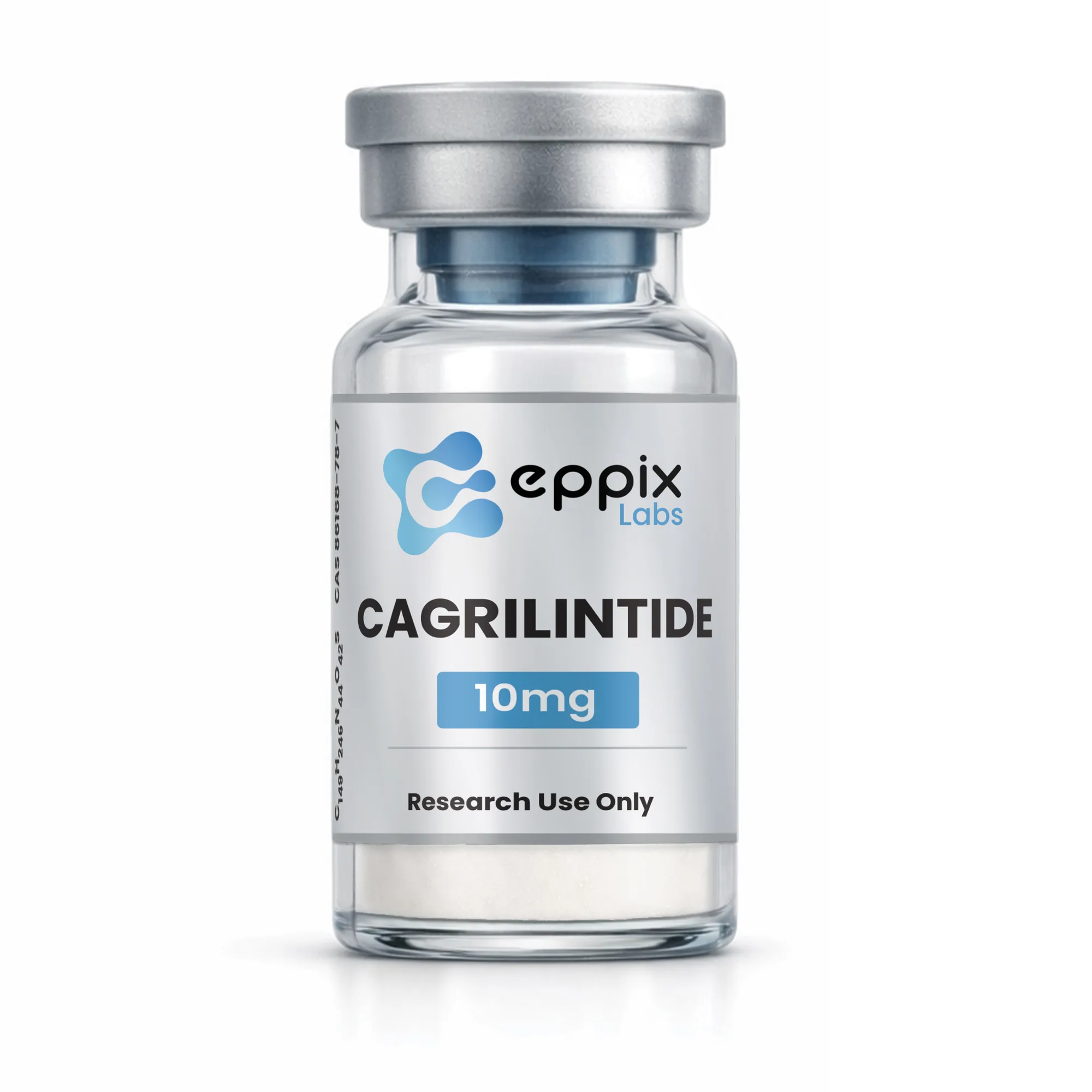
Cagrilintide research vial as supplied by Eppix Labs, lyophilized. The certificate further down states labeled and measured content.
Amino Acid Sequence
Amino Acid Sequence diagram
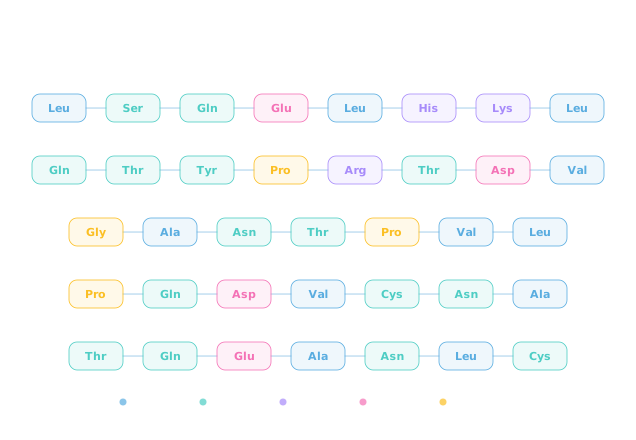
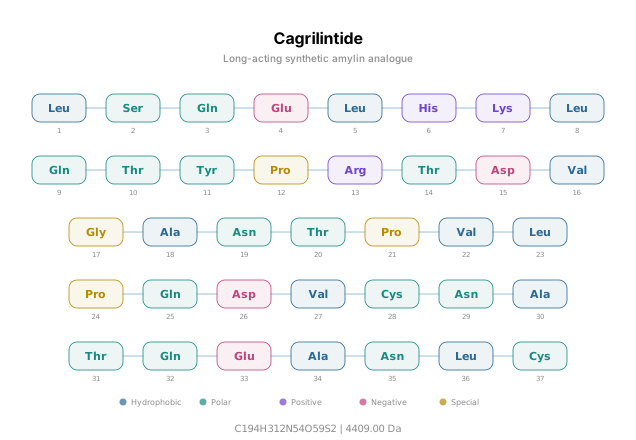
Amino-acid sequence of cagrilintide, read N-terminus to C-terminus.
Chemical Structure
Chemical Structure diagram
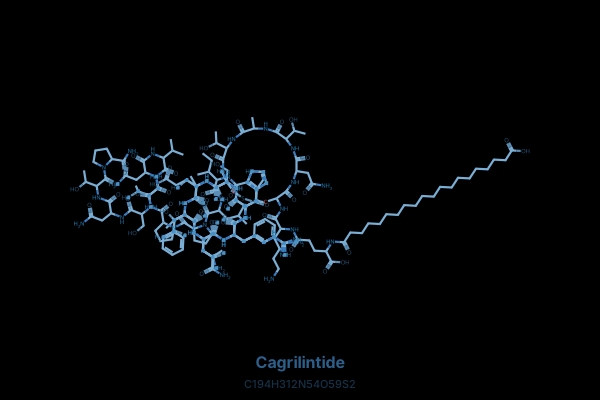
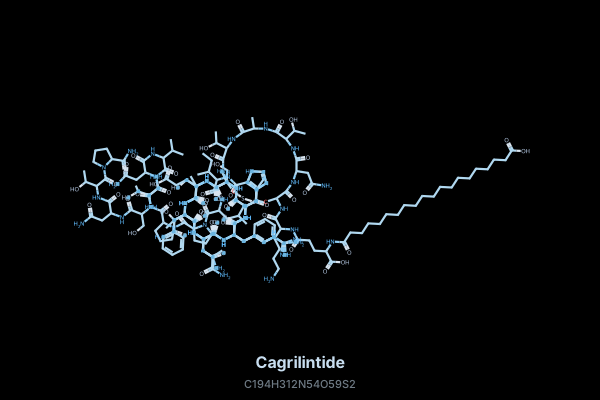
Chemical structure of cagrilintide, C₁₉₄H₃₁₂N₅₄O₅₉S₂.

The receptor system

Amylin receptors are heterodimers. The calcitonin receptor (CTR), a class B GPCR, pairs with one of three receptor activity-modifying proteins, and each pairing forms a distinct amylin receptor.[5]

Cagrilintide is described as a non-selective agonist with activity at amylin receptors and at CTR alone,[6] which is why it is sometimes grouped with the "dual amylin and calcitonin receptor agonists" (DACRAs). For in vitro work this matters: a cell line expressing CTR without RAMPs measures calcitonin receptor pharmacology, not amylin receptor pharmacology. Co-express the relevant RAMP to model each subtype:

  • ·AMY1. CTR + RAMP1.
  • ·AMY2. CTR + RAMP2.
  • ·AMY3. CTR + RAMP3.

Clinical research milestones

  • ·Phase 2 (The Lancet, 2021). Lau and colleagues ran a 26-week dose-finding trial of once-weekly cagrilintide in adults with overweight or obesity, with placebo and liraglutide comparators.[1] The trial reported dose-dependent effects on body weight and a tolerability profile dominated by gastrointestinal events, and supported further development of the compound, including in combination.
  • ·REDEFINE 1 (New England Journal of Medicine, 2025). A 68-week phase 3 trial in 3,417 adults without diabetes, testing cagrilintide 2.4 mg co-administered with semaglutide 2.4 mg ("CagriSema") against each component alone and against placebo.[2] Under the trial's treatment-policy estimand, mean body weight fell by 20.4% with the combination against 3.0% with placebo.[2] Novo Nordisk reported a mean reduction of 22.7% (against 2.3% with placebo) for participants who adhered to treatment.[3] The trial is the main evidence for combining amylin and GLP-1 receptor agonism.

Why combine amylin and GLP-1 agonism?

The two systems overlap in effect but differ in where and how they act. GLP-1R agonists act on hypothalamic and brainstem circuits and on the pancreas; amylin agonists act prominently on the area postrema and on glucagon suppression. Combination studies test whether engaging both pathways produces additive effects, and research questions remain about the mechanisms behind the combination's tolerability profile.

For comparison with the incretin class, see GLP-1, GIP and glucagon receptor pharmacology compared. The semaglutide half of the combination is covered in semaglutide in the US, and the cagrilintide sourcing guide is cagrilintide in the US.

Handling notes

  • ·Cagrilintide is acylated, so it binds albumin. As with other lipidated peptides, report the albumin concentration in assay media.
  • ·Use measured content from the certificate, not the label mass, for concentration calculations. The Peptide Calculator turns that measured mass into a stock concentration and molarity.

Eppix Labs batch data

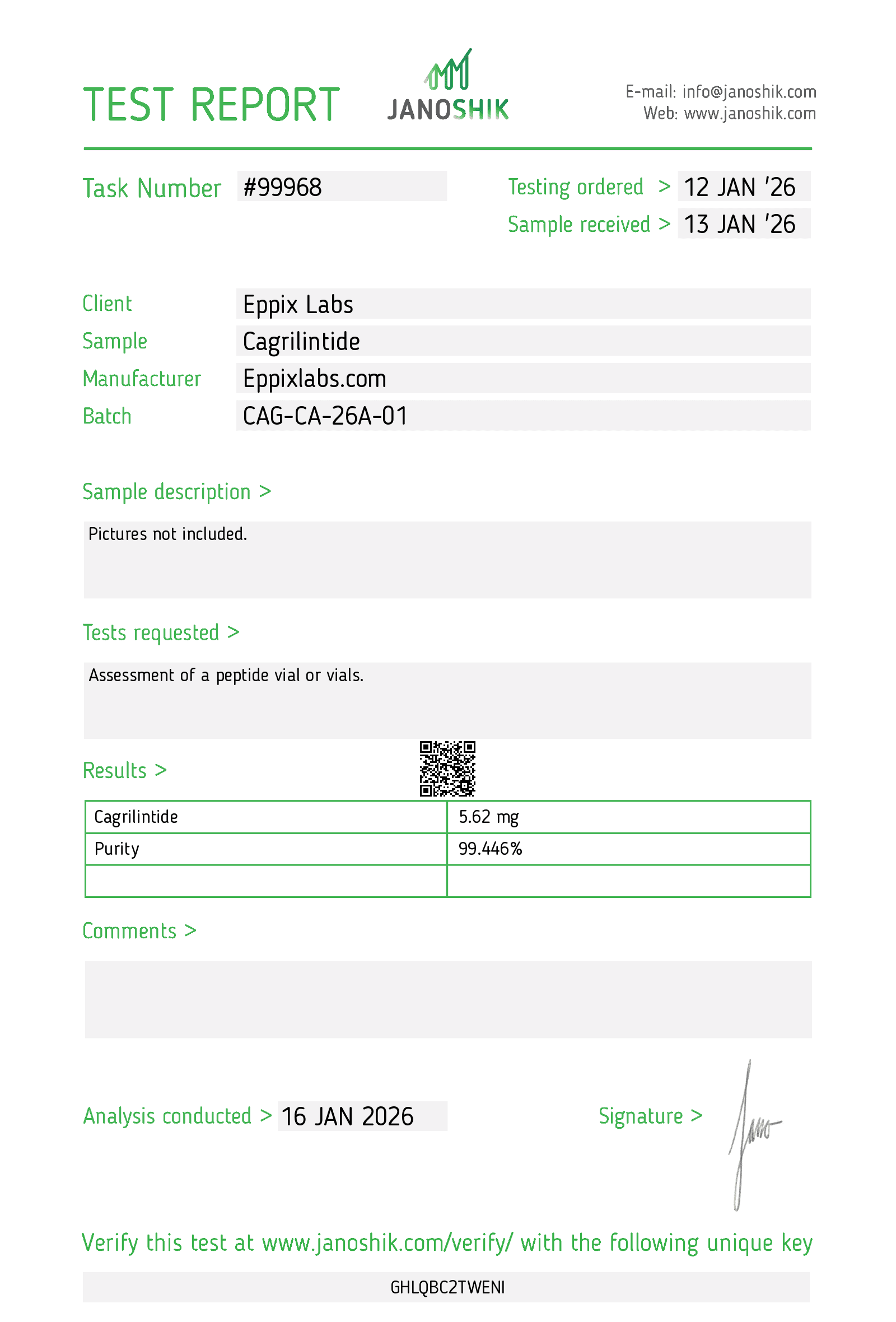
Each cagrilintide lot is tested by Janoshik Analytical before sale, and the certificate is published as the laboratory reported it, verifiable on Janoshik's own site. The current certificates are below, with a switch for each strength. See all reports on our certificates of analysis page.

Published Certificate
Certificate of analysis for Cagrilintide 5mg, batch CAG-CA-26A-01, 99.446% purity, 5.62 mg measured content

Select strength

Batch
CAG-CA-26A-01
Purity (HPLC)
99.446%
Measured content
5.62 mglabeled 5 mg
Laboratory
Janoshik
Published certificates of analysis for the current cagrilintide lots, by strength, read live from the batch record.

Frequently Asked

Is cagrilintide FDA-approved?

No. It is investigational in the US.

What is CagriSema?

The development name for cagrilintide co-administered with semaglutide, studied in the REDEFINE program.

How is cagrilintide different from pramlintide?

Pramlintide is a short-acting, approved amylin analog. Cagrilintide is acylated for a once-weekly interval in trials and engineered to resist aggregation.

References

  1. Lau, D.C.W., Erichsen, L. et al. (2021). Once-weekly cagrilintide for weight management in people with overweight and obesity: a multicentre, randomised, double-blind, placebo-controlled and active-controlled, dose-finding phase 2 trial. Lancet 398(10317):2160-2172. PMID 34798060
  2. Garvey, W.T. et al. (2025). Coadministered cagrilintide and semaglutide in adults with overweight or obesity. N Engl J Med 393(7):635-647. PMID 40544433
  3. Novo Nordisk (2025). CagriSema 2.4 mg / 2.4 mg demonstrated 22.7% mean weight reduction in adults with overweight or obesity in REDEFINE 1, published in NEJM. Press release, 22 June 2025. PR Newswire. Source
  4. Kruse, T. et al. (2021). Development of cagrilintide, a long-acting amylin analogue. J Med Chem 64(15):11183-11194. PMID 34288673
  5. Hay, D.L. et al. (2015). Amylin: pharmacology, physiology, and clinical potential. Pharmacol Rev 67(3):564-600. PMID 26071095
  6. Gabery, S. et al. (2025). Characterization of 0839, a tool compound for pre-clinical mode-of-action studies of amylin analogues such as cagrilintide. Life Sci 378:123845. PMID 40628316

Research Use Only

This article summarizes published preclinical research literature. Compounds referenced are supplied by Eppix Labs strictly as research materials for laboratory investigation within the United States. They are not approved by the FDA for human or veterinary use, and nothing on this page should be interpreted as medical advice or guidance on human or animal administration.