

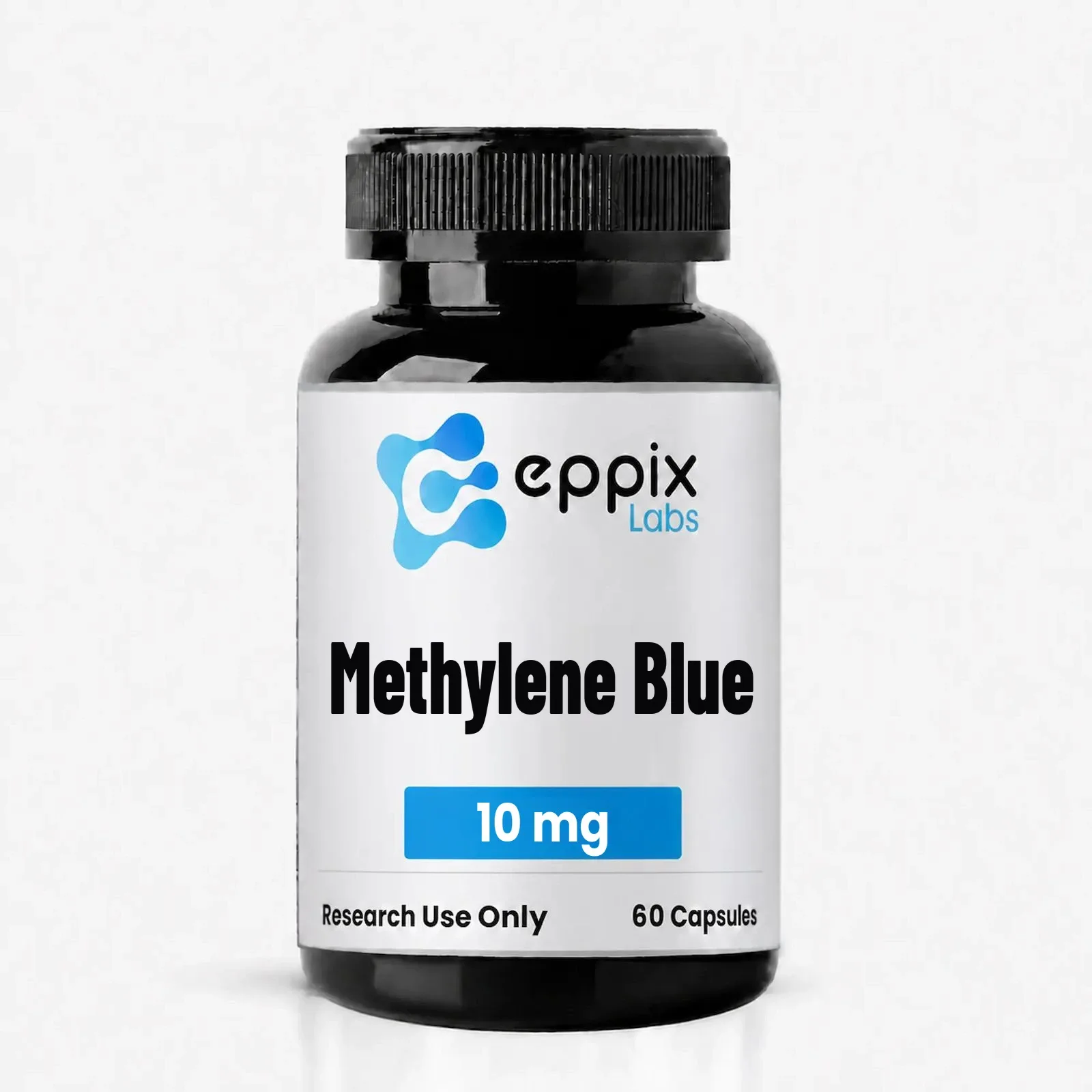
Methylene Blue Capsules
- Batch
- MBLUE-CA-26I-01
- Tested by
- Janoshik
- Tested on
- 2026-09-16
- Added
- 2026-10-03
Methylene Blue Capsules
Methylene Blue Capsules USA — Capsules
Phenothiazinium Redox Dye
Also known as Methylthioninium chloride
Methylene blue is a synthetic phenothiazinium salt and redox-active dye with the molecular formula C16H18ClN3S. It is supplied here in capsule form for laboratory research use within controlled experimental settings.
This product is intended strictly for laboratory research use within the United States. It is not approved by the FDA for the diagnosis, treatment, cure, or prevention of any disease. Not for human or veterinary use.
By purchasing, you confirm the material will be used solely for lawful research purposes in accordance with applicable U.S. federal, state, and local regulations.
Methylene blue is a synthetic phenothiazinium salt and redox-active dye with the molecular formula C16H18ClN3S. It is supplied here in capsule form for laboratory research use within controlled experimental settings.
The published literature on methylene blue is extensive and spans more than a century, covering its chemistry as an electron-accepting and electron-donating dye, its interaction with nucleic acids, and its examination in clinical and toxicological contexts including methemoglobinemia, vasoplegic states, parathyroid tissue identification, and antiparasitic investigation. Adverse effects, including hemolytic and neurologic events, are also documented in the record.
Third-party tested for purity, ID, quantity.
Coming Soon
The certificate of analysis for this lot is being finalised and will be published here as soon as the lab returns it.
Methylene blue cycles between its oxidized blue form and the reduced, colorless leucomethylene blue form, and this reversible redox behavior underlies most of the mechanisms described for it. In the literature on methemoglobinemia, the compound is characterized as an electron acceptor that participates in NADPH-dependent reduction of ferric hemoglobin iron back to the ferrous state. Reviews also describe inhibition of nitric oxide synthase and soluble guanylate cyclase as the basis for the vascular effects examined in vasoplegia and septic shock research. Separately, methylene blue is documented as a DNA-intercalating and groove-binding dye, a property exploited in electrochemical DNA-based sensor work.
Research endpoints across the record include methemoglobin reduction in hematologic toxicology, hemodynamic parameters in septic shock and vasoplegic syndrome studies, intraoperative tissue staining in parathyroid surgery series, parasitologic outcomes in malaria treatment reviews, and neurologic outcomes in ifosfamide-induced encephalopathy case reports. The literature also catalogs documented harms, including Heinz body hemolytic anemia, particularly in the setting of glucose-6-phosphate dehydrogenase deficiency, and serotonin-related encephalopathy associated with concurrent serotonergic agents.
Methylene blue was synthesized in the late nineteenth century as a textile dye and was subsequently adopted as a biological stain and as one of the earliest synthetic compounds investigated against malaria. Its application to methemoglobinemia followed from its redox chemistry and became the use most thoroughly documented in the modern literature, including reports addressing the neonatal and infant setting.
From the later twentieth century onward the research record widened. Reviews and case series examined intravenous administration in parathyroid surgery for tissue localization, adjunctive use in vasoplegic and septic shock states, and case-level reports in ifosfamide-induced encephalopathy. In parallel, reports of methylene blue-induced hemolytic anemia and of encephalopathy in patients receiving serotonergic drugs established limits on its use, and renewed interest in antimalarial applications has been reassessed in recent reviews.
Methylene blue appears in several distinct research frameworks: redox and electron-transfer chemistry, including NADPH-dependent methemoglobin reduction; nitric oxide and soluble guanylate cyclase pathway modulation in vasoplegia and septic shock models; nucleic acid binding and electrochemical biosensor development; antiparasitic investigation in malaria; and intraoperative tissue staining. A parallel toxicology literature documents hemolytic and neurologic adverse events, including interactions with serotonergic agents and susceptibility in G6PD deficiency. Formulation and diluent variables have also been examined as determinants of experimental outcome.
2 of the 5 areas below are addressed directly by a paper cited on this page.
Methemoglobin reduction and redox cycling models
Addressed on this page by Pushparajah 2021. Each is linked to its source record in the references below, so what was measured — and in what system — can be read rather than taken on trust.
- Pushparajah, Mak RS. et al. (2021) — Methylene Blue: An Antidote for Methemoglobinemia and Beyond
Nitric oxide and soluble guanylate cyclase pathway studies
No paper cited on this page reports on nitric, oxide or soluble. This heading marks where Methylene Blue Capsules is discussed in the category rather than a question the cited literature answers, and it is worth knowing which of these areas has work behind it and which does not.
Vasoplegia and septic shock hemodynamic research
Addressed on this page by Smith 2026. Each is linked to its source record in the references below, so what was measured — and in what system — can be read rather than taken on trust.
- Smith, BA. et al. (2026) — From Theory to Therapy: Methylene Blue's Emerging Role in the Management of Septic Shock
DNA intercalation and electrochemical biosensor chemistry
No paper cited on this page reports on intercalation, electrochemical or biosensor. This heading marks where Methylene Blue Capsules is discussed in the category rather than a question the cited literature answers, and it is worth knowing which of these areas has work behind it and which does not.
Antimalarial and antiparasitic investigation
No paper cited on this page reports on antimalarial or antiparasitic. This heading marks where Methylene Blue Capsules is discussed in the category rather than a question the cited literature answers, and it is worth knowing which of these areas has work behind it and which does not.
The references section of this page cites 6 primary papers published between 1994 and 2026 — a limited but non-trivial record. Every citation is linked to its PubMed or DOI record so it can be read rather than taken on trust, and the summaries above describe what those papers report rather than what the compound is claimed to do.
Methylene Blue Capsules is frequently listed as a peptide by suppliers in this market. It is not one. The structure published on this page is the compound's actual chemistry, and research on it should be read against its own class rather than against peptide literature.
Research compounds attract claims that outrun their evidence. Below are the ones most often encountered for Methylene Blue Capsules, set against what the papers cited on this page actually report. Where the record is thin or contested, that is stated rather than smoothed over.
Methylene Blue Capsules is commonly described online in connection with faster healing from injury and improved recovery. In the research literature the same compound is filed under methemoglobin reduction and redox cycling models, nitric oxide and soluble guanylate cyclase pathway studies and vasoplegia and septic shock hemodynamic research.
The 6 papers cited on this page, published between 1994 and 2026 (2 reviews) describe laboratory and animal work. None reports a controlled trial in humans. Findings in cell culture or in a rodent model describe what happened in that system; they do not establish that the same occurs in humans, and this compound is not approved for human use.
Nothing above is a statement of what this material does. It is a summary of what has been published and what has not. Eppix Labs supplies research materials only and provides no dosing, administration or protocol guidance.
Verification for Methylene Blue Capsules is per lot, not per product. The current lot MBLUE-CA-26I-01 returned 11.53 mg measured, assayed by Janoshik. Those figures are the laboratory's, published in full rather than reduced to a badge.
The lot code printed on the bottle matches the code on the certificate for Methylene Blue Capsules. Matching the two is what confirms the unit in hand came from the batch that was tested — a certificate not tied to a lot code proves nothing about any particular unit.
Researchers who buy Methylene Blue Capsules in the United States through Eppix Labs receive the lot described by the certificate above: the code printed on the vial label is the code on the certificate, and both are searchable on the batch verification page.
- Storage
- Cool, dry, away from direct light
- Humidity
- Keep sealed; capsule shells are hygroscopic
- Reconstitution
- Not applicable — supplied pre-measured
- Format
- Oral capsule
Methylene Blue Capsules is supplied in capsule form, which removes the reconstitution step entirely: there is no vehicle to add, no reconstitution volume to record and no post-reconstitution stability window to track. What that leaves a laboratory to control is storage — capsule shells draw moisture from the air, so the container should be kept sealed and dry rather than decanted into an open vessel.
Because the material is already at its labelled quantity per capsule, batch verification carries more weight in this format than it does for powder: there is no point at which the researcher independently confirms mass by weighing. The measured content published for each lot is the figure that answers that question.
- 1 × sealed capsule bottle (10mg per capsule / Single Bottle - Pack of 60), batch-labelled
- Batch documentation for the lot shipped, once its certificate is published
- Discreet outer packaging with no product names on the exterior
- FedEx, tracked, typically 1–3 business days domestically
- Laboratory consumables of any kind
- Dosing, administration or protocol guidance of any kind
No. Eppix Labs products are supplied exclusively for laboratory research. We do not provide dosing, administration, or usage guidance.
Each capsule contains the labeled quantity of methylene blue. Independent third-party analysis verifies purity, identity, and net content per batch.
The container holds only the capsules. Any laboratory materials required for preparation, handling, or experimental procedures must be sourced separately.
Duration depends entirely on research design, storage conditions, and laboratory protocol.
A Review of Methylene Blue's Interactions with DNA and Their Relevance for DNA-Based Sensors
PubMedFrom Theory to Therapy: Methylene Blue's Emerging Role in the Management of Septic Shock
PubMedMethylene blue encephalopathy: a case report and review of published cases
PubMedRelated
You May Also Like
Fisetin-Derived Research Compound CMS-121 is a synthetic small molecule derived from the plant flavonoid fisetin, produced for laboratory research use only. It is supplied in capsule form for controlled experimental work and is not intended for any other application.
$29.99
Methylated Beta-Carboline Alkaloid 9-Me-BC (9-methyl-beta-carboline) is a small methylated beta-carboline alkaloid studied in neurochemical research models. It is supplied in capsule form strictly for laboratory research use.
$64.99
Uncharacterised Research Compound Compound-7P is supplied as capsules for laboratory research use. The designation "Compound-7P" is a non-systematic label and does not correspond to a single identified chemical entity in the published chemical or pharmacological literature. No PubChem record matches the name, and no molecular formula, sequence or structural profile was supplied with it.
$49.99
Redox-Active Flavin Analogue 5-Deazaflavin is a synthetic analogue of the flavin ring system in which the nitrogen at position 5 of the isoalloxazine core is replaced by carbon. The parent heterocycle (C11H7N3O2, MW 213.19) and its substituted derivatives are produced for laboratory research and are handled within controlled experimental environments.
$59.99