

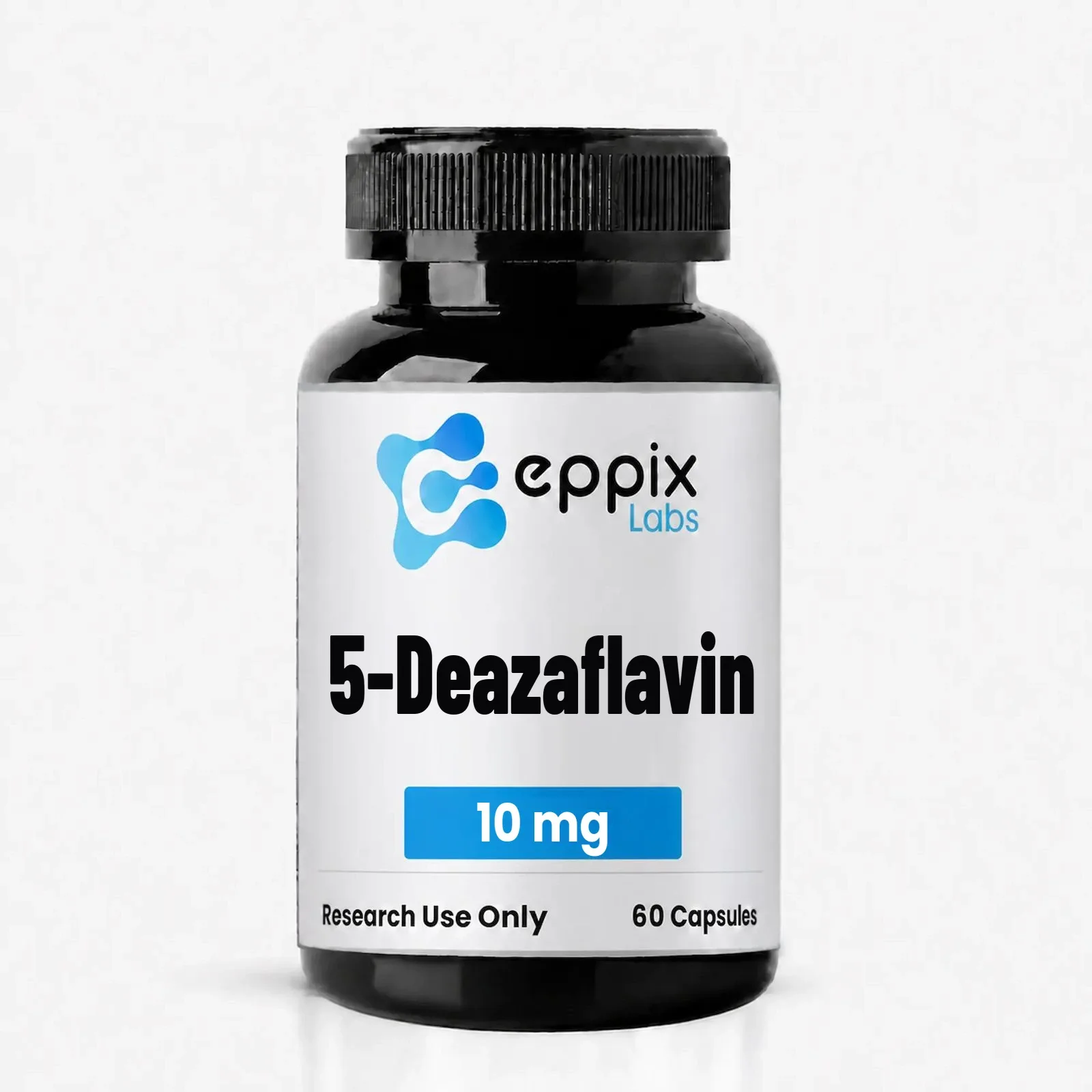
5-Deazaflavin Capsules
- Batch
- DEAZ-CA-26I-01
- Tested by
- Janoshik
- Tested on
- 2026-09-24
- Added
- 2026-10-03
5-Deazaflavin Capsules
5-Deazaflavin Capsules USA — Capsules
Redox-Active Flavin Analogue
5-Deazaflavin is a synthetic analogue of the flavin ring system in which the nitrogen at position 5 of the isoalloxazine core is replaced by carbon. The parent heterocycle (C11H7N3O2, MW 213.19) and its substituted derivatives are produced for laboratory research and are handled within controlled experimental environments.
This product is intended strictly for laboratory research use within the United States. It is not approved by the FDA for the diagnosis, treatment, cure, or prevention of any disease. Not for human or veterinary use.
By purchasing, you confirm the material will be used solely for lawful research purposes in accordance with applicable U.S. federal, state, and local regulations.
5-Deazaflavin is a synthetic analogue of the flavin ring system in which the nitrogen at position 5 of the isoalloxazine core is replaced by carbon. The parent heterocycle (C11H7N3O2, MW 213.19) and its substituted derivatives are produced for laboratory research and are handled within controlled experimental environments.
In scientific literature, 5-deazaflavins appear chiefly in chemical and enzymological work on redox biocatalysis, in studies of radical and semiquinone intermediates, in photochemical electron- and halogen-transfer systems, and in medicinal chemistry series screened against protein-protein interaction and kinase targets. Reported research is conducted in vitro, in isolated enzyme systems, and in tissue preparations.
Third-party tested for purity, ID, quantity.
Coming Soon
The certificate of analysis for this lot is being finalised and will be published here as soon as the lab returns it.
The defining feature of the 5-deazaflavin scaffold is its altered redox behaviour relative to natural flavin. Chemical evaluations comparing flavin and 5-deazaflavin in modified flavoproteins described the deaza analogue as favouring two-electron, hydride-type transfer over the one-electron chemistry typical of flavosemiquinones, and comparative spectroscopic work characterised 5-deazaflavin radicals as structurally and electronically distinct from natural flavin radicals. Related analogue work on 5-thia-5-deazaflavin examined a variant capable of one-electron transfer, and photochemically induced dynamic nuclear polarization has been used to provide direct evidence of the 5-deazaflavin radical in solution. Deazaflavin chemistry also intersects with microbial cofactor biology, where 8-hydroxy-5-deazaflavin functions as a cofactor in methanogen enzyme systems, including deazaflavin-dependent NADP+ reductase and formate dehydrogenase, and where the biosynthetic route to the deazaflavin core has been examined in terms of radical-mediated steps.
Research endpoints reported for the scaffold fall into several separate lines. Enzymological studies have assessed relative substrate activity of 8-hydroxy-5-deazaflavin analogues in purified cofactor-dependent reductase assays. Photochemical studies have evaluated C5-substituted 5-deazaflavins as sensitizers in photodehalogenation of aryl halides, and separate work has examined DNA photocleavage together with DNA and serum albumin binding for bis(tetrahydro-5-deazaflavin) analogues. Medicinal chemistry series have reported 5-deazaflavin derivatives as inhibitors of HDM2-mediated p53 ubiquitination, as sialic acid conjugates evaluated in antitumour screens, and as kinase-screened derivatives assessed in cell-based antitumour assays with accompanying docking and in silico ADME characterisation. In tissue-level work, the 5-deazaflavin derivative TND1128 has been examined in mouse brain slice preparations for effects on mitochondrial membrane potential and ATP-related readouts, with one report comparing it against beta-nicotinamide mononucleotide in the same preparation.
5-Deazaflavin entered the literature in the 1970s as a probe compound in mechanistic flavin chemistry, where substitution of carbon for nitrogen at position 5 was used to interrogate how flavoproteins carry out redox biocatalysis. Reconstitution of flavoproteins with the deaza analogue, and spectroscopic comparison of deazaflavin radicals with natural flavosemiquinones, established the scaffold as a mechanistic tool rather than a cofactor substitute. Parallel work on thia-substituted variants extended the series to analogues with differing electron-transfer character.
A second line developed from microbial biochemistry, where 8-hydroxy-5-deazaflavin was identified as a cofactor in methanogen enzymes and used in substrate-activity comparisons and in studies of formate dehydrogenase; later work addressed how the deazaflavin core is assembled biosynthetically. From the 1990s onward the scaffold was taken up in synthetic and medicinal chemistry, producing conjugates and substituted series evaluated against tumour cell lines, HDM2-p53 ubiquitination, and kinase panels, alongside photochemical applications. Most recently, the derivative TND1128 has been reported in mouse brain slice studies of mitochondrial membrane potential. The published record for the unsubstituted parent compound as a standalone research article is limited; most reports concern specific derivatives, and no single origin point for the capsule-format material offered here is documented.
Laboratory investigations involving 5-deazaflavin span mechanistic redox chemistry, cofactor enzymology, photochemistry, and derivative-based medicinal chemistry. Research frameworks have examined hydride versus single-electron transfer behaviour in reconstituted flavoprotein systems, radical and semiquinone structure by spectroscopic and polarization methods, substrate activity of 8-hydroxy-5-deazaflavin analogues in deazaflavin-dependent reductase assays, photosensitized dehalogenation and DNA photocleavage, inhibition of HDM2-mediated p53 ubiquitination, kinase-screened antitumour derivative series, and mitochondrial membrane potential readouts in mouse brain slice preparations using the derivative TND1128.
4 of the 5 areas below are addressed directly by a paper cited on this page.
Flavin redox mechanism models
Addressed on this page by Hemmerich 1977, Takahashi 2024, Goldberg 1981. Each is linked to its source record in the references below, so what was measured — and in what system — can be read rather than taken on trust.
- Hemmerich, P. et al. (1977) — Flavin and 5-deazaflavin: a chemical evaluation of 'modified' flavoproteins with respect to the mechanisms of redox biocatalysis
- Takahashi, N. et al. (2024) — TND1128, a 5-deazaflavin derivative with auto-redox ability, facilitates polarization of mitochondrial membrane potential (ΔΨ(m)) and on-demand ATP synthesis in mice brain slices
- Goldberg, M. et al. (1981) — Structure and properties of 5-deazaflavin radicals as compared to natural flavosemiquinones
Radical and semiquinone spectroscopy
Addressed on this page by Goldberg 1981. Each is linked to its source record in the references below, so what was measured — and in what system — can be read rather than taken on trust.
- Goldberg, M. et al. (1981) — Structure and properties of 5-deazaflavin radicals as compared to natural flavosemiquinones
Deazaflavin-dependent cofactor enzymology
Addressed on this page by Yamazaki 1982, Hemmerich 1977, Goldberg 1981. Each is linked to its source record in the references below, so what was measured — and in what system — can be read rather than taken on trust.
- Yamazaki, S. et al. (1982) — Analogues of 8-hydroxy-5-deazaflavin cofactor: relative activity as substrates for 8-hydroxy-5-deazaflavin-dependent NADP+ reductase from Methanococcus vannielii
- Hemmerich, P. et al. (1977) — Flavin and 5-deazaflavin: a chemical evaluation of 'modified' flavoproteins with respect to the mechanisms of redox biocatalysis
- Goldberg, M. et al. (1981) — Structure and properties of 5-deazaflavin radicals as compared to natural flavosemiquinones
Photosensitized electron-transfer chemistry
No paper cited on this page reports on photosensitized, electron or transfer. This heading marks where 5-Deazaflavin Capsules is discussed in the category rather than a question the cited literature answers, and it is worth knowing which of these areas has work behind it and which does not.
Mitochondrial membrane potential models
Addressed on this page by Takahashi 2024. Each is linked to its source record in the references below, so what was measured — and in what system — can be read rather than taken on trust.
- Takahashi, N. et al. (2024) — TND1128, a 5-deazaflavin derivative with auto-redox ability, facilitates polarization of mitochondrial membrane potential (ΔΨ(m)) and on-demand ATP synthesis in mice brain slices
The references section of this page cites 6 primary papers published between 1977 and 2026 — a limited but non-trivial record. Every citation is linked to its PubMed or DOI record so it can be read rather than taken on trust, and the summaries above describe what those papers report rather than what the compound is claimed to do.
5-Deazaflavin Capsules is frequently listed as a peptide by suppliers in this market. It is not one. The structure published on this page is the compound's actual chemistry, and research on it should be read against its own class rather than against peptide literature.
Research compounds attract claims that outrun their evidence. Below are the ones most often encountered for 5-Deazaflavin Capsules, set against what the papers cited on this page actually report. Where the record is thin or contested, that is stated rather than smoothed over.
5-Deazaflavin Capsules is commonly described online in connection with faster healing from injury and improved recovery. In the research literature the same compound is filed under flavin redox mechanism models, radical and semiquinone spectroscopy and deazaflavin-dependent cofactor enzymology.
The 6 papers cited on this page, published between 1977 and 2026 (1 in animal models) describe laboratory and animal work. None reports a controlled trial in humans. Findings in cell culture or in a rodent model describe what happened in that system; they do not establish that the same occurs in humans, and this compound is not approved for human use.
Nothing above is a statement of what this material does. It is a summary of what has been published and what has not. Eppix Labs supplies research materials only and provides no dosing, administration or protocol guidance.
Verification for 5-Deazaflavin Capsules is per lot, not per product. The current lot DEAZ-CA-26I-01 returned 7.14 mg measured, assayed by Janoshik. Those figures are the laboratory's, published in full rather than reduced to a badge.
The lot code printed on the bottle matches the code on the certificate for 5-Deazaflavin Capsules. Matching the two is what confirms the unit in hand came from the batch that was tested — a certificate not tied to a lot code proves nothing about any particular unit.
Researchers who buy 5-Deazaflavin Capsules in the United States through Eppix Labs receive the lot described by the certificate above: the code printed on the vial label is the code on the certificate, and both are searchable on the batch verification page.
- Storage
- Cool, dry, away from direct light
- Humidity
- Keep sealed; capsule shells are hygroscopic
- Reconstitution
- Not applicable — supplied pre-measured
- Format
- Oral capsule
5-Deazaflavin Capsules is supplied in capsule form, which removes the reconstitution step entirely: there is no vehicle to add, no reconstitution volume to record and no post-reconstitution stability window to track. What that leaves a laboratory to control is storage — capsule shells draw moisture from the air, so the container should be kept sealed and dry rather than decanted into an open vessel.
Because the material is already at its labelled quantity per capsule, batch verification carries more weight in this format than it does for powder: there is no point at which the researcher independently confirms mass by weighing. The measured content published for each lot is the figure that answers that question.
- 1 × sealed capsule bottle (10mg per capsule / Single Bottle - Pack of 60), batch-labelled
- Batch documentation for the lot shipped, once its certificate is published
- Discreet outer packaging with no product names on the exterior
- FedEx, tracked, typically 1–3 business days domestically
- Laboratory consumables of any kind
- Dosing, administration or protocol guidance of any kind
No. Eppix Labs products are supplied exclusively for laboratory research. We do not provide dosing, administration, or usage guidance.
Each capsule contains the labeled quantity of 5-deazaflavin material. Independent third-party analysis verifies purity, identity, and net content per batch.
The unit contains only the capsule material. Any laboratory consumables, solvents, or instrumentation required for experimental procedures must be sourced separately.
Duration depends entirely on research design, storage conditions, and laboratory protocol.
Flavin and 5-deazaflavin: a chemical evaluation of 'modified' flavoproteins with respect to the mechanisms of redox biocatalysis
PubMedStructure and properties of 5-deazaflavin radicals as compared to natural flavosemiquinones
PubMedTND1128, a 5-deazaflavin derivative with auto-redox ability, facilitates polarization of mitochondrial membrane potential (ΔΨ(m)) and on-demand ATP synthesis in mice brain slices
PubMed5-Deazaflavin derivatives as inhibitors of p53 ubiquitination by HDM2
PubMedAnalogues of 8-hydroxy-5-deazaflavin cofactor: relative activity as substrates for 8-hydroxy-5-deazaflavin-dependent NADP+ reductase from Methanococcus vannielii
PubMedC5-alkyl and C5-aryl Substituted 5-Deazaflavin as Sensitizers for Photodehalogenation of Aryl Halides
PubMedRelated
You May Also Like
Fisetin-Derived Research Compound CMS-121 is a synthetic small molecule derived from the plant flavonoid fisetin, produced for laboratory research use only. It is supplied in capsule form for controlled experimental work and is not intended for any other application.
$29.99
Methylated Beta-Carboline Alkaloid 9-Me-BC (9-methyl-beta-carboline) is a small methylated beta-carboline alkaloid studied in neurochemical research models. It is supplied in capsule form strictly for laboratory research use.
$64.99
Uncharacterised Research Compound Compound-7P is supplied as capsules for laboratory research use. The designation "Compound-7P" is a non-systematic label and does not correspond to a single identified chemical entity in the published chemical or pharmacological literature. No PubChem record matches the name, and no molecular formula, sequence or structural profile was supplied with it.
$49.99
Phenothiazinium Redox Dye Methylene blue is a synthetic phenothiazinium salt and redox-active dye with the molecular formula C16H18ClN3S. It is supplied here in capsule form for laboratory research use within controlled experimental settings.
$29.99