

Compound-7P Capsules
Compound-7P Capsules USA — Capsules
Uncharacterised Research Compound
Compound-7P is supplied as capsules for laboratory research use. The designation "Compound-7P" is a non-systematic label and does not correspond to a single identified chemical entity in the published chemical or pharmacological literature. No PubChem record matches the name, and no molecular formula, sequence or structural profile was supplied with it.
This product is intended strictly for laboratory research use within the United States. It is not approved by the FDA for the diagnosis, treatment, cure, or prevention of any disease. Not for human or veterinary use.
By purchasing, you confirm the material will be used solely for lawful research purposes in accordance with applicable U.S. federal, state, and local regulations.
Compound-7P is supplied as capsules for laboratory research use. The designation "Compound-7P" is a non-systematic label and does not correspond to a single identified chemical entity in the published chemical or pharmacological literature. No PubChem record matches the name, and no molecular formula, sequence or structural profile was supplied with it.
Because the identity of the material behind this designation is not established in the literature, no mechanism of action, target class or research history can be described for it. Labels of the form "compound 7p" appear routinely inside medicinal chemistry papers as internal series numbering for one analogue within a synthesized set, and the same label is reused independently across unrelated series.
Third-party tested for purity, ID, quantity.
Coming Soon
The certificate of analysis for this lot is being finalised and will be published here as soon as the lab returns it.
There is no published record attached to "Compound-7P" as a named compound. In medicinal chemistry publications, designations such as 7p are assigned by authors to individual members of a synthetic series, and the number refers only to that paper's internal numbering scheme. Different papers use the same label for structurally unrelated molecules, so the designation alone does not identify a substance or a target.
Among the available candidate literature, author-numbered analogues of this general form appear in series spanning butyrylcholinesterase inhibition, orphan G protein-coupled receptor GPR27 ligand development, thiazolidine-2,4-dione antidiabetic and allosteric IKK-beta kinase scaffolds, and protein tyrosine phosphatase 1B inhibitor work. These are separate research programmes with no established relationship to one another and no demonstrated connection to the material sold here. No research endpoints can be attributed to this product without an independent structural identification.
The origin of the designation "Compound-7P" is not documented. No primary publication, patent, or development programme could be identified that introduces a compound under this name.
What can be said is that the labelling convention is common: synthetic chemistry papers number their analogues sequentially, and a label like 7p belongs to the numbering table of whichever paper assigned it. Without the originating reference or an analytical identity for the capsule contents, any account of where this material came from would be invented rather than reported.
No research framework can be assigned to this product, because the designation does not resolve to an identified compound in the published record. The research areas listed below describe the fields in which similarly numbered series analogues appear in the candidate literature. They are context for the naming convention only and are not claims about the contents of this product.
4 of the 5 areas below are addressed directly by a paper cited on this page.
Author-numbered analogue series in medicinal chemistry
No paper cited on this page reports on author, numbered or analogue. This heading marks where Compound-7P Capsules is discussed in the category rather than a question the cited literature answers, and it is worth knowing which of these areas has work behind it and which does not.
Selective butyrylcholinesterase inhibition studies
Addressed on this page by Yu 2024. Each is linked to its source record in the references below, so what was measured — and in what system — can be read rather than taken on trust.
- Yu, C. et al. (2024) — Novel anti-neuroinflammatory pyranone-carbamate derivatives as selective butyrylcholinesterase inhibitors for treating Alzheimer's disease
Orphan GPCR ligand development (GPR27)
Addressed on this page by Pillaiyar 2023. Each is linked to its source record in the references below, so what was measured — and in what system — can be read rather than taken on trust.
- Pillaiyar, T. et al. (2023) — Development of Ligands for the Super Conserved Orphan G Protein-Coupled Receptor GPR27 with Improved Efficacy and Potency
Thiazolidine-2,4-dione scaffold investigations
Addressed on this page by Elkamhawy 2020. Each is linked to its source record in the references below, so what was measured — and in what system — can be read rather than taken on trust.
- Elkamhawy, A. et al. (2020) — Thiazolidine-2,4-dione-based irreversible allosteric IKK-β kinase inhibitors: Optimization into in vivo active anti-inflammatory agents
Protein tyrosine phosphatase 1B inhibitor research
Addressed on this page by Pillaiyar 2023, Yu 2024, Elkamhawy 2020. Each is linked to its source record in the references below, so what was measured — and in what system — can be read rather than taken on trust.
- Pillaiyar, T. et al. (2023) — Development of Ligands for the Super Conserved Orphan G Protein-Coupled Receptor GPR27 with Improved Efficacy and Potency
- Yu, C. et al. (2024) — Novel anti-neuroinflammatory pyranone-carbamate derivatives as selective butyrylcholinesterase inhibitors for treating Alzheimer's disease
- Elkamhawy, A. et al. (2020) — Thiazolidine-2,4-dione-based irreversible allosteric IKK-β kinase inhibitors: Optimization into in vivo active anti-inflammatory agents
The references section of this page cites 3 primary papers published between 2020 and 2024 — a thin record. Every citation is linked to its PubMed or DOI record so it can be read rather than taken on trust, and the summaries above describe what those papers report rather than what the compound is claimed to do.
Compound-7P Capsules is frequently listed as a peptide by suppliers in this market. It is not one. The structure published on this page is the compound's actual chemistry, and research on it should be read against its own class rather than against peptide literature.
Research compounds attract claims that outrun their evidence. Below are the ones most often encountered for Compound-7P Capsules, set against what the papers cited on this page actually report. Where the record is thin or contested, that is stated rather than smoothed over.
Compound-7P Capsules is described across this category in connection with author-numbered analogue series in medicinal chemistry, selective butyrylcholinesterase inhibition studies and orphan GPCR ligand development (GPR27).
The 3 papers cited on this page, published between 2020 and 2024 describe laboratory and animal work. None reports a controlled trial in humans. Findings in cell culture or in a rodent model describe what happened in that system; they do not establish that the same occurs in humans, and this compound is not approved for human use.
Nothing above is a statement of what this material does. It is a summary of what has been published and what has not. Eppix Labs supplies research materials only and provides no dosing, administration or protocol guidance.
Every lot of Compound-7P Capsules is independently assayed before it is released, and the certificate for the lot shipped is published rather than summarised. Where a certificate for a current lot is not yet posted, the lot has not yet been released against it.
Researchers who buy Compound-7P Capsules in the United States through Eppix Labs receive a batch-labelled vial whose certificate is published against that lot code, so the material can be matched to its analysis rather than to a generic specification.
- Storage
- Cool, dry, away from direct light
- Humidity
- Keep sealed; capsule shells are hygroscopic
- Reconstitution
- Not applicable — supplied pre-measured
- Format
- Oral capsule
Compound-7P Capsules is supplied in capsule form, which removes the reconstitution step entirely: there is no vehicle to add, no reconstitution volume to record and no post-reconstitution stability window to track. What that leaves a laboratory to control is storage — capsule shells draw moisture from the air, so the container should be kept sealed and dry rather than decanted into an open vessel.
Because the material is already at its labelled quantity per capsule, batch verification carries more weight in this format than it does for powder: there is no point at which the researcher independently confirms mass by weighing. The measured content published for each lot is the figure that answers that question.
- 1 × sealed capsule bottle (10mg per capsule / Single Bottle - Pack of 60), batch-labelled
- Batch documentation for the lot shipped, once its certificate is published
- Discreet outer packaging with no product names on the exterior
- FedEx, tracked, typically 1–3 business days domestically
- Laboratory consumables of any kind
- Dosing, administration or protocol guidance of any kind
No. Eppix Labs products are supplied exclusively for laboratory research. We do not provide dosing, administration, or usage guidance.
Each capsule contains the labeled quantity of material. Because this designation does not correspond to an identified compound in the published literature, researchers should rely on the batch analysis supplied for identity and net content, and on independent verification where identity matters to the study design.
The container holds only the capsules. Any laboratory materials required for analytical identification, extraction, or experimental procedures must be sourced separately.
Duration depends entirely on research design, storage conditions, and laboratory protocol.
Development of Ligands for the Super Conserved Orphan G Protein-Coupled Receptor GPR27 with Improved Efficacy and Potency
PubMedNovel anti-neuroinflammatory pyranone-carbamate derivatives as selective butyrylcholinesterase inhibitors for treating Alzheimer's disease
PubMedThiazolidine-2,4-dione-based irreversible allosteric IKK-β kinase inhibitors: Optimization into in vivo active anti-inflammatory agents
PubMedRelated
You May Also Like
Fisetin-Derived Research Compound CMS-121 is a synthetic small molecule derived from the plant flavonoid fisetin, produced for laboratory research use only. It is supplied in capsule form for controlled experimental work and is not intended for any other application.
$29.99
Methylated Beta-Carboline Alkaloid 9-Me-BC (9-methyl-beta-carboline) is a small methylated beta-carboline alkaloid studied in neurochemical research models. It is supplied in capsule form strictly for laboratory research use.
$64.99
Redox-Active Flavin Analogue 5-Deazaflavin is a synthetic analogue of the flavin ring system in which the nitrogen at position 5 of the isoalloxazine core is replaced by carbon. The parent heterocycle (C11H7N3O2, MW 213.19) and its substituted derivatives are produced for laboratory research and are handled within controlled experimental environments.
$59.99
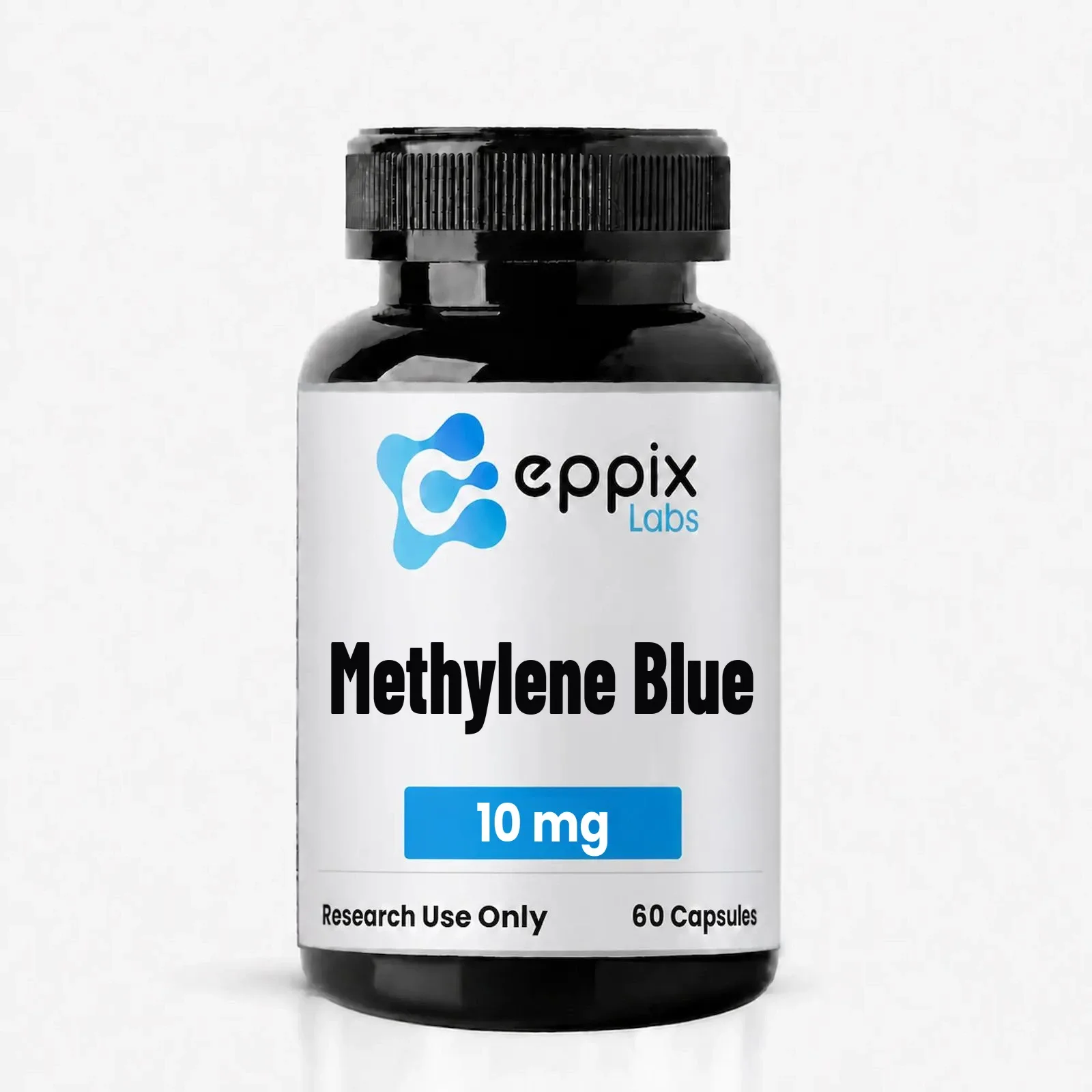
Phenothiazinium Redox Dye Methylene blue is a synthetic phenothiazinium salt and redox-active dye with the molecular formula C16H18ClN3S. It is supplied here in capsule form for laboratory research use within controlled experimental settings.
$29.99