

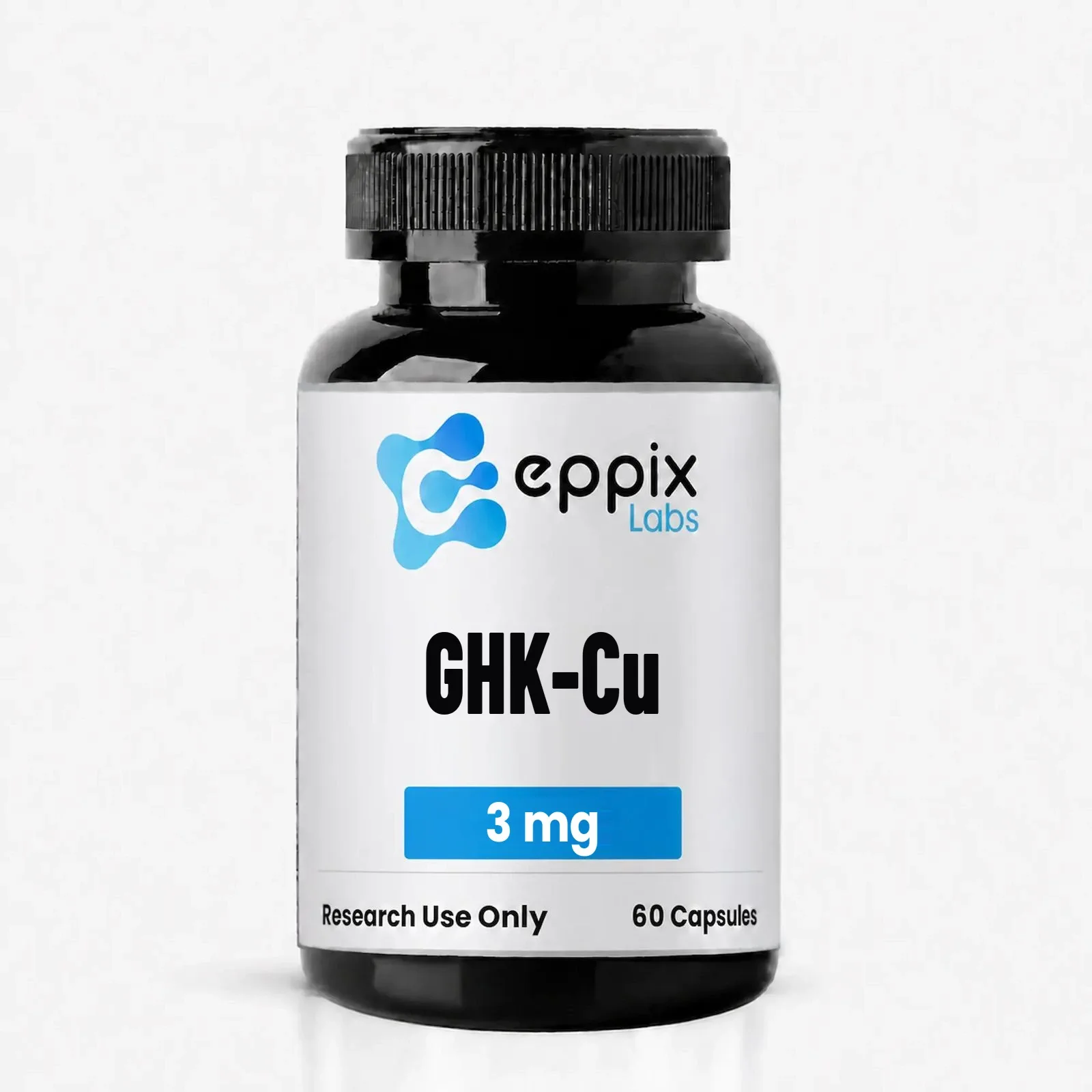
GHK-Cu Capsules
GHK-Cu Capsules USA — Capsules
Copper-Binding Tripeptide Complex
GHK-Cu is a complex of the tripeptide glycyl-L-histidyl-L-lysine with copper(II). The free tripeptide occurs in human plasma and in other tissues, and binds copper with high affinity to form the metallopeptide studied in the literature. It is supplied here in capsule form strictly for laboratory research.
This product is intended strictly for laboratory research use within the United States. It is not approved by the FDA for the diagnosis, treatment, cure, or prevention of any disease. Not for human or veterinary use.
By purchasing, you confirm the material will be used solely for lawful research purposes in accordance with applicable U.S. federal, state, and local regulations.
GHK-Cu is a complex of the tripeptide glycyl-L-histidyl-L-lysine with copper(II). The free tripeptide occurs in human plasma and in other tissues, and binds copper with high affinity to form the metallopeptide studied in the literature. It is supplied here in capsule form strictly for laboratory research.
Published work on GHK-Cu has focused largely on skin and connective tissue models, gene expression profiling, and formulation chemistry. A smaller body of work has examined the complex in inflammatory and oxidative stress models and as a cargo molecule in delivery systems such as liposomes and hydroxyapatite microspheres.
Third-party tested for purity, ID, quantity.
Coming Soon
The certificate of analysis for this lot is being finalised and will be published here as soon as the lab returns it.
The characterised activity of GHK-Cu in the literature centres on copper coordination. The tripeptide sequence binds Cu(II) in a square-planar arrangement, and the resulting complex has been described as a copper carrier that participates in copper-dependent processes in experimental systems. Reported research activity includes interaction with extracellular matrix components, effects on collagen and glycosaminoglycan synthesis in cultured cells, and broad changes in gene expression profiles reported from transcriptomic analyses. The coordination chemistry, stability and formulation behaviour of the complex have been reviewed in detail.
Research endpoints evaluated in the published record include in vitro matrix protein production, wound closure and skin regeneration models, antioxidant and anti-inflammatory markers, and skin permeation measurement when the complex is encapsulated in liposomal or microsphere carriers. An experimental colitis model has been used to examine the complex outside dermal systems. Reviews addressing peptides in musculoskeletal and sports medicine contexts have discussed GHK-Cu and noted the absence of adequate controlled human data in those applications.
The GHK tripeptide was identified in human plasma during investigations of plasma fractions that altered the behaviour of cultured liver tissue. Its high affinity for copper(II) was established subsequently, and the copper complex became the form most commonly used in experimental work. Much of the early and continuing characterisation of the complex comes from a single research lineage, with later reviews consolidating findings on skin regeneration and cellular pathway modulation.
Later work shifted toward gene expression analysis, where transcriptomic datasets were used to describe the breadth of pathways associated with the peptide, and toward formulation science. Recent publications address encapsulation in liposomes, incorporation into injectable microsphere fillers, analytical methods for measuring skin permeation, and the use of the complex as a model analyte in copper-selective fluorescent sensing. The published record for orally administered GHK-Cu specifically is not well documented; the literature assembled here concerns topical, injectable and in vitro systems.
GHK-Cu appears in research frameworks concerned with copper-binding peptides, extracellular matrix biology, and skin regeneration models. Laboratory investigations have examined copper coordination chemistry, matrix protein and glycosaminoglycan synthesis in cell culture, transcriptomic responses, and markers of oxidative stress and inflammation in animal models including experimental colitis. A parallel body of work treats the complex as a formulation subject, evaluating liposomal and microsphere carriers and the analytical challenges of measuring its permeation through skin.
4 of the 5 areas below are addressed directly by a paper cited on this page.
Copper coordination and metallopeptide chemistry
Addressed on this page by Mateescu 2026. Each is linked to its source record in the references below, so what was measured — and in what system — can be read rather than taken on trust.
- Mateescu, DM. et al. (2026) — GHK-Cu as a Bioactive Metallopeptide and Drug-Delivery Cargo: Coordination Chemistry, Formulation Science, Therapeutic Evidence, and a Translational Roadmap
Skin regeneration and extracellular matrix models
Addressed on this page by Pickart 2015. Each is linked to its source record in the references below, so what was measured — and in what system — can be read rather than taken on trust.
- Pickart, L. et al. (2015) — GHK Peptide as a Natural Modulator of Multiple Cellular Pathways in Skin Regeneration
Transcriptomic and gene expression profiling
Addressed on this page by Pickart 2018, Pickart 2015. Each is linked to its source record in the references below, so what was measured — and in what system — can be read rather than taken on trust.
- Pickart, L. et al. (2018) — Regenerative and Protective Actions of the GHK-Cu Peptide in the Light of the New Gene Data
- Pickart, L. et al. (2015) — GHK Peptide as a Natural Modulator of Multiple Cellular Pathways in Skin Regeneration
Oxidative stress and inflammatory pathway models
No paper cited on this page reports on oxidative, stress or inflammatory. This heading marks where GHK-Cu Capsules is discussed in the category rather than a question the cited literature answers, and it is worth knowing which of these areas has work behind it and which does not.
Liposomal and microsphere delivery formulation
Addressed on this page by Mateescu 2026. Each is linked to its source record in the references below, so what was measured — and in what system — can be read rather than taken on trust.
- Mateescu, DM. et al. (2026) — GHK-Cu as a Bioactive Metallopeptide and Drug-Delivery Cargo: Coordination Chemistry, Formulation Science, Therapeutic Evidence, and a Translational Roadmap
The references section of this page cites 6 primary papers published between 2015 and 2026 — a limited but non-trivial record. Every citation is linked to its PubMed or DOI record so it can be read rather than taken on trust, and the summaries above describe what those papers report rather than what the compound is claimed to do.
GHK-Cu Capsules is frequently listed as a peptide by suppliers in this market. It is not one. The structure published on this page is the compound's actual chemistry, and research on it should be read against its own class rather than against peptide literature.
Research compounds attract claims that outrun their evidence. Below are the ones most often encountered for GHK-Cu Capsules, set against what the papers cited on this page actually report. Where the record is thin or contested, that is stated rather than smoothed over.
GHK-Cu Capsules is commonly described online in connection with faster healing from injury and improved recovery. In the research literature the same compound is filed under copper coordination and metallopeptide chemistry, skin regeneration and extracellular matrix models and transcriptomic and gene expression profiling.
The 6 papers cited on this page, published between 2015 and 2026 describe laboratory and animal work. None reports a controlled trial in humans. Findings in cell culture or in a rodent model describe what happened in that system; they do not establish that the same occurs in humans, and this compound is not approved for human use.
Nothing above is a statement of what this material does. It is a summary of what has been published and what has not. Eppix Labs supplies research materials only and provides no dosing, administration or protocol guidance.
Every lot of GHK-Cu Capsules is independently assayed before it is released, and the certificate for the lot shipped is published rather than summarised. Where a certificate for a current lot is not yet posted, the lot has not yet been released against it.
Researchers who buy GHK-Cu Capsules in the United States through Eppix Labs receive a batch-labelled vial whose certificate is published against that lot code, so the material can be matched to its analysis rather than to a generic specification.
- Storage
- Cool, dry, away from direct light
- Humidity
- Keep sealed; capsule shells are hygroscopic
- Reconstitution
- Not applicable — supplied pre-measured
- Format
- Oral capsule
GHK-Cu Capsules is supplied in capsule form, which removes the reconstitution step entirely: there is no vehicle to add, no reconstitution volume to record and no post-reconstitution stability window to track. What that leaves a laboratory to control is storage — capsule shells draw moisture from the air, so the container should be kept sealed and dry rather than decanted into an open vessel.
Because the material is already at its labelled quantity per capsule, batch verification carries more weight in this format than it does for powder: there is no point at which the researcher independently confirms mass by weighing. The measured content published for each lot is the figure that answers that question.
- 1 × sealed capsule bottle (3mg per capsule / Single Bottle - Pack of 60), batch-labelled
- Batch documentation for the lot shipped, once its certificate is published
- Discreet outer packaging with no product names on the exterior
- FedEx, tracked, typically 1–3 business days domestically
- Laboratory consumables of any kind
- Dosing, administration or protocol guidance of any kind
No. Eppix Labs products are supplied exclusively for laboratory research. We do not provide dosing, administration, or usage guidance.
Each capsule contains the labeled quantity of GHK-Cu. Independent third-party analysis verifies purity, identity, and net content per batch.
The capsules contain only the labeled compound. Any laboratory materials required for extraction, preparation, or experimental procedures must be sourced separately.
Duration depends entirely on research design, storage conditions, and laboratory protocol.
Regenerative and Protective Actions of the GHK-Cu Peptide in the Light of the New Gene Data
PubMedGHK-Cu as a Bioactive Metallopeptide and Drug-Delivery Cargo: Coordination Chemistry, Formulation Science, Therapeutic Evidence, and a Translational Roadmap
PubMedGHK Peptide as a Natural Modulator of Multiple Cellular Pathways in Skin Regeneration
PubMedExploring the beneficial effects of GHK-Cu on an experimental model of colitis and the underlying mechanisms
PubMedRelated
You May Also Like
Fisetin-Derived Research Compound CMS-121 is a synthetic small molecule derived from the plant flavonoid fisetin, produced for laboratory research use only. It is supplied in capsule form for controlled experimental work and is not intended for any other application.
$29.99
Methylated Beta-Carboline Alkaloid 9-Me-BC (9-methyl-beta-carboline) is a small methylated beta-carboline alkaloid studied in neurochemical research models. It is supplied in capsule form strictly for laboratory research use.
$64.99
Uncharacterised Research Compound Compound-7P is supplied as capsules for laboratory research use. The designation "Compound-7P" is a non-systematic label and does not correspond to a single identified chemical entity in the published chemical or pharmacological literature. No PubChem record matches the name, and no molecular formula, sequence or structural profile was supplied with it.
$49.99
Redox-Active Flavin Analogue 5-Deazaflavin is a synthetic analogue of the flavin ring system in which the nitrogen at position 5 of the isoalloxazine core is replaced by carbon. The parent heterocycle (C11H7N3O2, MW 213.19) and its substituted derivatives are produced for laboratory research and are handled within controlled experimental environments.
$59.99