FedEx Delivery1–3 day delivery across the U.S.Free on orders over $200

Sourcing Guide

How to Choose a Peptide Supplier in the US: A Nine-Point Checklist

Nine things that are checkable before you spend anything, ordered by how much they tell you

·Compiled by Eppix Labs

Every supplier in this market says the same things: high purity, third-party tested, fast shipping. Those claims cost nothing to make, which is why they carry no information. What separates suppliers is the set of claims that are checkable before you spend money.

These are nine such checks, ordered roughly by how much each one tells you. Every item can be verified from a supplier's public website in under fifteen minutes, ours included.

1 to 3: the testing questions

  • ·1. Is every lot tested, or only some? "Third-party tested" is compatible with having tested one batch in 2024. The question is whether the specific lot you are buying was tested. A supplier testing every lot will say so plainly and will have an archive that grows.
  • ·2. Is the certificate published before sale, or supplied on request? This is a structural difference, not a customer-service one. A supplier that publishes results before listing has removed its own ability to quietly not list a bad lot. One that supplies certificates on request retains that ability.
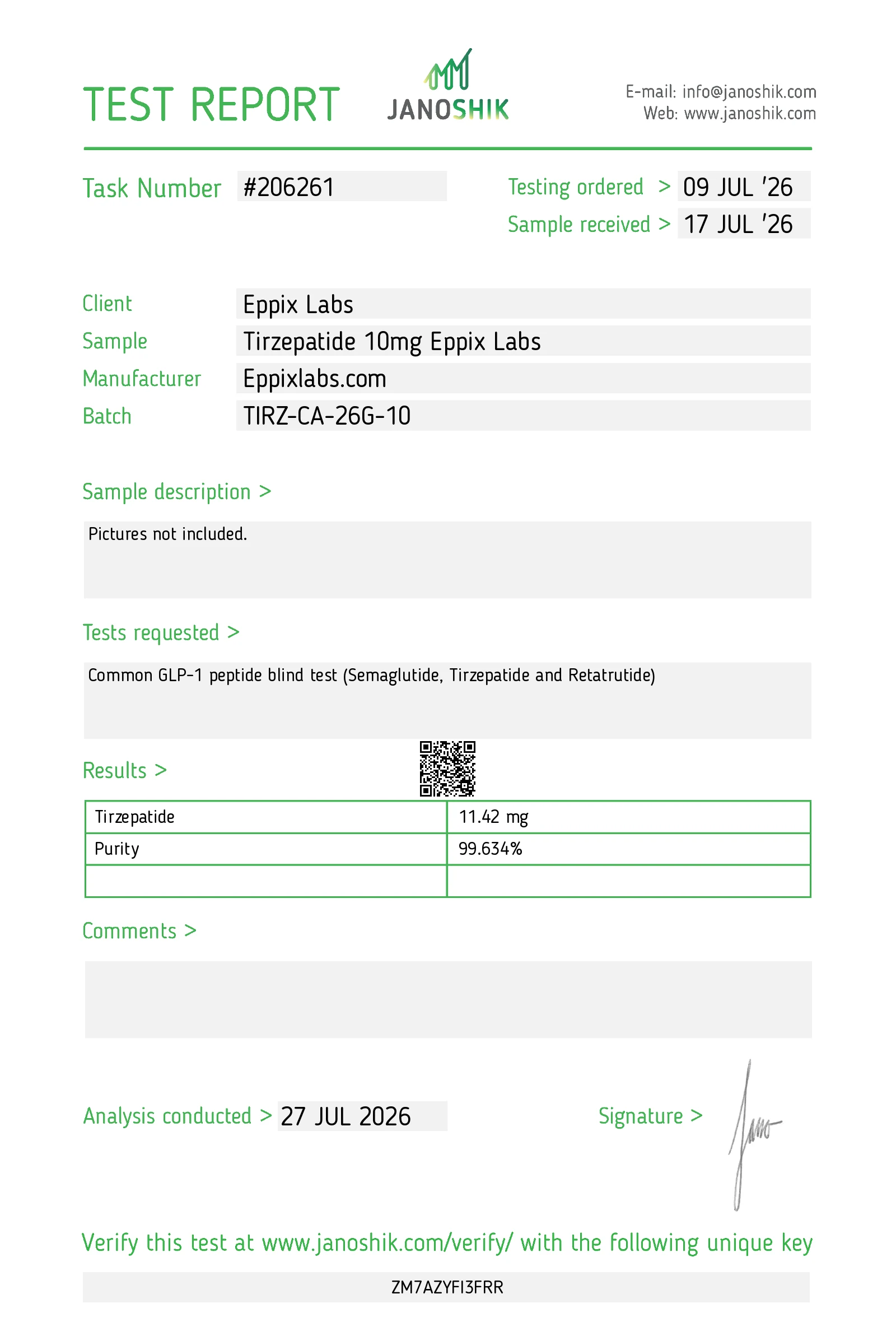
  • ·3. Does the certificate report measured content, or only purity? Purity is the fraction of what is present that is the right compound. Content is how much is present against the label. A vial can be 99.5% pure and hold half of what the label says. Suppliers who test content publish it; suppliers who do not will explain why it is unnecessary.
Published Certificate
Certificate of analysis for Tirzepatide 10mg, batch TIRZ-CA-26A-01, 99.634% purity, 11.42 mg measured content

Select strength

Batch
TIRZ-CA-26A-01
Purity (HPLC)
99.634%
Measured content
11.42 mglabeled 10 mg
Laboratory
Janoshik
What items 1 to 3 look like in practice: per-strength certificates carrying batch, purity and measured content, published before sale.

4 and 5: the verification questions

  • ·4. Can the certificate be verified at the laboratory rather than on the seller's site? A PDF hosted by a seller proves the seller has a PDF. A report key that resolves on the issuing laboratory's own database proves something a seller cannot fabricate. Laboratories operating a public verification system, Janoshik among them, make this a two-minute check.
  • ·5. Do the vials carry batch codes that appear on the certificates? Without that link there is no chain from the object in your hand to the document on the screen. Check that the supplier prints a lot code on the label and that the same code appears on the published certificate.

6 and 7: the supply questions

  • ·6. Is stock held in the US, or drop-shipped from overseas? Domestic stock removes the customs layer entirely: no inspection, no hold, no refusal at the border, and delivery measured in days rather than weeks. A supplier that ships from abroad while presenting as US is passing the import risk to you.
  • ·7. Is stock status per strength, and is it accurate? A catalog where everything is permanently "in stock" is not tracking inventory. A supplier showing genuine out-of-stock states per strength is telling you the numbers on the rest of the page are real.

8: the compliance question

8. Does the site market to human use? Read for dosing tables, protocol suggestions, before-and-after imagery, testimonials describing personal results, or outcome language in product copy. Under the Food and Drugs Act, selling an unapproved substance for human consumption is an offence, and marketing is what establishes intended use.

This is worth caring about for a practical reason beyond principle: enforcement action against a supplier removes its whole catalog, and its customers' supply chain with it. The legal framing is at are peptides legal in the US.

9: the pricing question

9. Is the price explicable? Both directions matter. Material priced far below the market for its class is either underfilled, impure, or not the compound claimed, and the only way to tell is a content figure on a verifiable certificate. Material priced far above the market should come with something identifiable in return: independent testing, domestic stock, published lot history.

Price differences that track synthesis difficulty are real. A 39-residue lipidated peptide costs more to make than a tripeptide, and a catalog that prices them similarly is telling you something about at least one of them.

Using the list

A supplier that fails items 1 to 5 has not established that the vial contains what the label says, whatever else is true about them. Items 6 and 7 concern whether you will receive it. Items 8 and 9 concern whether the supplier will still exist in a year.

For the underlying methods, see how to verify a peptide COA and how to spot a fake COA. Our own published archive is at certificates of analysis and the batch lookup at verify.

Frequently Asked

What is the single most informative check?

Whether the certificate for the specific lot you are buying is published before sale and verifiable on the issuing laboratory's own database. That one item subsumes most of the others.

Does "third-party tested" mean every batch is tested?

No. It is compatible with a single test years ago. The meaningful question is whether the lot you are buying was tested, and whether its certificate carries the batch code on your vial.

Why does domestic stock matter beyond speed?

It removes the customs layer. Imported shipments can be inspected, held or refused, and the importer carries that risk. Domestic stock avoids the question entirely.

Is a very low price always a warning sign?

Not always, but it needs an explanation that a certificate can support. Underfilling is the cheapest way to cut price and the hardest to detect without a measured content figure.

Why does a supplier's marketing language matter to me as a buyer?

Because marketing establishes intended use, and selling an unapproved substance for human consumption is an offence under the Food and Drugs Act. Enforcement against a supplier takes its catalog, and its customers' supply, offline.

How long should this checklist take?

Fifteen minutes on a supplier's public website, before spending anything. Every item is answerable from what a supplier publishes rather than from what it says in response to an email.

Research Use Only

This article summarizes published preclinical research literature. Compounds referenced are supplied by Eppix Labs strictly as research materials for laboratory investigation within the United States. They are not approved by the FDA for human or veterinary use, and nothing on this page should be interpreted as medical advice or guidance on human or animal administration.