FedEx Delivery1–3 day delivery across the U.S.Free on orders over $200

Sourcing Guide

NAD+ in the US: The Coenzyme, Not a Peptide

What NAD+ actually is, why it does not get a purity certificate that looks like a peptide certificate, and what the literature supports

·Compiled by Eppix Labs

NAD+ is the odd item in a peptide catalog, and treating it as a peptide is the first mistake buyers make. It is a dinucleotide coenzyme present in every living cell, not a synthetic peptide, and both the science and the certificate look different as a result.

This guide covers what the coenzyme does, what the NAD-boosting literature actually supports, and why a NAD+ certificate reports what it reports. NAD+ is supplied for laboratory research use only.

Chemical Identity

Name
β-Nicotinamide adenine dinucleotide (NAD+)
Also known as
NAD+, NAD, Nicotinamide adenine dinucleotide, Coenzyme I
Molecular formula
C₂₁H₂₇N₇O₁₄P₂
Molecular weight
663.43 g/mol
CAS number
53-84-9
PubChem CID
5892
Salt forms
Free acid · Disodium salt

What NAD+ is

Nicotinamide adenine dinucleotide is a coenzyme composed of two nucleotides joined through their phosphate groups: one bearing adenine, the other nicotinamide. It cycles between an oxidized form (NAD+) and a reduced form (NADH), and that cycling is the central electron-transfer currency of cellular metabolism.

Beyond redox chemistry, NAD+ is a consumed substrate rather than merely a cofactor for three enzyme families: the sirtuins, the PARPs, and the CD38/CD157 ectoenzymes. Because those enzymes cleave NAD+ rather than recycle it, cellular NAD+ has to be continuously resynthesized, and the balance between consumption and synthesis is what the ageing literature is about.[3]
Research Material
General Image
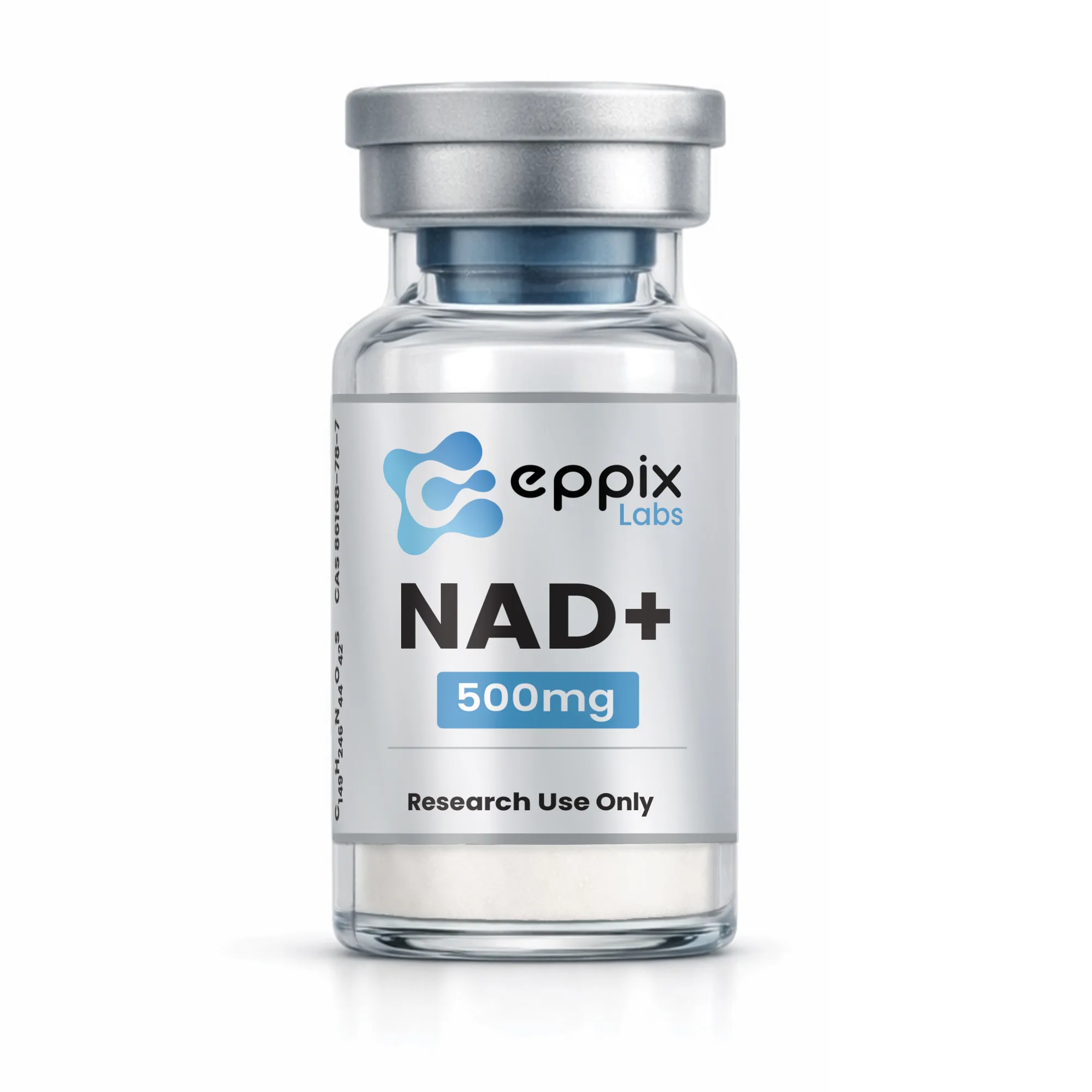
NAD+ lyophilized research material as supplied by Eppix Labs. Labelled and measured content are stated on the certificate below.

Structure

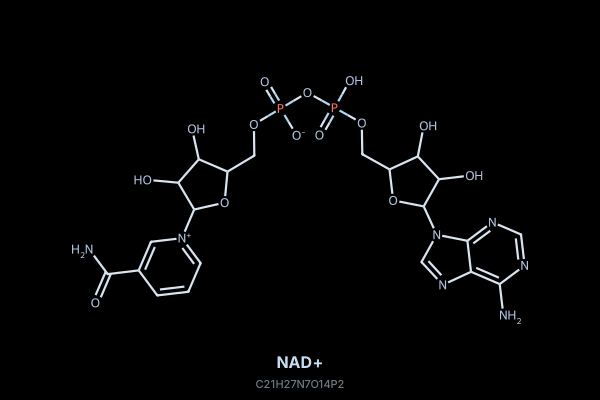
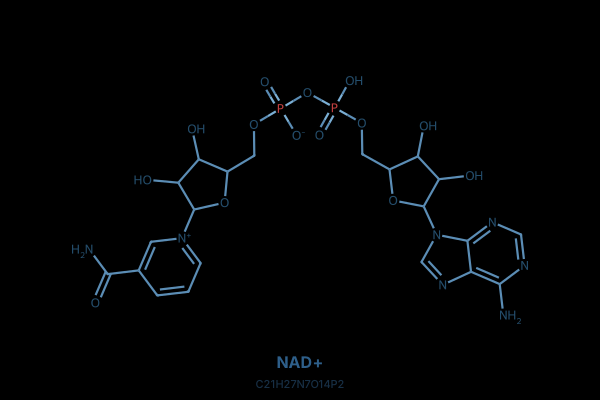
A 663 Da dinucleotide. There is no amino-acid sequence, so there is no chain diagram: this is a small molecule, produced by enzymatic or chemical synthesis rather than by solid-phase peptide synthesis, and its impurity profile is entirely different from a peptide's.

Chemical Structure
Chemical Structure diagram
Chemical structure of β-nicotinamide adenine dinucleotide, C₂₁H₂₇N₇O₁₄P₂.

What the published research shows

The literature divides cleanly into two parts, and conflating them is the standard error in NAD+ marketing.

Part one, which is settled: NAD+ is essential to metabolism, cellular NAD+ declines with age across tissues and species, and that decline is associated with mitochondrial and metabolic dysfunction. Covarrubias et al. (2021) review this in detail.[3] Cantó et al. (2015) cover the energy-homeostasis side.[4]

Part two, which is not settled: whether raising NAD+ by administering precursors or NAD+ itself produces meaningful outcomes. Rajman et al. (2018) review the in-vivo evidence for NAD-boosting molecules and are explicit that the animal data are considerably stronger than the human data.[1] Yoshino et al. (2018) cover the precursor biology, NMN and NR, and the same gap.[2]

The limit of the evidence

Human trials of NAD+ precursors have generally shown that circulating NAD+ metabolites can be raised. Demonstrating a clinical outcome from having raised them is a separate question that the published trials have largely not answered. Direct NAD+ administration has a much thinner human literature than the precursors do.

There is a specific pharmacological problem worth stating: NAD+ is a large, charged molecule that does not readily cross cell membranes intact, and much of what is administered is degraded extracellularly to precursors that are then taken up. Whether "NAD+ administration" is meaningfully different from precursor administration is an open question in the literature, not a settled one.

Regulatory status in the United States

NAD+ is not approved by the FDA as a medicine for human or veterinary use. Nicotinamide and some NAD+ precursors appear in the natural health product framework under separate rules, which do not extend to research material supplied in vials. NAD+ was not among the peptides considered by the US FDA advisory committee in July 2026. Eppix supplies it as a laboratory research material only.

Verifying a NAD+ lot, and why the certificate looks different

A peptide certificate reports HPLC purity as area percent against a single peptide analyte. NAD+ certificates commonly report measured content against the labeled amount instead, and that is not an omission: NAD+ is hygroscopic, degrades in solution, and its relevant quality question is how much intact NAD+ is in the vial rather than what fraction of a synthesis product it represents.

What to check: batch number matching the vial, a named laboratory with an independent verification path, identity confirmed, and measured content against label. If a supplier presents a peptide-style purity figure for NAD+ without explaining the method, ask what analyte it was measured against.

Published Certificate
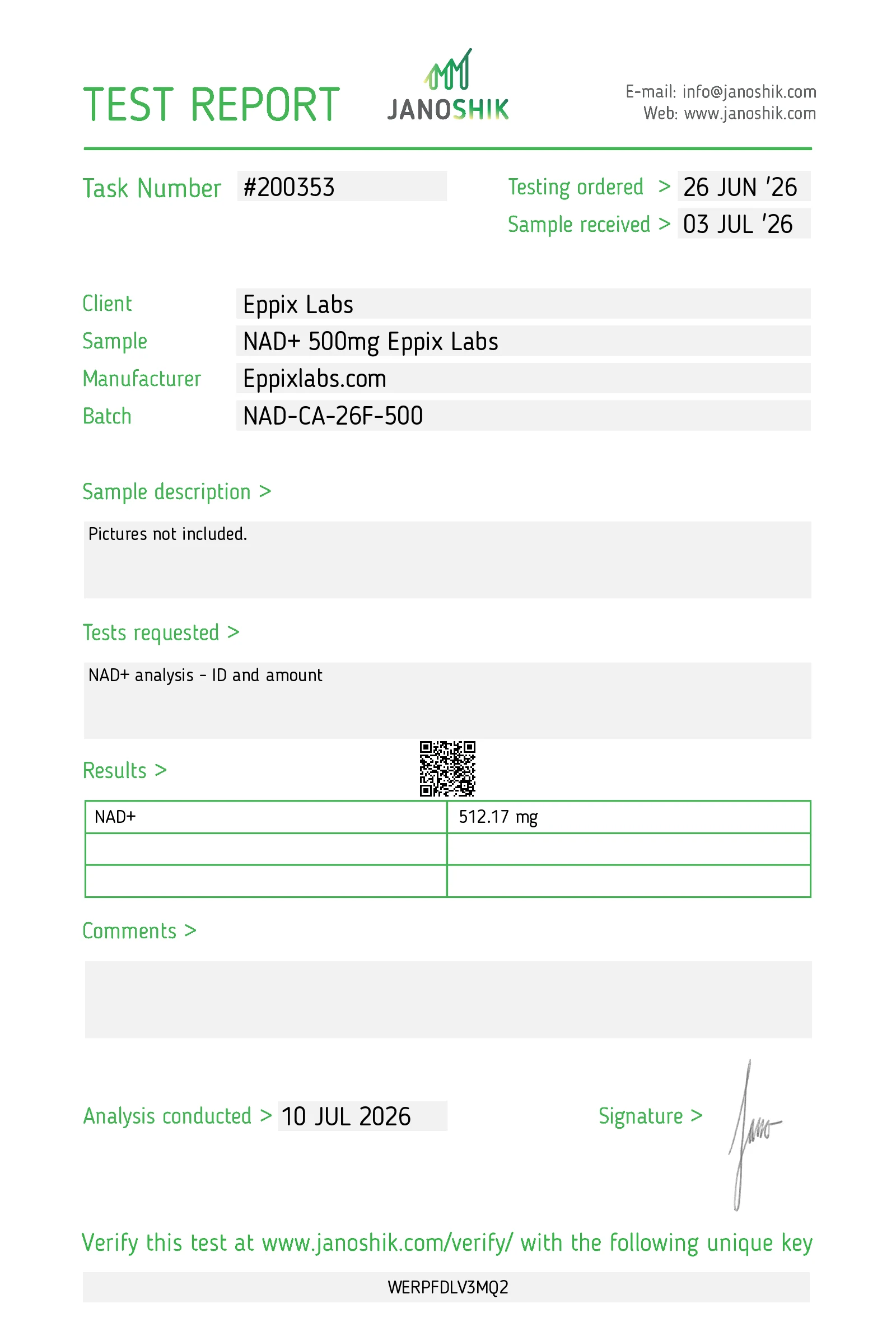
Certificate of analysis for NAD+ 500mg, batch NAD-CA-26A-01, 512.17 mg measured content

Select strength

Batch
NAD-CA-26A-01
Purity (HPLC)
Not reported
Measured content
512.17 mglabeled 500 mg
Laboratory
Janoshik
Published certificates for the current NAD+ lots, by strength. Content is reported against the labeled amount.

Sourcing in the United States

Domestic fulfillment is by FedEx, typically one to three business days across the United States, free over $200 USD, with card and PayPal checkout and mix-and-match pricing at 5 and 10 vials.

NAD+ is more hygroscopic and less stable in solution than most peptides in the catalog, so the handling notes in the peptide storage guide apply with less margin.

Frequently Asked

Is NAD+ a peptide?

No. It is a dinucleotide coenzyme, a small molecule of about 663 Da with no amino-acid sequence. It sits in a peptide catalog for commercial reasons rather than chemical ones.

Is NAD+ legal in the US?

It may be sold and held as a laboratory research material. It is not approved by the FDA as a medicine. Some NAD+ precursors are regulated separately as natural health products, which does not extend to research vials. This is not legal advice.

Why does a NAD+ certificate not show HPLC purity like a peptide certificate?

Because the meaningful question differs. NAD+ is hygroscopic and degrades in solution, so the quality attribute that matters is how much intact NAD+ the vial contains against the label, which is what a content assay measures.

What is the difference between NAD+, NMN and NR?

NAD+ is the coenzyme itself. NMN (nicotinamide mononucleotide) and NR (nicotinamide riboside) are biosynthetic precursors that cells convert to NAD+. Most human trial data in this area is on the precursors rather than on NAD+ itself.

Does the human evidence show that raising NAD+ produces outcomes?

Trials have shown that precursors raise circulating NAD+ metabolites. Showing a clinical outcome from that increase is a separate question the published literature has largely not resolved.

How is NAD+ stored?

Lyophilized: cool, dry, dark, at -20 °C, with particular attention to moisture because NAD+ is markedly hygroscopic. Reconstituted: refrigerated and used promptly, since it is less stable in solution than most peptides.

References

  1. Rajman, L., Chwalek, K., Sinclair, D.A. (2018). Therapeutic potential of NAD-boosting molecules: the in vivo evidence. Cell Metab 27(3):529-547. PMID 29514064
  2. Yoshino, J., Baur, J.A., Imai, S.I. (2018). NAD+ intermediates: the biology and therapeutic potential of NMN and NR. Cell Metab 27(3):513-528. PMID 29249689
  3. Covarrubias, A.J. et al. (2021). NAD+ metabolism and its roles in cellular processes during ageing. Nat Rev Mol Cell Biol 22(2):119-141. PMID 33353981
  4. Cantó, C., Menzies, K.J., Auwerx, J. (2015). NAD+ metabolism and the control of energy homeostasis: a balancing act between mitochondria and the nucleus. Cell Metab 22(1):31-53. PMID 26118927

Research Use Only

This article summarizes published preclinical research literature. Compounds referenced are supplied by Eppix Labs strictly as research materials for laboratory investigation within the United States. They are not approved by the FDA for human or veterinary use, and nothing on this page should be interpreted as medical advice or guidance on human or animal administration.