FedEx Delivery1–3 day delivery across the U.S.Free on orders over $200

Sourcing Guide

5-Amino-1MQ in the US: The NNMT Inhibitor That Is Not a Peptide

A small molecule in a peptide catalog, with a specific enzyme target and a certificate that should look different

·Compiled by Eppix Labs

Two things about 5-Amino-1MQ are worth establishing before anything else. It is not a peptide: it is a small quinolinium molecule of about 159 Da, and both its chemistry and its certificate differ accordingly. And it has a specific, named enzyme target, nicotinamide N-methyltransferase, which is unusual in a category where mechanisms are often described loosely.

This guide covers the target, the published work, and what a certificate for a small molecule should show. 5-Amino-1MQ is supplied for laboratory research use only.

Chemical Identity

Name
5-Amino-1-methylquinolinium (5-Amino-1MQ)
Also known as
5-Amino-1MQ, 5-amino-1-methylquinolinium, NNMT inhibitor
Molecular formula
C₁₀H₁₁N₂⁺ (cation)
Molecular weight
159.21 g/mol (cation); supplied as the iodide salt, 286.11 g/mol
CAS number
90561-90-9 (cation); 42464-96-0 (iodide salt, as supplied)
Salt forms
Iodide · Chloride

What 5-Amino-1MQ is

Nicotinamide N-methyltransferase (NNMT) methylates nicotinamide using S-adenosylmethionine as the methyl donor, producing 1-methylnicotinamide. Because nicotinamide is a NAD+ precursor, NNMT activity diverts it away from NAD+ salvage, and the enzyme is overexpressed in adipose tissue in obesity. That is the rationale: inhibit NNMT, preserve the nicotinamide pool, raise cellular NAD+.[3]

5-Amino-1MQ is a small-molecule, membrane-permeable NNMT inhibitor from the medicinal-chemistry program described by Neelakantan et al., which explored the quinolinium scaffold as a bisubstrate-competitive inhibitor series.[2]
Research Material
5-Amino-1MQ
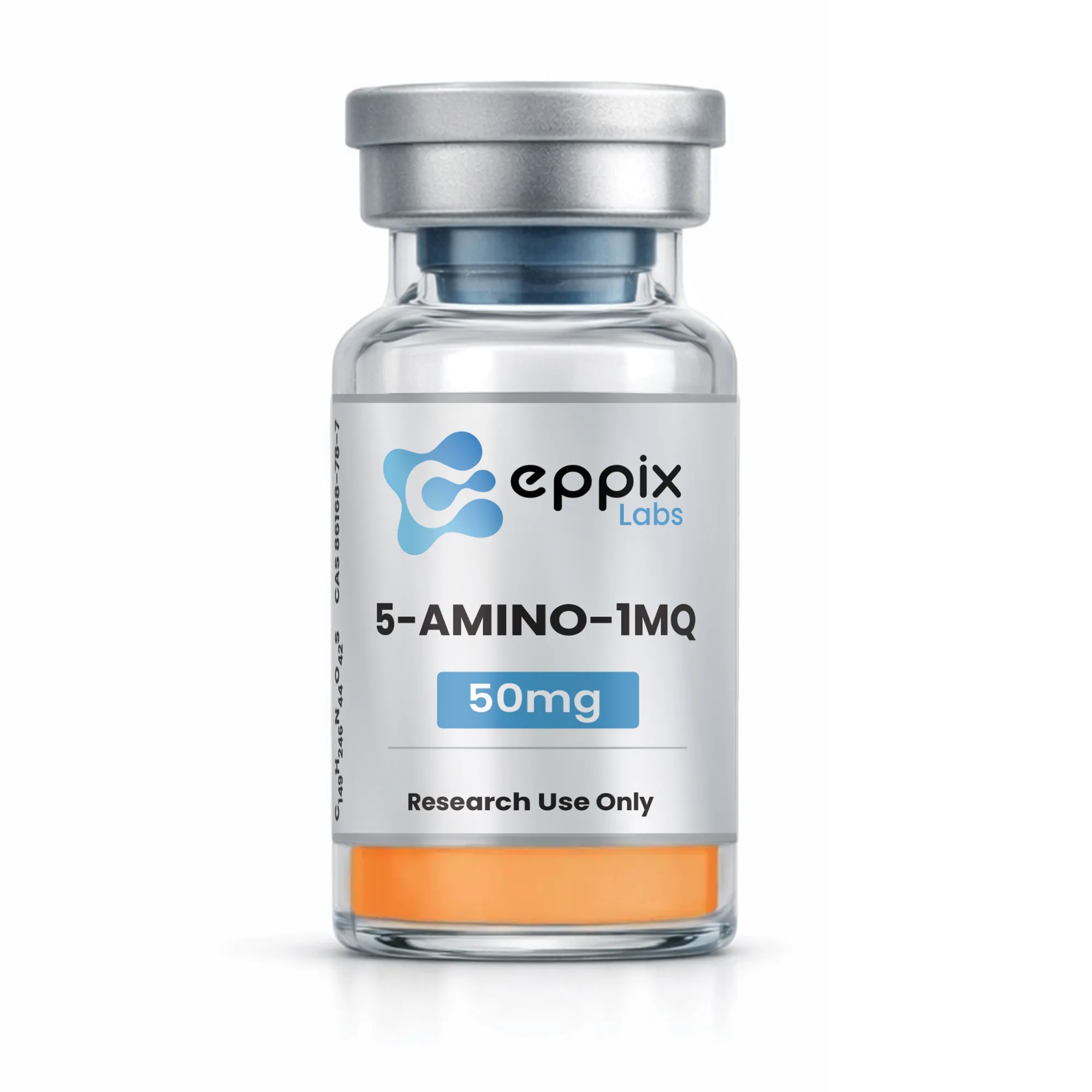
5-Amino-1MQ research material as supplied by Eppix Labs. Labelled and measured content are stated on the certificate below.

Structure

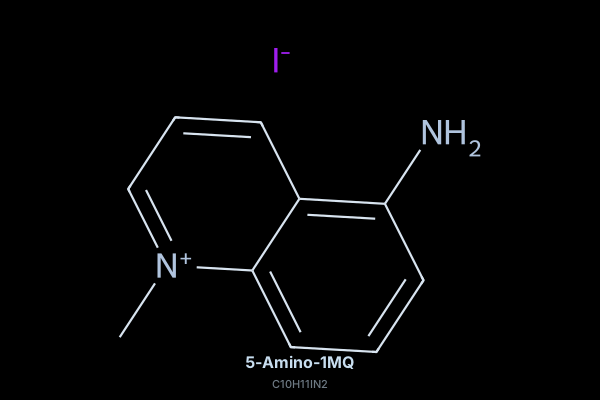
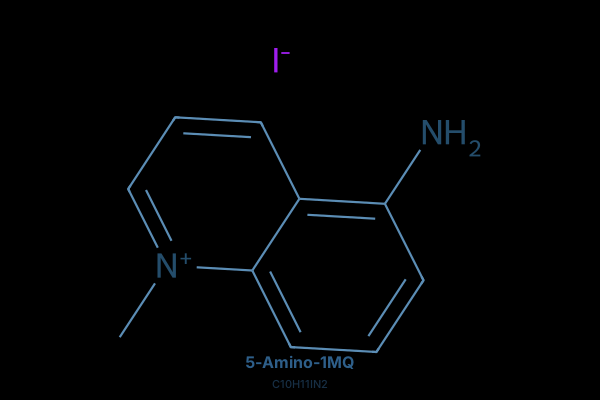
A methylated aminoquinolinium cation, around 159 Da. There is no amino-acid sequence and no chain diagram: this is a heterocyclic small molecule made by organic synthesis, and its impurity profile is that of a small molecule (residual solvents, starting materials, regioisomers) rather than that of a peptide (deletion and truncation sequences).

It is supplied as a salt, most often the iodide. That matters when comparing quoted quantities: the counter-ion contributes mass, and a milligram figure for the iodide salt is not the same quantity of active cation as a milligram figure for the free base.

Chemical Structure
Chemical Structure diagram
Chemical structure of 5-amino-1-methylquinolinium.

What the published research shows

A small, coherent medicinal-chemistry and animal-model literature:

  • ·Target validation. Kraus et al., Nature 2014: knockdown of NNMT in adipose tissue and liver protected mice against diet-induced obesity, with increased cellular energy expenditure. This is the genetic result the pharmacological program was built on.[3]
  • ·Inhibitor series. Neelakantan et al., Journal of Medicinal Chemistry 2017: structure-activity relationships for small-molecule NNMT inhibitors, including the quinolinium scaffold.[2]
  • ·In-vivo pharmacology. Neelakantan et al., Biochemical Pharmacology 2018: selective, membrane-permeable NNMT inhibitors reversed diet-induced obesity in mice, with reported reductions in body weight and adipose mass.[1]

The limit of the evidence

The entire published record is preclinical. There are no human trials of 5-Amino-1MQ, no established human dose, no human safety data, and no approved indication anywhere. The mouse results are from a small number of studies within one research program.

There is also a mechanistic caveat worth stating: NNMT is expressed across many tissues, not only adipose, and the consequences of inhibiting it systemically are not characterized in humans. the FDA has authorized nothing containing it.

Verifying a small-molecule lot, and why the certificate differs

A peptide certificate reports HPLC purity and a measured mass from an assay designed around peptides. A small-molecule certificate should report identity (by MS, and ideally by NMR for a synthetic heterocycle), purity by HPLC against the correct analyte, and content against label, along with the salt form.

Two questions to ask that do not arise for peptides: which salt is being quoted, and whether the quoted quantity refers to the salt or to the free cation. A supplier who cannot answer either has not characterized the material to the standard the compound requires.

Every Eppix 5-Amino-1MQ lot is tested by Janoshik Analytical, published before sale and verifiable on the laboratory's own database.

Published Certificate
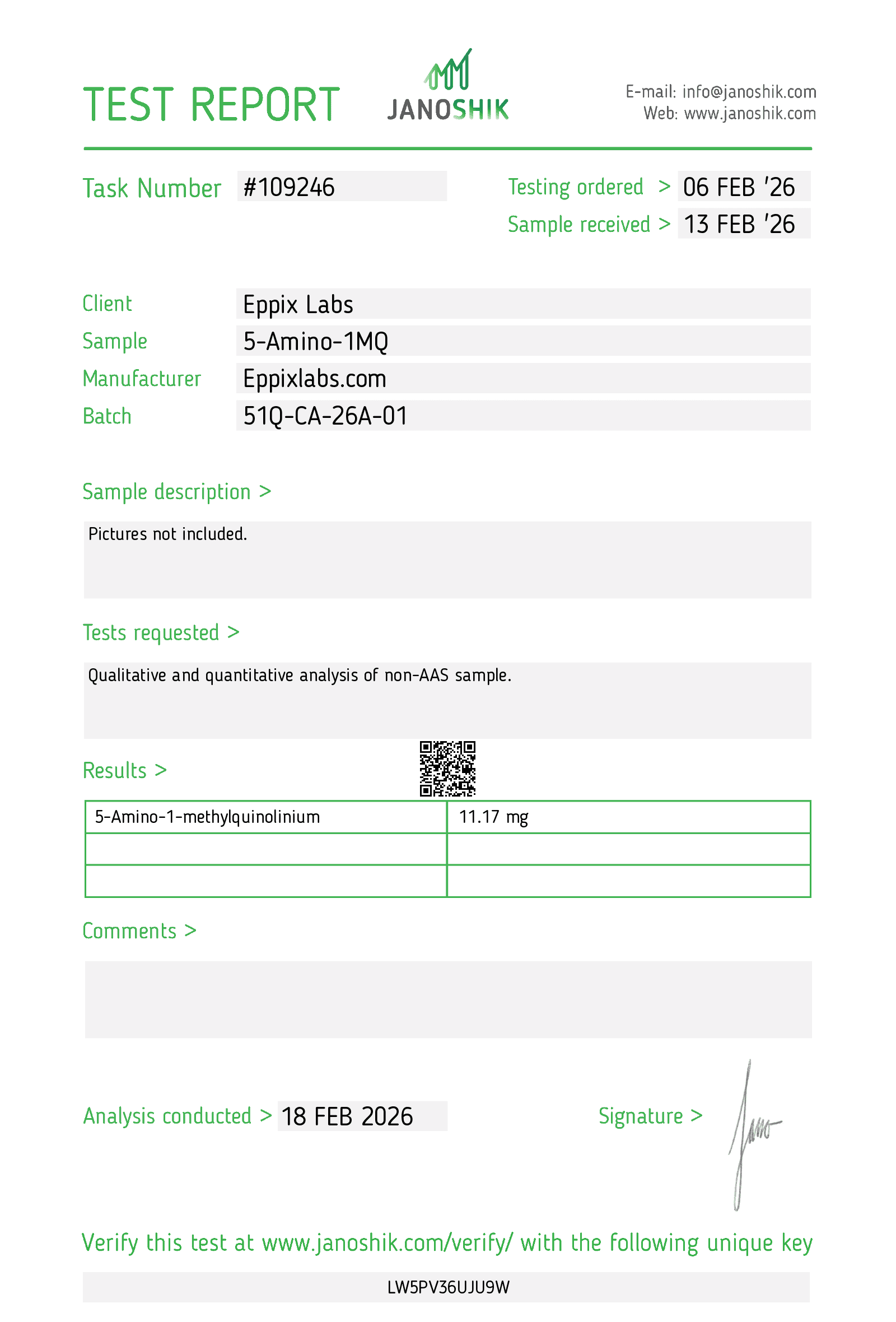
Certificate of analysis for 5-Amino-1MQ 10mg, batch 51Q-CA-26A-01, 11.17 mg measured content
Batch
51Q-CA-26A-01
Purity (HPLC)
Not reported
Measured content
11.17 mglabeled 10 mg
Laboratory
Janoshik
Published certificate for the current 5-Amino-1MQ lot, read live from the batch record.

Frequently Asked

Is 5-Amino-1MQ a peptide?

No. It is a small quinolinium molecule of about 159 Da with no amino-acid sequence, made by organic synthesis. It appears in peptide catalogues for commercial reasons rather than chemical ones.

What does NNMT do?

Nicotinamide N-methyltransferase methylates nicotinamide, diverting it from the NAD+ salvage pathway. It is overexpressed in adipose tissue in obesity, which is the basis for interest in inhibiting it.

Is 5-Amino-1MQ legal in the US?

It may be sold and held as a laboratory research material. It is not approved by the FDA for human or veterinary use. This is not legal advice.

Are there human trials of 5-Amino-1MQ?

No. The published record is entirely preclinical: enzyme assays, medicinal-chemistry work and mouse models.

Why does the salt form matter?

The compound is supplied as a salt, usually the iodide. The counter-ion contributes mass, so a milligram figure for the salt is not the same quantity of active cation as the same figure for the free base. A certificate should state which it refers to.

How is 5-Amino-1MQ stored?

Cool, dry and dark. Small heterocyclic salts are generally more robust than peptides, but quaternary ammonium compounds are hygroscopic and should be protected from moisture.

References

  1. Neelakantan, H. et al. (2018). Selective and membrane-permeable small molecule inhibitors of nicotinamide N-methyltransferase reverse high fat diet-induced obesity in mice. Biochem Pharmacol 147:141-152. PMID 29155147
  2. Neelakantan, H. et al. (2017). Structure-activity relationship for small molecule inhibitors of nicotinamide N-methyltransferase. J Med Chem 60(12):5015-5028. PMID 28548833
  3. Kraus, D. et al. (2014). Nicotinamide N-methyltransferase knockdown protects against diet-induced obesity. Nature 508(7495):258-262. PMID 24717514

Research Use Only

This article summarizes published preclinical research literature. Compounds referenced are supplied by Eppix Labs strictly as research materials for laboratory investigation within the United States. They are not approved by the FDA for human or veterinary use, and nothing on this page should be interpreted as medical advice or guidance on human or animal administration.