✦Canada Post Xpress1–2 day delivery across CanadaFree on orders over $200
Your cart is empty
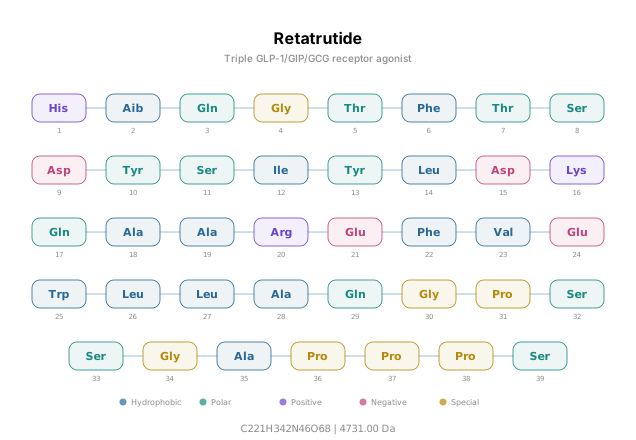
Triple Receptor Agonist
Reta is a research compound studied in laboratory models for its interaction with metabolic signaling pathways, particularly those related to energy balance and glucose regulation systems. Investigations often focus on its receptor activity, downstream intracellular signaling, and overall effects on metabolic pathway modulation in controlled experimental settings.
This product is intended strictly for laboratory research use within Canada. It is not approved by Health Canada for the diagnosis, treatment, cure, or prevention of any disease. Not for human or veterinary use.
By purchasing, you confirm the material will be used solely for lawful research purposes in accordance with applicable Canadian regulations.
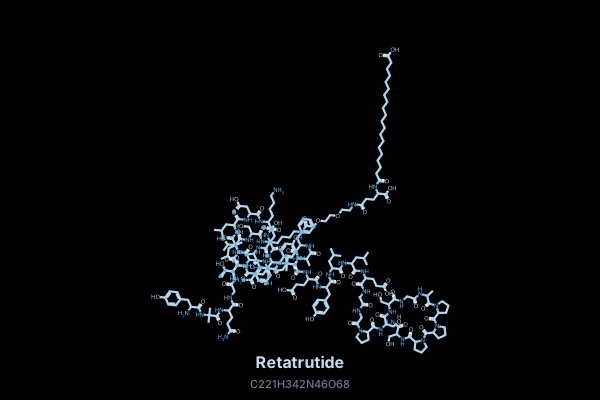
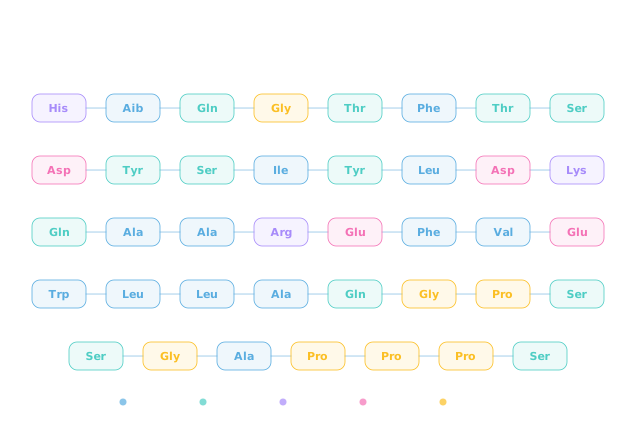
Reta, also known as retatrutide, is a synthetic peptide developed for controlled laboratory research involving multi-receptor signaling systems. It is structurally designed to interact with GLP-1, GIP, and glucagon receptor pathways within experimental environments.
In scientific literature, Reta is studied for its interaction with multi-receptor signaling pathways, including GLP-1, GIP, and glucagon receptor systems. Research frameworks examine its role in metabolic signaling processes, insulin-related pathway activity, and energy regulation mechanisms within controlled in vitro and preclinical models.
Third-party tested for purity, ID, quantity.
Reta (retatrutide) is a next-generation synthetic peptide evaluated in research focused on triple agonist receptor activity. As a compound engineered to interact with GLP-1, GIP, and glucagon receptor systems, it is studied within experimental models examining receptor-driven signaling pathways and metabolic pathway interaction.
Preclinical and clinical research publications have explored its receptor-binding profile, downstream pathway activation, and multi-receptor signaling dynamics under controlled study conditions.
Retatrutide emerged from ongoing research into incretin-based and glucagon receptor–targeted peptide analogues. It was developed as part of broader investigations into multi-agonist strategies within metabolic and endocrine research frameworks.
Early phase studies documented its simultaneous receptor activity across three distinct hormonal pathways, contributing to its classification as a triple receptor agonist in experimental literature.
Laboratory investigations into Reta have focused on its multi-receptor agonist properties and signaling behavior across GLP-1, GIP, and glucagon receptor systems. Research models examine receptor activation dynamics, metabolic signaling pathways, insulin-related pathway interaction, and endocrine regulatory mechanisms under controlled experimental conditions.
No. Eppix Labs products are supplied exclusively for laboratory research. We do not provide dosing, administration, or usage guidance.
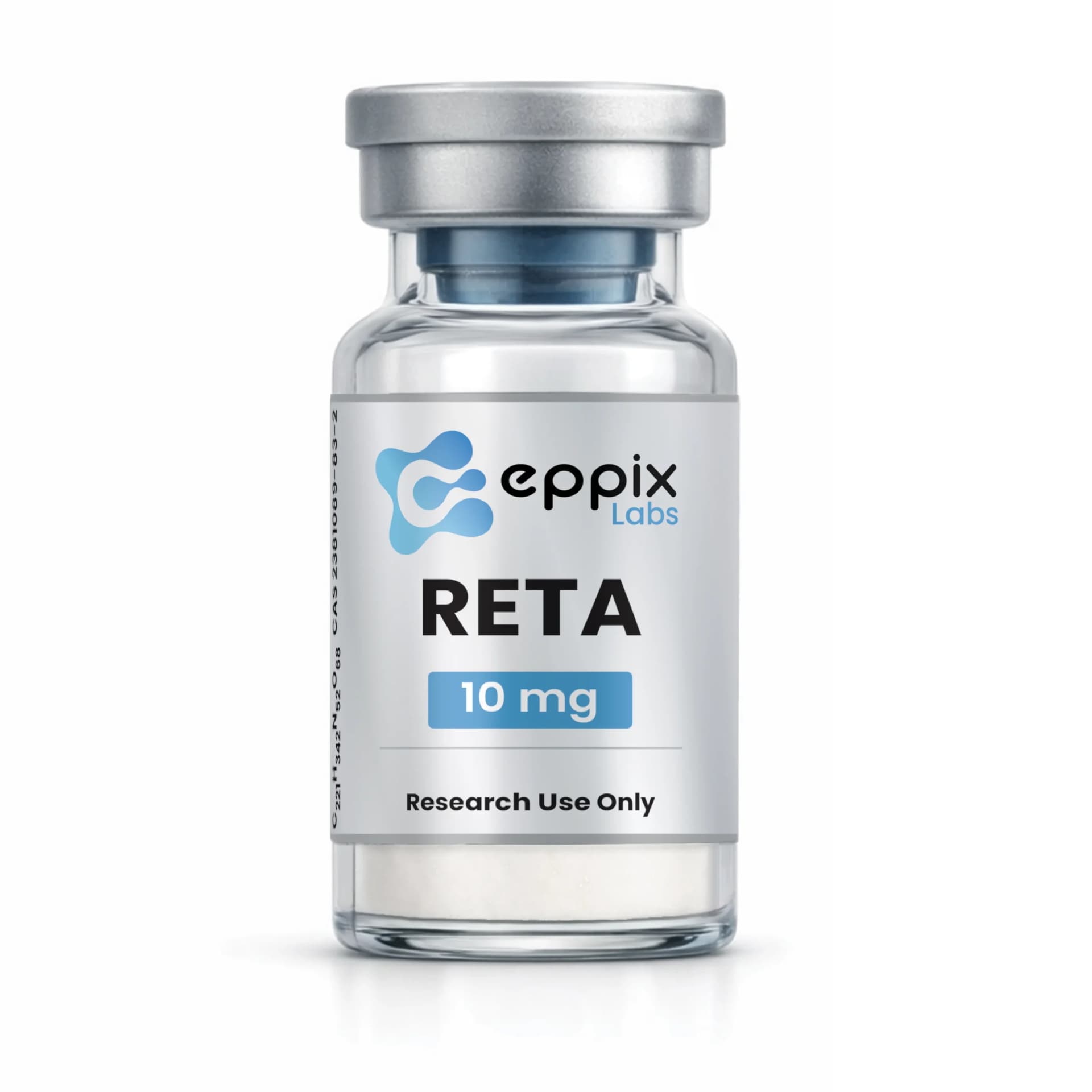
Each vial contains the labeled quantity (10mg, 20mg, or 50mg) of lyophilized Reta. Independent third-party analysis verifies purity, identity, and net content per batch.
The vial contains only the lyophilized compound. Any laboratory materials required for reconstitution or experimental procedures must be sourced separately.
Duration depends entirely on research protocol, storage conditions, and laboratory application.
Triple-Hormone-Receptor Agonist Retatrutide for Obesity - A Phase 2 Trial. N Engl J Med 389(6):514–526.
PubMedLY3437943, a novel triple glucagon, GIP, and GLP-1 receptor agonist for glycemic control and weight loss: From discovery to clinical proof of concept. Cell Metab 34(9):1234–1247.e9.
PubMedRetatrutide, a GIP, GLP-1 and glucagon receptor agonist, for people with type 2 diabetes: a randomised, double-blind, placebo and active-controlled, parallel-group, phase 2 trial conducted in the USA. Lancet 402(10401):529–544.
PubMedGlucagon Receptor Signaling and Glucagon Resistance. Int J Mol Sci 20(13):3314.
PubMedEmerging opportunities for the treatment of metabolic diseases: Glucagon-like peptide-1 based multi-agonists. Mol Cell Endocrinol 418 Pt 1:42–54.
PubMedRelated
Studied in metabolic research for its effects on glucose regulation, appetite signaling, and energy balance.
From$180.00
Dual incretin receptor agonist studied for glucose regulation, metabolic signaling, and weight pathway research
From$10.00
Immune-modulating peptide studied for T-cell signaling and immune system regulatory pathway research
From$70.00
GHRH analog studied for growth hormone regulation and metabolic pathway signaling research
From$95.00