Store launching soon — browse the catalog and join the waitlist to be notified at launch.
✦USPS Priority Mail1–3 day delivery across the U.S.Free on orders over $200
Store launching soon — browse the catalog and join the waitlist to be notified at launch.
Your cart is empty
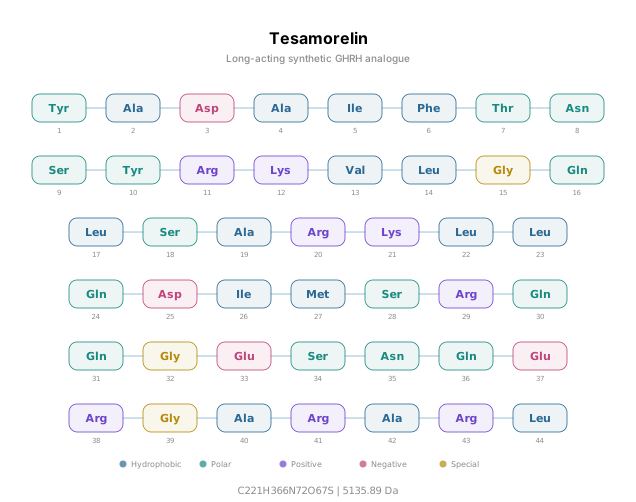
Janoshik
Batch TESA-CA-26A-01
GHRH Analogue Research Peptide
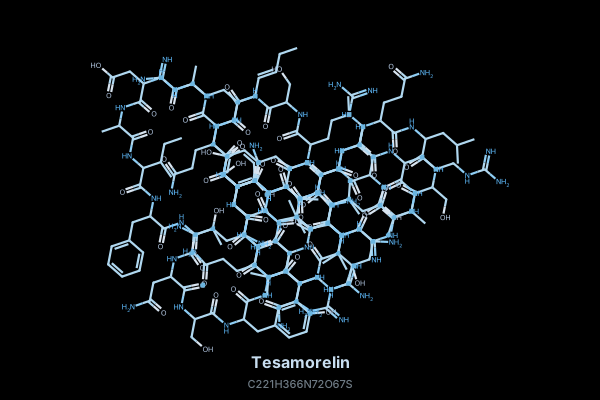
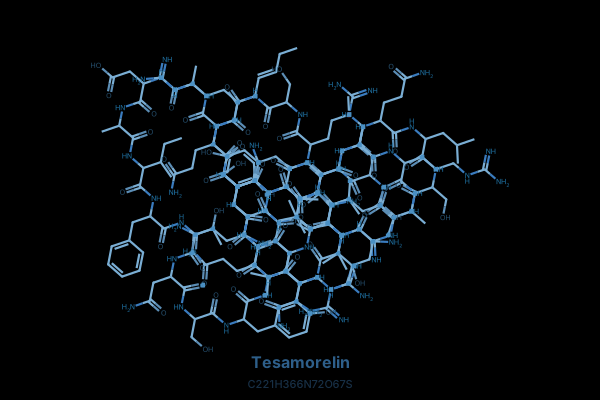
Tesamorelin is a synthetic peptide studied in laboratory settings for its role in stimulating growth hormone–releasing pathways and downstream endocrine signaling. Research often examines its interaction with GH-related mechanisms, metabolic regulation processes, and broader hormonal communication systems in controlled experimental models.
🚀 Launching soon — join the waitlist to be notified when this product is available.
This product is intended strictly for laboratory research use within the United States. It is not approved by the FDA for the diagnosis, treatment, cure, or prevention of any disease. Not for human or veterinary use.
By purchasing, you confirm the material will be used solely for lawful research purposes in accordance with applicable U.S. federal, state, and local regulations.
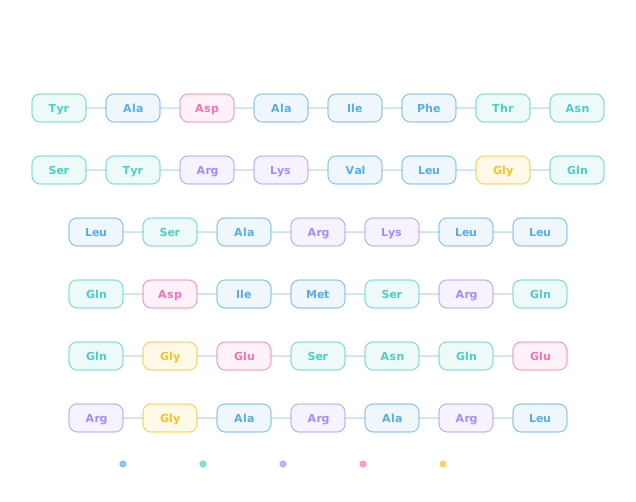
Tesamorelin is a synthetic peptide analogue of growth hormone–releasing hormone (GHRH). It is developed for controlled laboratory research involving hypothalamic-pituitary signaling systems.
In scientific literature, tesamorelin is studied in experimental models examining GHRH receptor interaction, endocrine pathway signaling cascades, and downstream growth hormone–associated regulatory mechanisms under in vitro and preclinical research conditions.


Tesamorelin is a stabilized synthetic analogue of GHRH designed to extend receptor interaction duration within experimental systems. Research has examined its interaction with GHRH receptors and associated endocrine signaling frameworks in controlled laboratory environments.
Preclinical and clinical research publications have explored its receptor-binding characteristics and downstream growth hormone–associated pathway activity under structured study conditions.
Tesamorelin was developed through research efforts aimed at modifying native GHRH sequences to enhance stability and receptor interaction time. Investigations into GHRH pathway modulation led to the synthesis of stabilized analogues for experimental evaluation.
Subsequent studies documented its receptor-binding profile and signaling characteristics within endocrine research frameworks.
Laboratory investigations into tesamorelin have focused on GHRH receptor activation models and downstream endocrine signaling pathways. Research frameworks evaluate receptor-mediated interaction, hypothalamic-pituitary axis dynamics, and growth hormone–associated regulatory systems under controlled in vitro and preclinical conditions.
No. Eppix Labs products are supplied exclusively for laboratory research. We do not provide dosing, administration, or usage guidance.
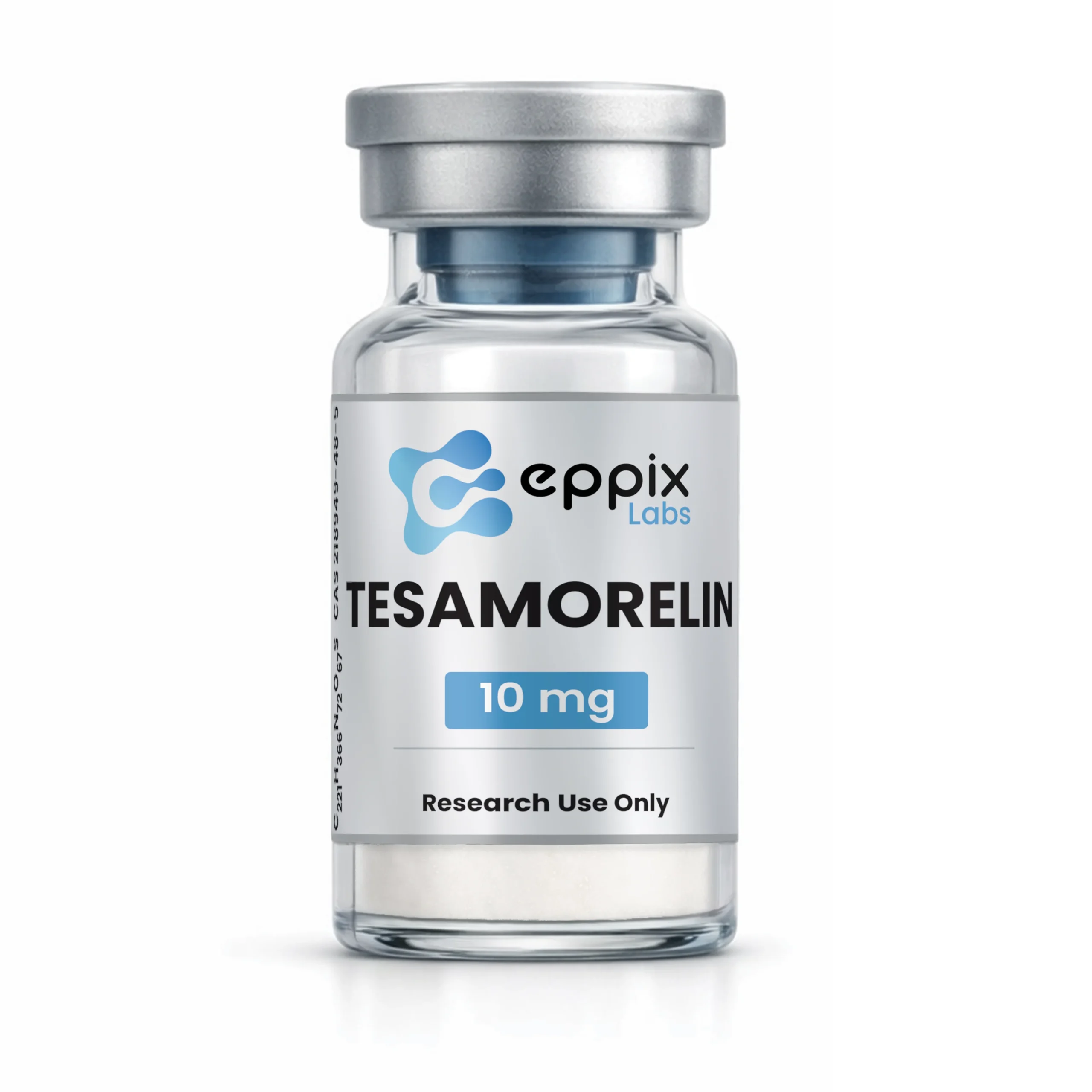
Each vial contains 10mg of lyophilized tesamorelin. Independent third-party testing verifies purity, identity, and net content per batch.
The vial contains only the peptide preparation. Any laboratory materials required for experimental procedures must be sourced separately.
Duration depends entirely on research protocol, storage conditions, and laboratory application.
Effects of tesamorelin (TH9507), a growth hormone–releasing factor analogue, in HIV-infected patients with abdominal fat accumulation: a randomized placebo-controlled trial with a safety extension.
PubMedEffects of tesamorelin (TH9507), a growth hormone-releasing factor analog, in human immunodeficiency virus-infected patients with excess abdominal fat: a pooled analysis of two multicenter, double-blind placebo-controlled phase 3 trials with safety extension data. J Clin Endocrinol Metab 95(9):4291–4304.
PubMedEffects of tesamorelin on non-alcoholic fatty liver disease in HIV: a randomised, double-blind, multicentre trial. Lancet HIV 6(12):e821–e830.
PubMedRelated
Pentadecapeptide studied for angiogenesis signaling, tissue repair pathways, and cellular regeneration research
From$50.00
$60.00
Small molecule studied for metabolic regulation, NAD pathways, and cellular energy signaling
From$40.00
Dual peptide complex studied for actin signaling, tissue regeneration pathways, and recovery system research
From$80.00
Oral peptide format studied for systemic repair signaling and gastrointestinal pathway research
$140.00