

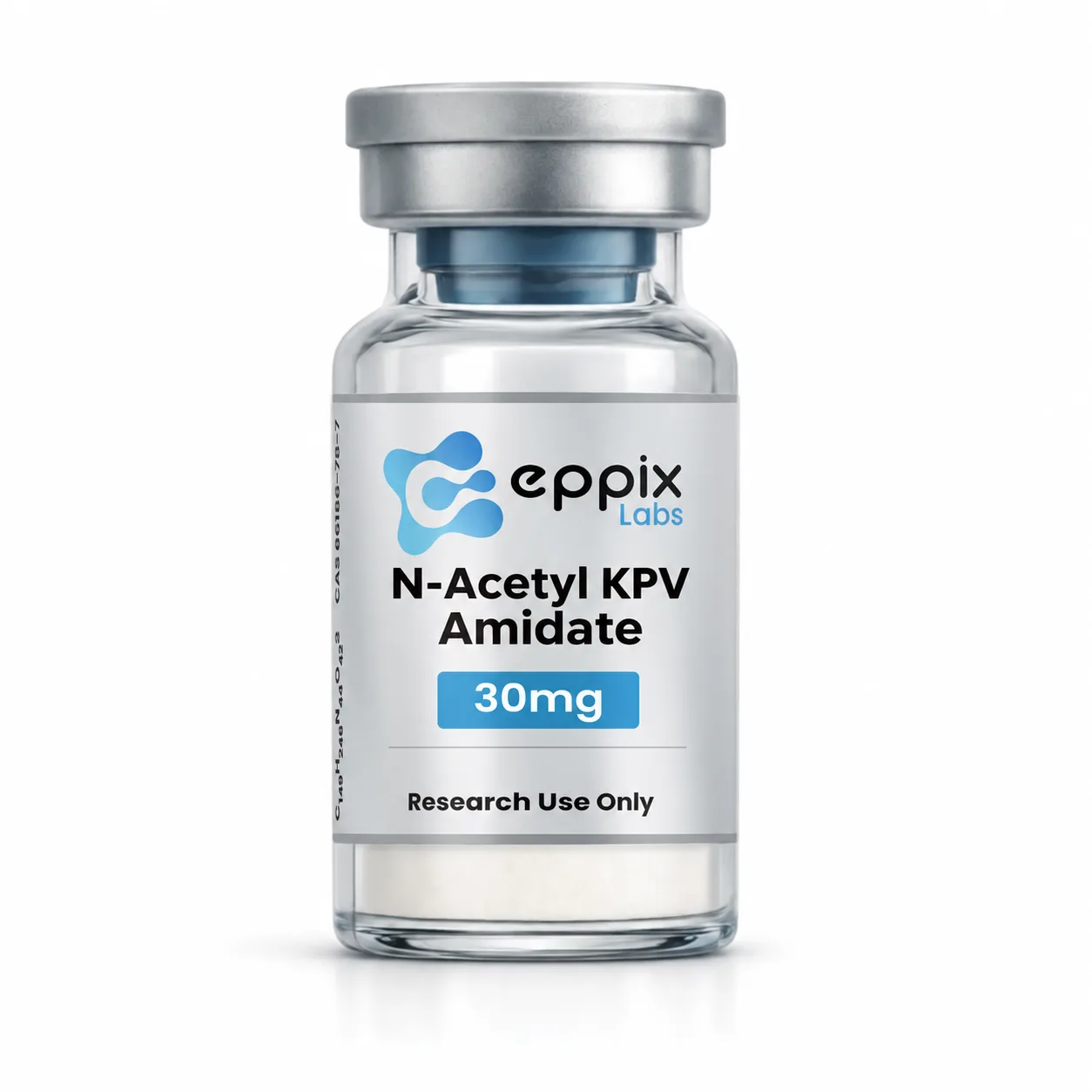
N-Acetyl KPV Amidate30mg
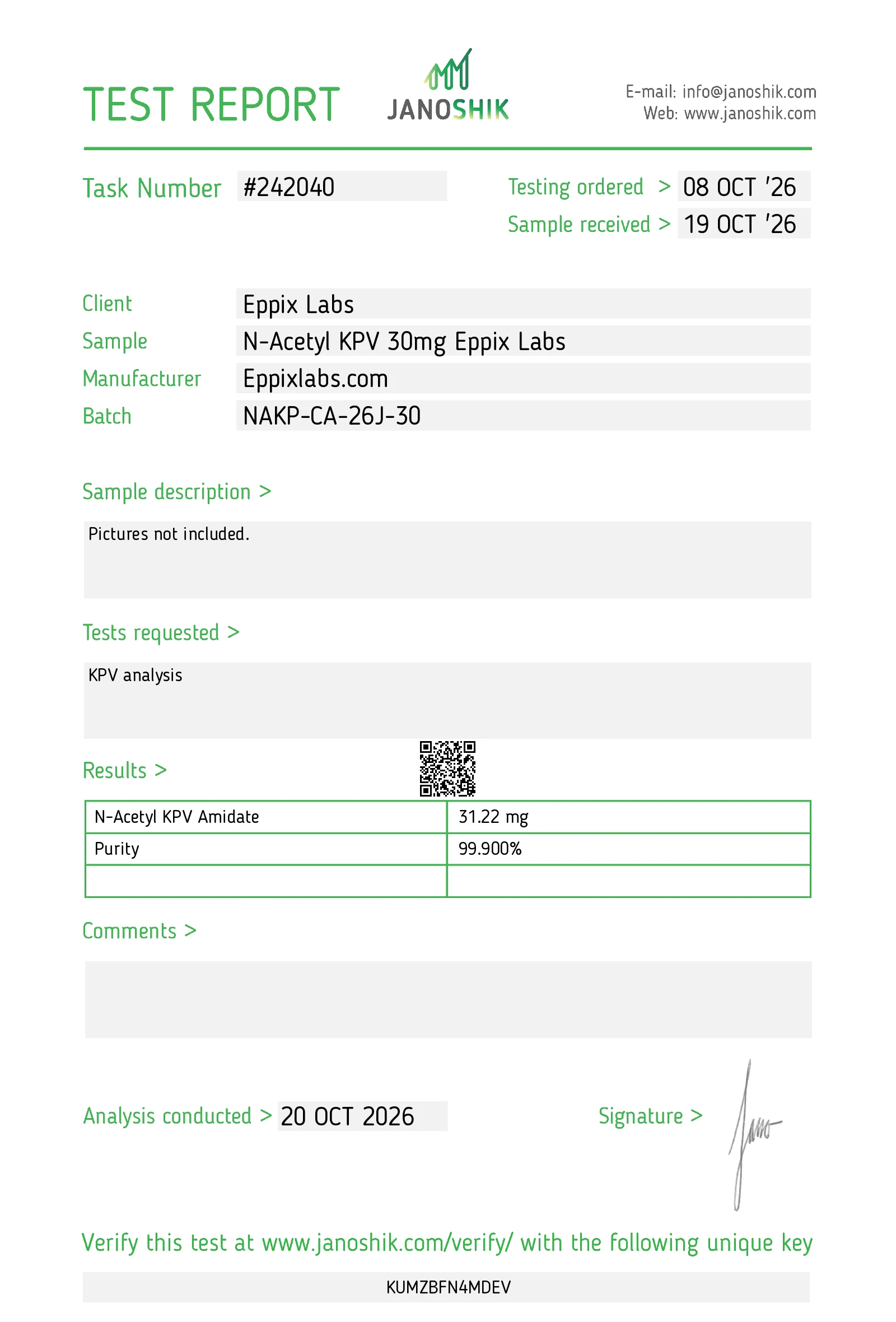
- Batch
- NAKP-CA-26J-30
- Tested by
- Janoshik
- Tested on
- 2026-10-20
- Added
- 2026-11-02
1.754 EU/Vial.
Measures bacterial endotoxin present in the material.
Batch NAKP-CA-26J-30 · this lot
View endotoxin report →Endotoxin and heavy-metals testing is done periodically on selected batches to verify quality — not on every batch. Each result applies to the batch shown.
N-Acetyl KPV Amidate 30 mg
N-Acetyl KPV Amidate USA — 30 mg Lyophilized Vials
Tripeptide Research Compound
Also known as Ac-KPV-NH2
N-Acetyl KPV Amidate is a short synthetic peptide corresponding to the lysine-proline-valine sequence with an acetyl group at the N-terminus and an amide at the C-terminus. It is supplied for laboratory research use only.
Mix & Match
1 vial — no vial discount yet.
Add 2 more vials for 5% off.
After that, 10% at 5 vials, 20% at 10 vials.
This product is intended strictly for laboratory research use within the United States. It is not approved by the FDA for the diagnosis, treatment, cure, or prevention of any disease. Not for human or veterinary use.
By purchasing, you confirm the material will be used solely for lawful research purposes in accordance with applicable U.S. federal, state, and local regulations.
N-Acetyl KPV Amidate is a short synthetic peptide corresponding to the lysine-proline-valine sequence with an acetyl group at the N-terminus and an amide at the C-terminus. It is supplied for laboratory research use only.
No published literature specific to this compound was identified during preparation of this page. The research record for this exact modified sequence is not documented in the sources available to us, and statements about its activity cannot be grounded here.
Third-party tested for purity, ID, quantity.
The named structure is a tripeptide bearing two common terminal modifications: N-terminal acetylation and C-terminal amidation. These modifications are used generally in peptide chemistry, but their specific effect on this sequence has not been established in literature available for this page.
A mechanism of action for N-Acetyl KPV Amidate is not well documented. No receptor target, signaling pathway, or set of evaluated research endpoints could be verified for this compound, and none is asserted here.
The origin of N-Acetyl KPV Amidate is not well documented. No synthesis report, originating laboratory, or development program could be identified for this specific modified sequence.
Because no published record was located, the way research interest in this compound developed cannot be described. Any account of its history would be speculation.
No research frameworks involving N-Acetyl KPV Amidate could be verified from published sources. The compound is supplied as a laboratory reference material, and the published record for this exact sequence and modification pattern appears to be absent or not retrievable. Investigators should establish characterization and study design independently rather than relying on assumed precedent.
0 of the 3 areas below are addressed directly by a paper cited on this page.
Synthetic tripeptide chemistry
No paper is cited on this page for N-Acetyl KPV Amidate, so nothing supports this line of enquiry specifically. The heading describes where the compound is discussed in this category, not what has been shown about it.
Terminally modified peptide characterization
No paper is cited on this page for N-Acetyl KPV Amidate, so nothing supports this line of enquiry specifically. The heading describes where the compound is discussed in this category, not what has been shown about it.
Analytical reference material use
No paper is cited on this page for N-Acetyl KPV Amidate, so nothing supports this line of enquiry specifically. The heading describes where the compound is discussed in this category, not what has been shown about it.
No primary literature is cited on this page for N-Acetyl KPV Amidate. Where a compound has little or no indexed research behind it, saying so is more useful than presenting a thin record as a full one.
Research compounds attract claims that outrun their evidence. Below are the ones most often encountered for N-Acetyl KPV Amidate, set against what the papers cited on this page actually report. Where the record is thin or contested, that is stated rather than smoothed over.
N-Acetyl KPV Amidate is described across this category in connection with synthetic tripeptide chemistry, terminally modified peptide characterization and analytical reference material use.
No primary literature is cited on this page for N-Acetyl KPV Amidate, because none suitable for citation was identified. That is the finding, not an omission: where a compound has no indexed published research behind it, no claim about what it does in any system is supported — including the framing above. It is supplied strictly as a research material for laboratory use.
Nothing above is a statement of what this material does. It is a summary of what has been published and what has not. Eppix Labs supplies research materials only and provides no dosing, administration or protocol guidance.
Verification for N-Acetyl KPV Amidate is per lot, not per product. The current 30mg lot NAKP-CA-26J-30 returned 99.9% purity, 31.22 mg measured, 104.1% of the labelled 30 mg, assayed by Janoshik. Those figures are the laboratory's, published in full rather than reduced to a badge.
Purity is half the number. It states what fraction of the material in the vial is N-Acetyl KPV Amidate; it says nothing about how much material is in the vial, and a short-filled vial can return a purity result that is entirely accurate. The figure that answers the second question is measured mass against expected content — for N-Acetyl KPV Amidate, this lot measured 104.1% of its labelled 30 mg. Both numbers are published for every lot, whichever way they fall.
The lot code printed on the vial matches the code on the certificate for N-Acetyl KPV Amidate. Matching the two is what confirms the unit in hand came from the batch that was tested — a certificate not tied to a lot code proves nothing about any particular unit.
Researchers who buy N-Acetyl KPV Amidate in the United States through Eppix Labs receive the lot described by the certificate above: the code printed on the vial label is the code on the certificate, and both are searchable on the batch verification page.
- Lyophilized storage
- −20 °C long-term; stable at room temperature in transit
- After reconstitution
- 2–8 °C
- Light
- Protect from UV and direct light
- Freeze-thaw
- Avoid repeated cycles
- Vehicle
- Solvent selection depends on the compound; consult the published literature
- Format
- Lyophilized powder
N-Acetyl KPV Amidate is supplied as lyophilized powder. It is not a peptide, and solvent behaviour follows from its own chemistry rather than from the aqueous-vehicle conventions that apply to peptide material — the published literature for this compound is the reference for solvent selection, not a general peptide protocol.
Dry storage below freezing and protection from light are the general controls. As with any lyophilized material, the powder frequently sits as a thin film at the base of the vial and is easy to mistake for an empty vial before inspection.
Vials may appear empty on arrival. Lyophilized material collects at the base of the vial and is often not visible until the vial is inspected under direct light.
- 1 × sealed glass vial in the strength selected (30mg / Single Vial, 30mg / 5-Pack, 30mg / 10-Pack available), batch-labelled
- The batch-linked Certificate of Analysis for the exact lot shipped
- Discreet outer packaging with no product names on the exterior
- FedEx, tracked, typically 1–3 business days domestically
- Bacteriostatic water or any other reconstitution vehicle
- Syringes, needles or filters
- Dosing, administration or protocol guidance of any kind
Reconstitution materials are sourced separately. The reconstitution calculator on this site works out concentrations for a given volume, but it is an arithmetic tool for laboratory record-keeping and not a protocol.
No. Eppix Labs products are supplied exclusively for laboratory research. We do not provide dosing, administration, or usage guidance.
Each vial contains the labeled quantity of lyophilized N-Acetyl KPV Amidate. Independent third-party analysis verifies purity, identity, and net content per batch.
The vial contains only the lyophilized compound. Any laboratory materials required for reconstitution or experimental procedures must be sourced separately.
Duration depends entirely on research design, storage conditions, and laboratory protocol.
Related
You May Also Like
Recovery Compound BPC-157 is a synthetic peptide derived from a fragment of a naturally occurring gastric protein. It is produced for laboratory research and studied within controlled experimental environments.
From$49.99
Thymosin Beta-4 Fragment Research Peptide TB-500 is a synthetic research peptide modeled after thymosin beta-4, a naturally occurring peptide involved in cellular signaling processes. It is developed for controlled laboratory investigation within regulated experimental environments.
From$59.99
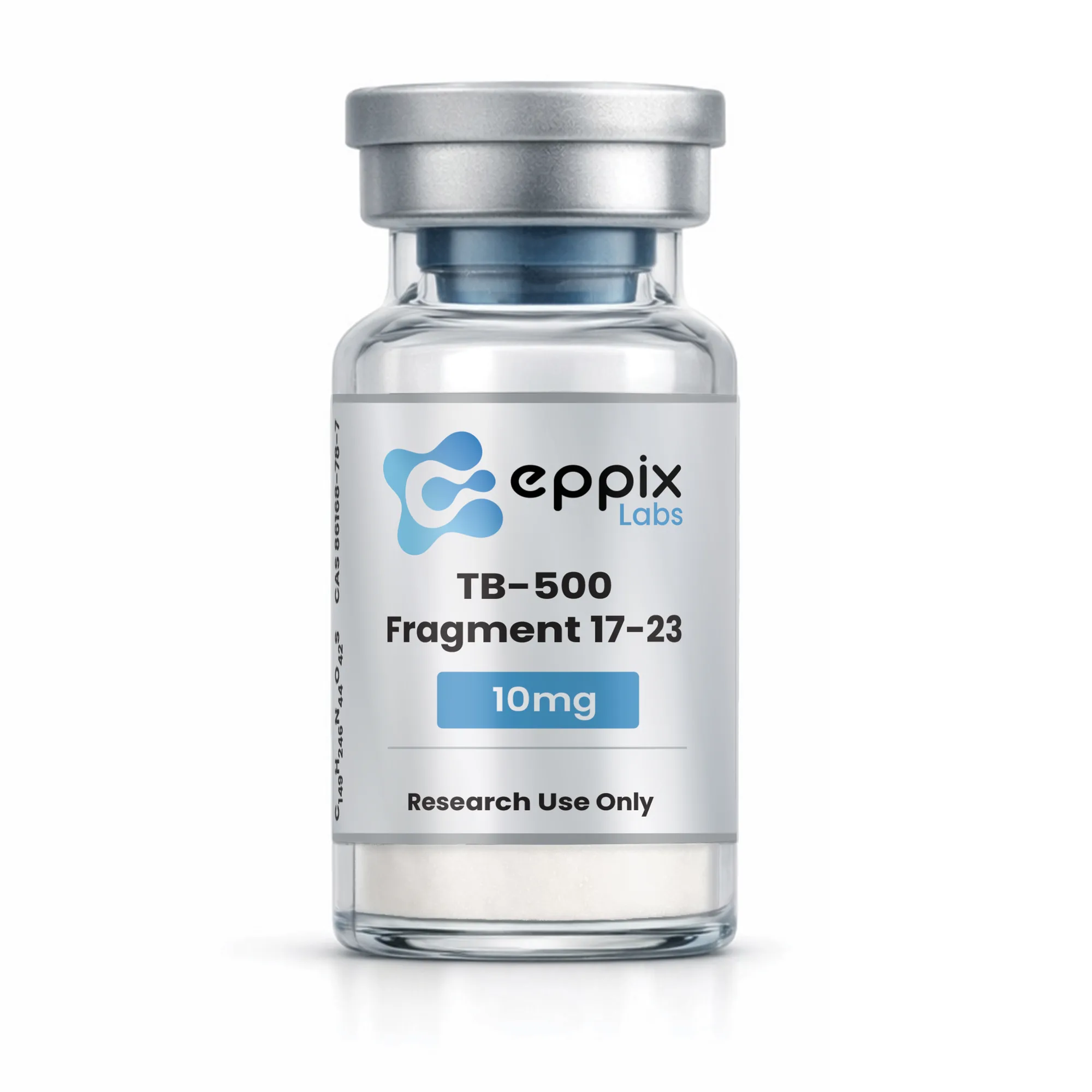
Thymosin Beta-4 Actin-Binding Fragment TB-500 Fragment 17-23 is the seven-residue actin-binding region of thymosin beta-4, studied in research on tissue repair and cell migration.
From$44.99
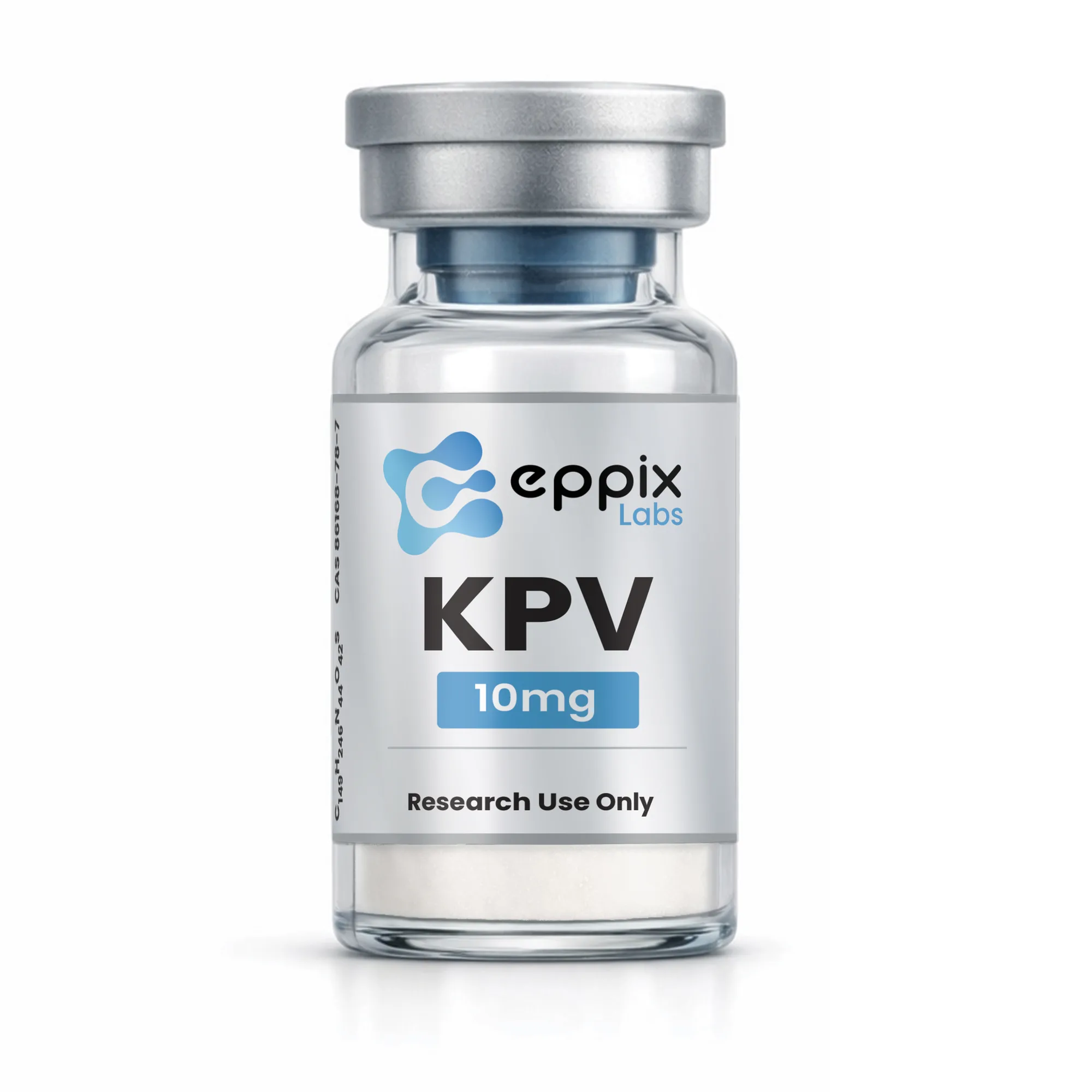
Tripeptide Research Compound KPV is a synthetic tripeptide composed of lysine–proline–valine and represents a fragment derived from the alpha-melanocyte–stimulating hormone (α-MSH) sequence. It is developed for controlled laboratory research involving peptide-mediated signaling systems.
From$49.99