

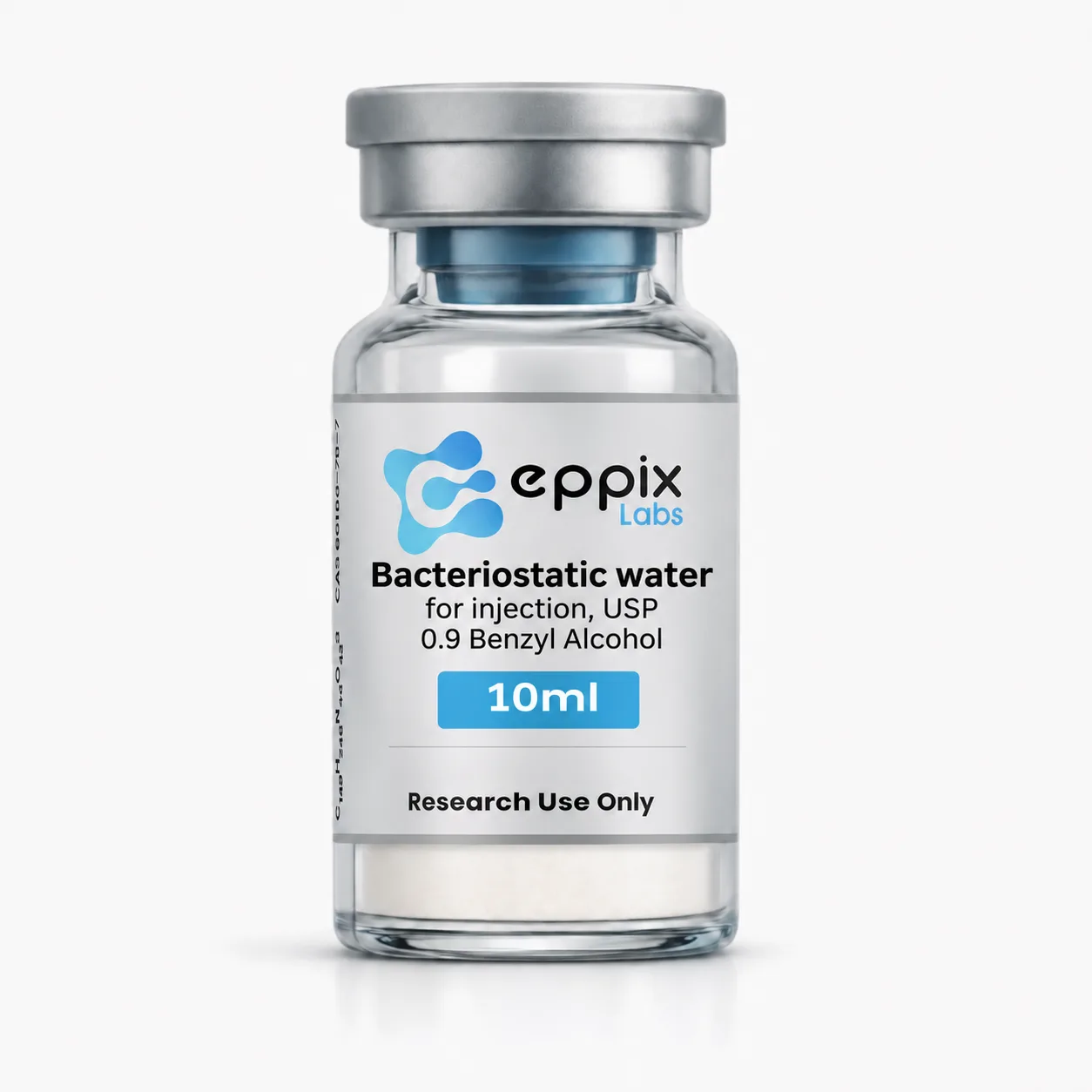
Bacteriostatic water
Bacteriostatic water USA
Preserved Laboratory Diluent
Bacteriostatic water is purified water containing an added antimicrobial preservative, most commonly benzyl alcohol, intended to inhibit bacterial growth within a sealed multi-use container. It is a laboratory diluent rather than an active compound, and the water itself carries the simplest possible molecular profile: H2O, molecular weight 18.015.
Limit one per order.
Mix & Match
1 vial — no vial discount yet.
Add 2 more vials for 5% off.
After that, 10% at 5 vials, 20% at 10 vials.
This product is intended strictly for laboratory research use within the United States. It is not approved by the FDA for the diagnosis, treatment, cure, or prevention of any disease. Not for human or veterinary use.
By purchasing, you confirm the material will be used solely for lawful research purposes in accordance with applicable U.S. federal, state, and local regulations.
Bacteriostatic water is purified water containing an added antimicrobial preservative, most commonly benzyl alcohol, intended to inhibit bacterial growth within a sealed multi-use container. It is a laboratory diluent rather than an active compound, and the water itself carries the simplest possible molecular profile: H2O, molecular weight 18.015.
The published record relating to bacteriostatic water is limited and mostly peripheral. It consists of pharmaceutical quality-control work on how such preparations are characterised, broader literature on the mechanisms by which antimicrobial agents inhibit bacterial growth, and isolated case reporting of adverse neurological outcomes associated with preservative-containing water.
Third-party tested for purity, ID, quantity.
Coming Soon
The certificate of analysis for this lot is being finalised and will be published here as soon as the lab returns it.
The distinguishing feature of bacteriostatic water is not the water but the preservative dissolved in it. Bacteriostatic action, as described in the antimicrobial literature, refers to inhibition of bacterial replication rather than bacterial killing, and the general mechanisms by which antiseptic and preservative agents interfere with microbial membranes, enzymes and macromolecules have been reviewed in detail. That literature also documents reduced susceptibility and resistance developing under sub-inhibitory exposure, which is a recurring theme across preservative and disinfectant systems generally rather than a property specific to any one formulation.
Analytical work on bacteriostatic water for injection has focused on measurement problems rather than biological endpoints. Because the solution is very weakly buffered and has extremely low ionic strength, pH determination is technically difficult and sensitive to electrode selection, equilibration and atmospheric carbon dioxide, and published pharmaceutical science work addresses these measurement artefacts. Separately, the clinical literature contains reports of neurotoxicity attributed to the benzyl alcohol preservative in bacteriostatic water, which is the principal reason the preserved and unpreserved grades are treated as distinct materials. Water quality and pH from differing sources has also been surveyed in other contexts, underlining that water used as a diluent is not a uniform material.
Bacteriostatic preparations of water entered pharmaceutical use as multi-use diluents, distinguished from sterile water by the inclusion of an antimicrobial preservative so that a container could be entered more than once without supporting bacterial growth. The broader concept of bacteriostasis in aqueous systems is considerably older, with experimental work on the bacteriostatic and bactericidal action of natural high-salinity waters published in the 1930s.
The subsequent record developed in two directions. One line is pharmaceutical and analytical, concerned with specifying and verifying the properties of the preparation, including the persistent difficulty of measuring pH in low ionic strength water. The other is a safety literature, with reports in the 1980s describing neurotoxicity associated with the benzyl alcohol component. Outside these, most contemporary papers using the term bacteriostatic concern engineered materials, coatings, emulsions and water-treatment systems rather than bacteriostatic water for injection itself.
Bacteriostatic water appears in the literature chiefly as a pharmaceutical preparation subject to analytical characterisation, and as the vehicle in reports examining preservative-associated toxicity. Adjacent research frameworks address the general mechanisms of bacteriostatic and bactericidal action, resistance arising under preservative exposure, and bacteriostatic performance in engineered aqueous systems such as water lines, coatings and emulsion-based materials. The compound is not itself a subject of mechanistic study in the way an active peptide would be.
5 of the 5 areas below are addressed directly by a paper cited on this page.
Antimicrobial and preservative mechanism of action
Addressed on this page by Maillard 2024, Zobell 1937. Each is linked to its source record in the references below, so what was measured — and in what system — can be read rather than taken on trust.
- Maillard, JY. et al. (2024) — Disinfectants and antiseptics: mechanisms of action and resistance
- Zobell, CE. et al. (1937) — The Bacteriostatic and Bactericidal Action of Great Salt Lake Water
Pharmaceutical analytical characterisation and pH measurement
Addressed on this page by Hu 2023. Each is linked to its source record in the references below, so what was measured — and in what system — can be read rather than taken on trust.
- Hu, J. et al. (2023) — Critical Aspects of pH Measurement for Bacteriostatic Water for Injection
Preservative-associated toxicity case literature
Addressed on this page by Feasby 1983. Each is linked to its source record in the references below, so what was measured — and in what system — can be read rather than taken on trust.
- Feasby, TE. et al. (1983) — Neurotoxicity of bacteriostatic water
Bacteriostatic performance in engineered water systems
Addressed on this page by Hu 2023, Feasby 1983, Zobell 1937. Each is linked to its source record in the references below, so what was measured — and in what system — can be read rather than taken on trust.
- Hu, J. et al. (2023) — Critical Aspects of pH Measurement for Bacteriostatic Water for Injection
- Feasby, TE. et al. (1983) — Neurotoxicity of bacteriostatic water
- Zobell, CE. et al. (1937) — The Bacteriostatic and Bactericidal Action of Great Salt Lake Water
Bacterial resistance under sub-inhibitory exposure
Addressed on this page by Maillard 2024. Each is linked to its source record in the references below, so what was measured — and in what system — can be read rather than taken on trust.
- Maillard, JY. et al. (2024) — Disinfectants and antiseptics: mechanisms of action and resistance
The references section of this page cites 4 primary papers published between 1937 and 2024 — a limited but non-trivial record. Every citation is linked to its PubMed or DOI record so it can be read rather than taken on trust, and the summaries above describe what those papers report rather than what the compound is claimed to do.
Bacteriostatic water is frequently listed as a peptide by suppliers in this market. It is not one. The structure published on this page is the compound's actual chemistry, and research on it should be read against its own class rather than against peptide literature.
Research compounds attract claims that outrun their evidence. Below are the ones most often encountered for Bacteriostatic water, set against what the papers cited on this page actually report. Where the record is thin or contested, that is stated rather than smoothed over.
Bacteriostatic water is commonly described online in connection with stronger immune function and resistance to infection. In the research literature the same compound is filed under antimicrobial and preservative mechanism of action, pharmaceutical analytical characterisation and pH measurement and preservative-associated toxicity case literature.
The 4 papers cited on this page, published between 1937 and 2024 describe laboratory and animal work. None reports a controlled trial in humans. Findings in cell culture or in a rodent model describe what happened in that system; they do not establish that the same occurs in humans, and this compound is not approved for human use.
Nothing above is a statement of what this material does. It is a summary of what has been published and what has not. Eppix Labs supplies research materials only and provides no dosing, administration or protocol guidance.
Every lot of Bacteriostatic water is independently assayed before it is released, and the certificate for the lot shipped is published rather than summarised. Where a certificate for a current lot is not yet posted, the lot has not yet been released against it.
Researchers who buy Bacteriostatic water in the United States through Eppix Labs receive a batch-labelled vial whose certificate is published against that lot code, so the material can be matched to its analysis rather than to a generic specification.
- Lyophilized storage
- −20 °C long-term; stable at room temperature in transit
- After reconstitution
- 2–8 °C
- Light
- Protect from UV and direct light
- Freeze-thaw
- Avoid repeated cycles
- Vehicle
- Solvent selection depends on the compound; consult the published literature
- Format
- Lyophilized powder
Bacteriostatic water is supplied as lyophilized powder. It is not a peptide, and solvent behaviour follows from its own chemistry rather than from the aqueous-vehicle conventions that apply to peptide material — the published literature for this compound is the reference for solvent selection, not a general peptide protocol.
Dry storage below freezing and protection from light are the general controls. As with any lyophilized material, the powder frequently sits as a thin film at the base of the vial and is easy to mistake for an empty vial before inspection.
Vials may appear empty on arrival. Lyophilized material collects at the base of the vial and is often not visible until the vial is inspected under direct light.
- 1 × sealed glass vial in the strength selected (10ml / Single Vial, 30ml / Single Vial available), batch-labelled
- Batch documentation for the lot shipped, once its certificate is published
- Discreet outer packaging with no product names on the exterior
- FedEx, tracked, typically 1–3 business days domestically
- Bacteriostatic water or any other reconstitution vehicle
- Syringes, needles or filters
- Dosing, administration or protocol guidance of any kind
Reconstitution materials are sourced separately. The reconstitution calculator on this site works out concentrations for a given volume, but it is an arithmetic tool for laboratory record-keeping and not a protocol.
No. Eppix Labs products are supplied exclusively for laboratory research. We do not provide dosing, administration, or usage guidance.
Each vial contains the labeled fill volume of bacteriostatic water. Independent third-party analysis verifies identity and net content per batch.
The vial contains only the preserved water. Any laboratory materials required for experimental procedures must be sourced separately.
Duration depends entirely on research design, storage conditions, and laboratory protocol.
Related
You May Also Like
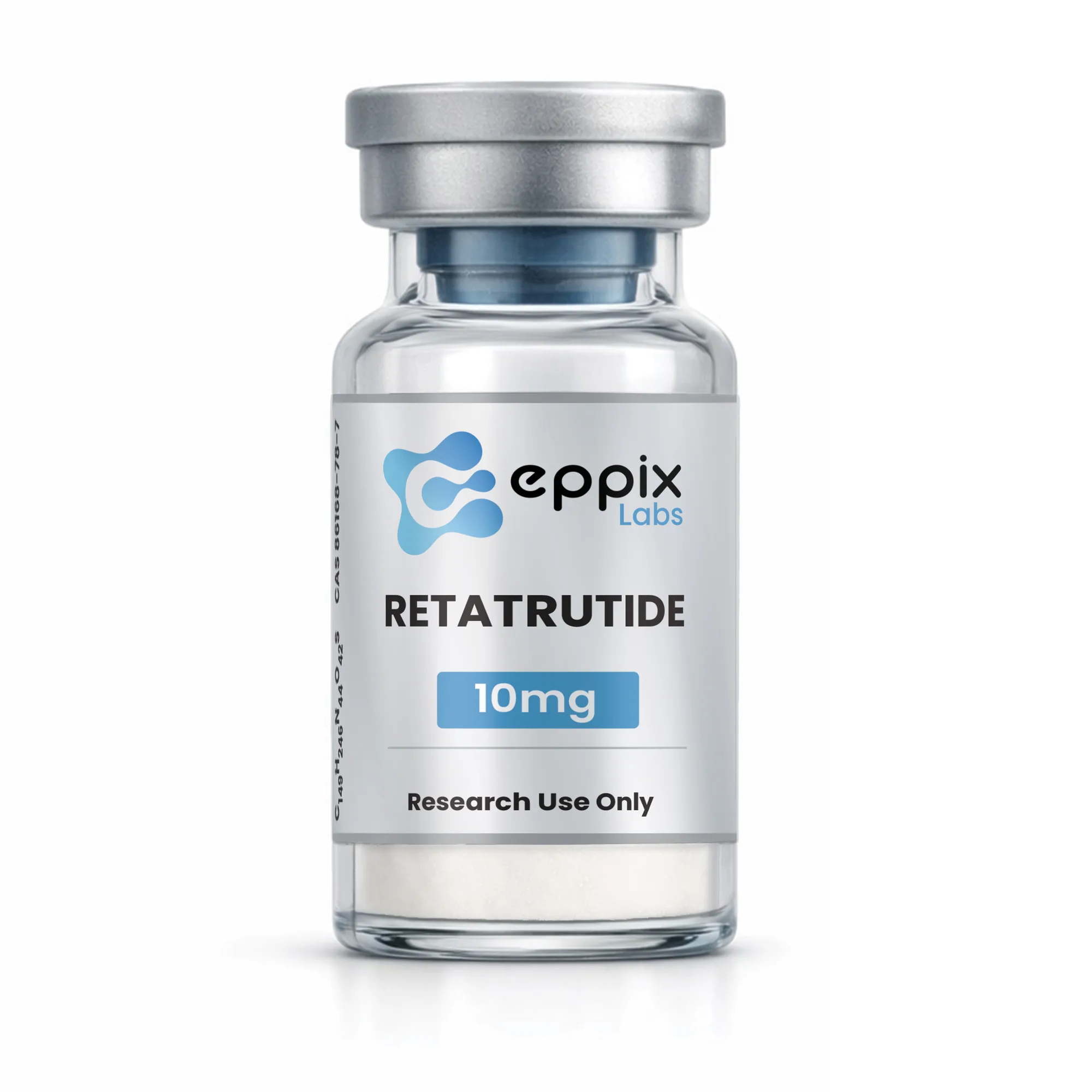
Triple Receptor Agonist Retatrutide is a synthetic peptide developed for controlled laboratory research involving multi-receptor signaling systems. It is structurally designed to interact with GLP-1, GIP, and glucagon receptor pathways within experimental environments.
From$79.99
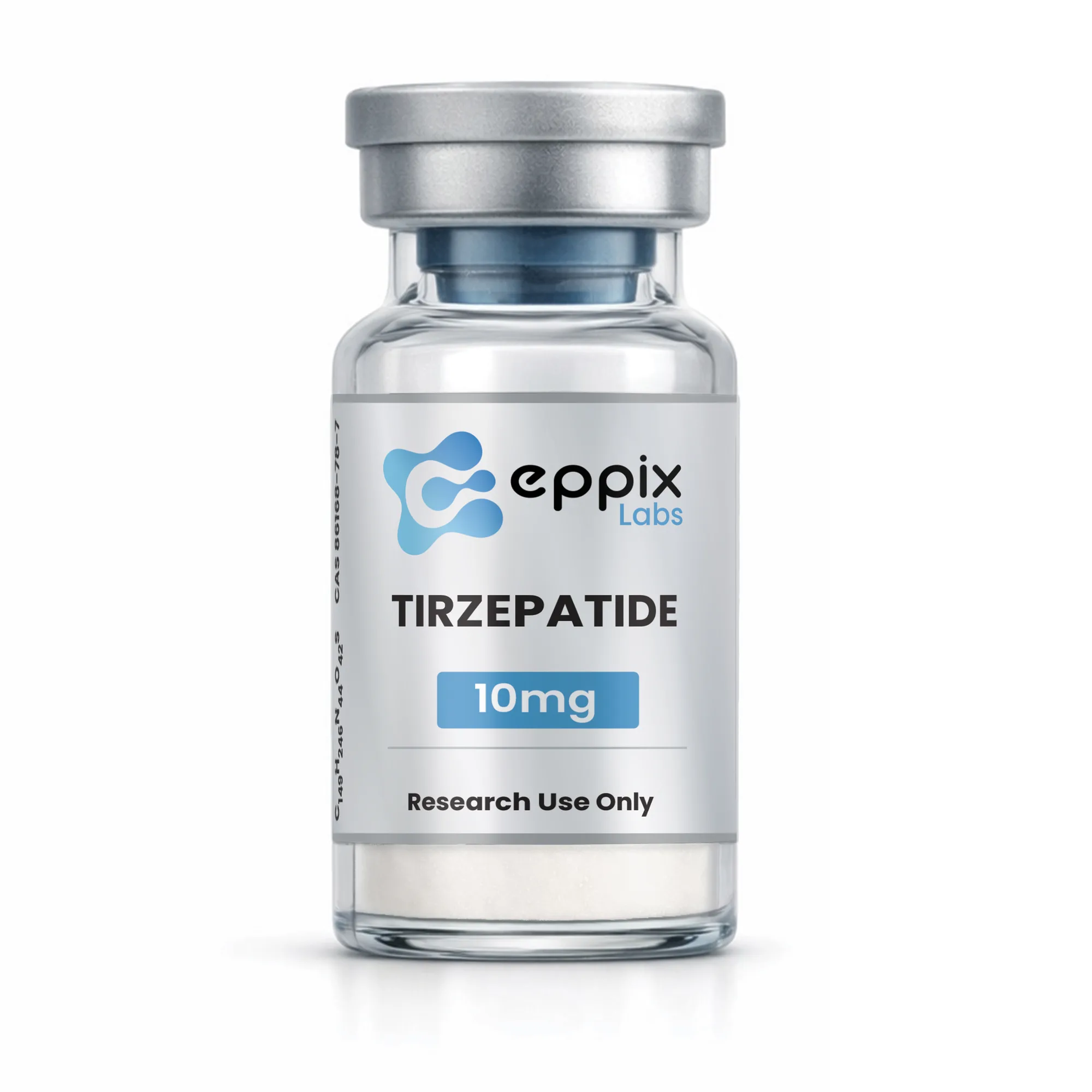
Dual GLP-1 / GIP Research Peptide Tirzepatide is a synthetic peptide developed for controlled laboratory research involving dual incretin receptor signaling systems. It is structurally designed to interact with GLP-1 and GIP receptor pathways within experimental environments.
From$39.99
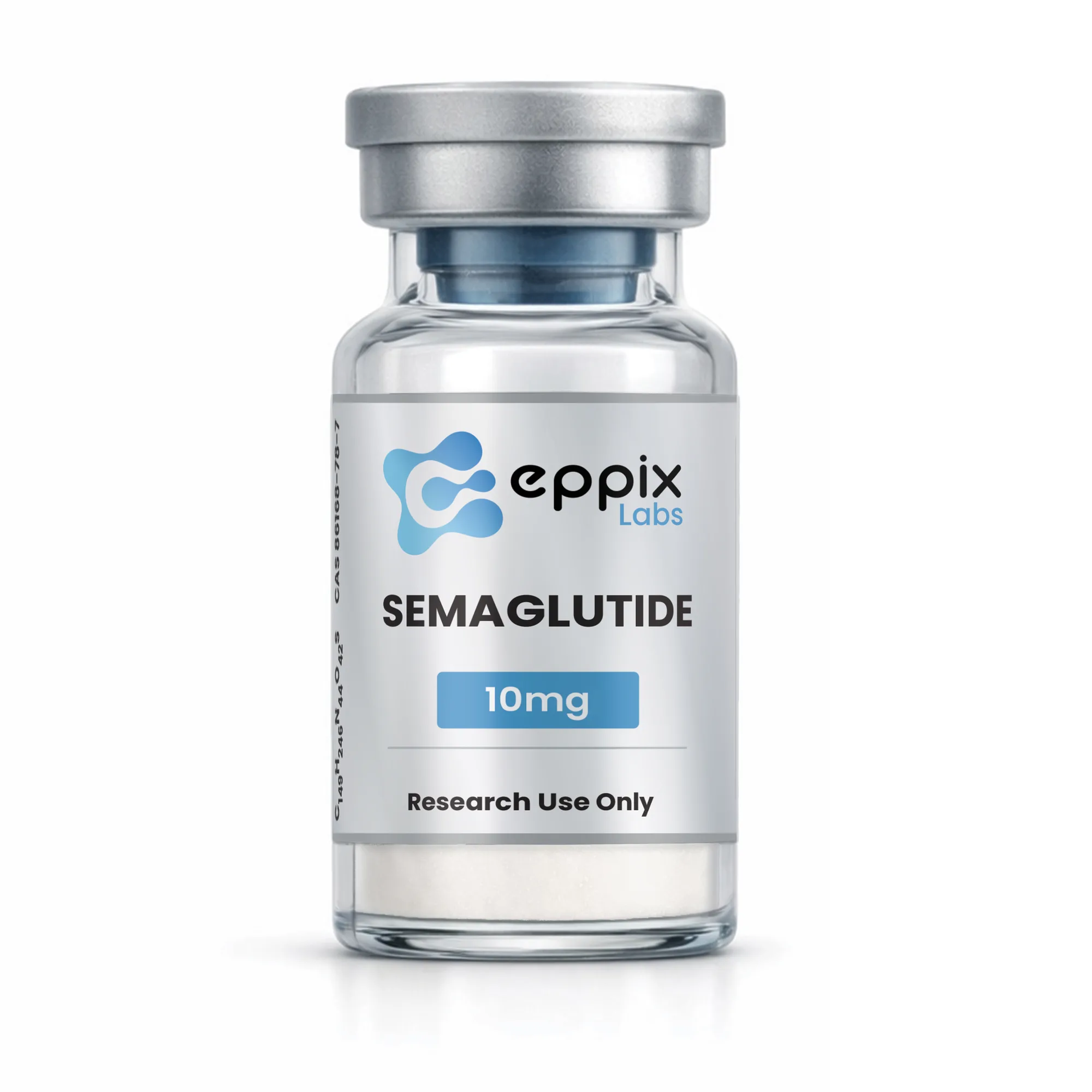
GLP-1 Receptor Agonist Research Peptide Semaglutide is a synthetic analogue of glucagon-like peptide-1 (GLP-1), a naturally occurring incretin hormone involved in glucose-dependent signaling. It is developed for controlled laboratory investigation within regulated experimental environments.
From$59.99
Selective Amylin Receptor Agonist This product is supplied as eloralintide (LY3841136), a long-acting, selective amylin receptor agonist studied in research on metabolic and body-weight regulation.
$100.00